email Personaization

How Personalization Can Enhance Your Lead Generation Efforts

“You’re out of business if you don’t have a prospect “– ZIG ZAGLER

Lead generation is an important part of marketing strategy. It can be classified as a Business to Business (B2B) and Business to consumer (B2C). The former describes the business that directly sells to other businesses while the latter one can be described as selling products & services directly to consumers. The B2B lead generation process is a good start to any sales process or marketing funnel filtration.

Though there are numerous ways to generate leads, the quality of leadership determines the prospect who can likely become your potential customers. Similarly, there is a huge number of techniques, tools & options to improve your lead quality. Despite various options, there is a big focus for marketers to generate better quality leads.

Marketing and Measurement survey from Google & Econsultancy states that 90 percent of the leading marketers say personalization plays a key role in business growth. Personalization has become an integral part of every business and the level of relevance expected by any prospect when they interact with the brand goes beyond the general interest. In today’s digital era almost all the consumers have become an important part of every company’s personalized lead nurturing strategy. This is considered a key element as lead nurturing paves the way to target a specific group of buyers.

What is a lead?

Lead is nothing but an individual or organization which shows interest in your products or services. There are higher chances that they can be your potential clients. By collecting holistic data you can easily analyze & understand the behavior of the target market.

Why personalization is the key factor here?

A study from HubSpot suggested nearly three fourth of the online customer get frustrated with ads, offers, promotions & pop-ups that has nothing to do with their interest. It is quite surprising, right? Hence it is important to nurture your leads by building relationships with them over a period of time. If lead nurturing is your ultimate goal, then adding personalization to your lead nurturing strategy can improve your sales. Yes, you read it right. Over the period of time, you understand your prospect & build strong relationships to convert your prospect into customers.

Here are basic principles of how lead generation strategy works:

They consist of five R’s: Retrieve, Recognize, Remember, Relevance and Retain.

Target your audience based on the type of campaign requirement & get to know about them. Interact with your prospects to know about their preference & reach the right prospect with the right message to nurture them for future engagement.

Communicate with your leads often:

With one conversation you can get closer with a potential lead. One on one conversation takes you one step closer with leads. Once you get to know about their business requirements, you can pick the conversation more easily. With the available communication channels, you can use live chat to connect with potential leads. Having a real conversation with your prospects or website is highly recommended to address their needs instantly. A relationship should be established in order to push them gently to try your products and services.

Personalize your website:

Creating a customized experience for your visitor is important for any business. Every business is shifting its sales from traditional to digital platforms. Thus providing a broad range of experience allows companies to present a unique ability to their attract visitors. As the concept of website personalization has become more prominent. This area is explored in recent times with the idea of providing a good user experience for visitors. A visitor can turn into loyal customers if you address your needs effectively.

Benefits of website personalization:

  • Well optimized landing pages
  • Better Qualified Leads
  • Improved user experience
  • High Brand Affirmity

Smart Database:

The Internet has brought tremendous change in the way we do business. Having a strong database in places like CRM or Marketing automation can help companies to collect customer information & track their actions. Keeping track of prospect’s actions and behaviors are essentials for any lead nurturing strategy. Even small actions such as searches, visits, clicks can be tracked to study the prospect.

Design your database in a fashion that fits your strategy & can create custom contact records based on the insights. Create a contact and accounts list based on the targeted list, which can be customized according to your business or marketing goals. The inclusion of basic details such as location, demographics & behaviors can create a strong buyer persona.

For example: capturing location can help many location businesses& improve their online presence to promote products and services.

Do you find anything in common among your leads? Then it is time to pay attention to those details & pitch offers according to their likes and dislikes.

Benefits of having a Smart Database:

  • Integrates marketing & sale team better
  • Gives proper insights about prospects
  • Segment prospects based on their demographics
  • Verified contact details

Use of AI for Lead generation process

Artificial Intelligence is one of the booming technologies which make our life easier. And no one is against it. We must agree. The only concern of using AI is that must work properly & improve business-standard. Use AI-powered chatbots to help businesses in building powerful conversations. This information helps the bot to understand the basic question by visitors & analyze their business requirements at the initial level. In a similar way automate all repetitive tasks to create a more personalized experience for the leads.

Having well-optimized opt-in forms & Thank you Pages:

Every business follows different methods and strategies to gather information& understand their behaviors from a lead. But almost 96% of the business agrees email is mandatory and plays a crucial part. For an effective lead nurturing strategy one must have the best practice that encourages visitors to hand over their email or phone numbers. Having personalized information about a prospect or customer allows marketers to craft their marketing messages based on the visitor’s specific interest.

On the other hand, thank you pages are an additional opportunity to build trust& deep relationships with prospects. Thank you pages can be used to capture conceptual data of visitors without any third-party intervention and it also improves website traffic organically.

How thank you pages can improve website traffic?

  • Thank you pages can have a direct link to high performing content
  • Improving social media followers
  • Providing exclusive promotional offers
  • Adding client testimonials to enhance your credibility and trust

Lead Tracking:

Turn your unknown visitors into hot leads by tracking their online behaviors and virtual identities. Score leads based on their requirement, behavior and the time they spend on your website. Over the period enrich your profile with meaningful information collected from various sources. This in turn empowers the sales team to establish personalized experience and build trusted conversation with potential leads. Alternatively, it helps the sales team to keep a close eye on high-quality leads to follow the prospect journey until they become customer and their decision-making process.

Creating Engaging Content:

A study by Demand Gen Report shows a 20% increase in sales opportunities through tailored content. By personalizing you can create content for different types of lead. As a marketer, you can prioritize and segment your marketing communication effectively through lead nurturing programs. As we all know content marketing plays a huge role in lead nurturing strategy. In order to utilize content marketing effectiveness as a company must focus on what is important to your prospects.

With a crystal clear landing page, blog post & other resources, you can create engaging content & show interest in communicating with prospects which can be a big step for them to become your customer. Also, include Call to Action which helps prospects or visitors to view more relevant information.

Can personalization boost lead generation?

Of course yes. Lead generation strategy offers a whole new level of customer experience with numerous benefits for marketers to understand their prospects better. And most importantly at every stage of the lead generation process, marketers need to leverage their capabilities to engage with prospects to get relevant information about prospects. The more you personalize the creamy part of your marketing campaign the more you relate to your prospects.


Top Benefits:

  • Improved Conversion Rate
  • Improve ROI
  • High Customer Retention
  • Improves engagement
  • Improves trust in the brand

Conclusion:

With growing trends and patterns, it is easy to generate more leads, but there comes a question of what percent of quality leads are developed which is highly recommended for your business & their conversion rate. Attracting & nurturing leads that are more likely to buy will see a drastic improvement in your sales and ROI. Creating a personalized experience gives immediate assistance to access relevant resources which in turn focus on customer satisfaction and achieve better results.

Looking for more strategies to personalize your conversion with leads? Then collaborate with LogiChannel to grow your business with quality leads.

b2b Marketing

B2B Lead Generation Tips[Infographics]

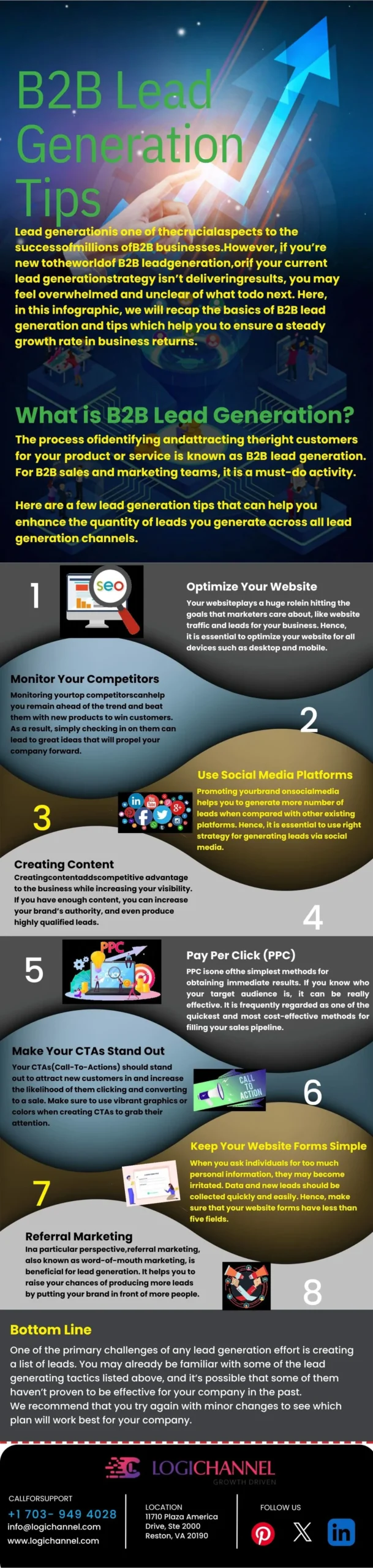
Lead generation is one of the crucial aspects of the success of millions of B2B businesses. However, if you’re new to the world of B2B lead generation, or if your current lead generation strategy isn’t delivering results, you may feel overwhelmed and unclear about what to do next. Here, in this infographic, we will recap the basics of B2B lead generation and tips which help you to ensure a steady growth rate in business returns.


What is B2B Lead Generation?

B2B Lead Generation Tips.pdf

The process of identifying and attracting the right customers for your product or service is known as B2B lead generation. For B2B sales and marketing teams, it is a must-do activity.

Here are a few lead generation tips that can help you enhance the number of leads you generate across all lead generation channels.

1. Optimize Your Website

Your website plays a huge role in hitting the goals that marketers care about, like website traffic and leads for your business. Hence, it is essential to optimize your website for all devices such as desktop and mobile.

2. Monitor Your Competitors

Monitoring your top competitors can help you remain ahead of the trend and beat them with new products to win customers. As a result, simply checking in on them can lead to great ideas that will propel your company forward.

3. Use Social Media Platforms

Promoting your brand on social media helps you to generate more leads when compared with other existing platforms. Hence, it is essential to use the right strategy for generating leads via social media.

4. Creating Content

Creating content adds a competitive advantage to the business while increasing your visibility. If you have enough content, you can increase your brand’s authority, and even produce highly qualified leads.

5. Pay Per Click (PPC)

PPC is one of the simplest methods for obtaining immediate results. If you know who your target audience is, it can be really effective. It is frequently regarded as one of the quickest and most cost-effective methods for filling your sales pipeline.

6. Make Your CTAs Stand Out

Your CTAs (Call-To-Actions) should stand out to attract new customers and increase the likelihood of them clicking and converting to a sale. Make sure to use vibrant graphics or colors when creating CTAs to grab their attention.

7. Keep Your Website Forms Simple

When you ask individuals for too much personal information, they may become irritated. Data and new leads should be collected quickly and easily. Hence, make sure that your website forms have less than five fields.

8. Referral Marketing

In a particular perspective, referral marketing, also known as word-of-mouth marketing, is beneficial for lead generation. It helps you to raise your chances of producing more leads by putting your brand in front of more people.

Bottom Line

One of the primary challenges of any lead generation effort is creating a list of leads. You may already be familiar with some of the lead-generating tactics listed above, and it’s possible that some of them haven’t proven to be effective for your company in the past. We recommend that you try again with minor changes to see which plan will work best for your company.

b2b Marketing

5 Metrics That Every B2B Marketer Should Track

B2B marketing analytics are critical to the long-term success of your business. Knowing how to properly measure your marketing efforts might give you a leg up on the competition. If you don’t use analytics, your team will struggle to understand campaign success, make plan improvements, and troubleshoot any reoccurring issues. But, with so much data at my disposal, which data points or metrics should I pay attention to the most? Indecision, indecisiveness, or, worse, decisions based on incorrect assumptions can result from too many facts without clarity or comprehension.

Continue reading to learn about five indicators to keep an eye on in order to ensure that your website and B2B marketing initiatives are performing at their best.

B2B Website Traffic

B2B Website Traffic

Set up a Google Analytics account to begin gathering data from your B2B website (or a similar tracking platform). Once you have some data, you should spend some time establishing baseline metrics for your initial B2B website visitors. This gives you information and tracks the traffic that comes in as a result of your various marketing efforts. Organic, paid, direct, and social, referral, or other traffic will be classed as follows: organic, paid, direct, social, referral, or other.

Website traffic is an important measure to track since it allows your marketing team to focus on the correct projects while also staying on top of any potential concerns. Low traffic or extremely low, or even high, levels of engagement can signal a problem with your Google Analytics implementation or a technical issue with your B2B website. Understanding your Google Analytics baseline might serve as your first line of protection against future website difficulties.

Engagement Rate

Engagement Rate

Any visitor who does not quickly bounce off a landing page, browses numerous pages on your website, spends a significant amount of time on your B2B website, or converts is considered to be engaged. Low engagement rates usually suggest that the quality of your material falls short of the user’s expectations. This gives you the chance to enhance the content on your B2B website or optimize for more relevant keywords. It’s critical that your sites provide clear answers to the search terms and questions you’re targeting, otherwise, you risk a user leaving your site.

Keyword Tracking

Keyword Tracking

As previously stated, the SEO keywords for your B2B website can make or break it. Early on in your B2B marketing campaigns, choosing and sticking to the right industry-specific keywords creates the framework for a more united and successful long-term strategy. Keyword reporting tools like as Moz and SEM Rush may provide a variety of data on keyword performance and trends.

It’s vital to remember that organic keywords fluctuate in popularity over time. Keywords that are consistently heading downward, on the other hand, may indicate that you should place more emphasis on that term in order to produce more high-quality searches. Over the following few months, you should add themes that target this term to your editorial schedule, whether through new landing pages or other thought leadership content. Although this term should be prioritized, don’t forget to keep an eye on your other high-performing keywords.

Lead Source

Lead Source

Lead generation is essential for any B2B website’s success. The next step is to evaluate which sources are converting after you’ve identified where your visitors are coming from and how they’re interacting with your website. Giving all leads that arrive from your B2B website a source can help you better understand the performance of each marketing effort.

Instead of focusing on the number of leads, it’s better to concentrate on the quality of the leads. Sure, having 100 leads is excellent, but if 90% of them aren’t qualified, irrelevant, or even spam solicitations, there could be greater problems lurking beyond the surface of your website. Leads from these sources inflate your statistics, making the success of your B2B marketing campaigns appear to be inflated.

Cost Per Conversion

When using paid search advertisements, bear in mind your overall campaign budget as well as how much you’re spending every convert. Paid advertising should always yield a positive Return on Investment (ROI). It’s critical to maintain a watch on your PPC campaign at all times to eliminate any bad keywords, optimize the landing page, and track your ad expenditure.

Keep in mind that the average conversion rate for Google Ads across all B2B businesses is roughly 3%. You may already be in a good situation if you frequently meet this criterion, but it’s always a good idea to check in on the accuracy and quality of those leads on a regular basis.

Bottom Line

Marketing metrics are dynamic, and there is no such thing as a one-size-fits-all approach. These five data points, on the other hand, are crucial to your organization’s performance, and comprehending them all together allows you to make confident, smart decisions in the future. Tracking the proper metrics for your B2B firm on a regular basis and making changes based on the data can be a game-changer for efficiently generating sales.

The metrics mentioned above will disclose whether or not your marketing initiatives are having the desired impact on your business. Knowing your data will help you optimize your marketing budget and generate excellent outcomes, regardless of the size of your company.

Service Line Marketing For Hospitals

Service Line Marketing: 10 Proven Strategies for Hospital Service Line Growth

In today’s fiercely competitive healthcare environment, hospitals and health systems need to adopt innovative strategies to stand out and drive sustainable growth. Service line marketing focuses on promoting specialized areas of care—such as cardiology, orthopedics, or oncology—carefully designed to address the unique needs of patients. By prioritizing these targeted services, hospitals can establish themselves as leaders in their fields, improve patient outcomes, and set themselves apart in a crowded market.

This guide presents 10 proven strategies for successfully marketing hospital service lines. From leveraging advanced digital channels and harnessing the power of data analytics to building meaningful community connections, these strategies empower healthcare providers to attract the right patients, maximize service utilization, and achieve measurable results. As a B2B marketer if you aim to refine existing campaigns or implement fresh initiatives, these actionable insights will help propel your hospital’s service line growth to the next level.

What is Service Line Marketing?

Service Line Marketing is a strategic approach in healthcare that focuses on highlighting specific clinical services or areas of care provided by a hospital or health system. These service lines often include specialties such as cardiology, oncology, orthopedics, women’s health, or pediatrics. The goal is to attract the right patients, build the hospital’s reputation in key specialties, and drive growth by addressing the unique healthcare needs of the community.

Key Components of Service Line Marketing:

  • Specialized Focus: Showcases a distinct area of care, spotlighting the hospital’s expertise, state-of-the-art technology, and exceptional outcomes that make it a leader in that specialty.
  • Targeted Outreach: Engages specific patient groups, such as those in need of joint replacements for orthopedics or oncology care for cancer treatment.
  • Data-Driven Strategies: Harnesses data and analytics to gauge market trends, profile patient demographics, and evaluate competitors to guide informed decisions.
  • Integrated Campaigns: Merges digital platforms, community initiatives, and traditional media to create cohesive and effective patient engagement strategies.
  • Outcome-Oriented: Monitors critical performance indicators, including patient volume, satisfaction ratings, and financial results, to measure and refine success.

By focusing on high-demand or profitable specialties, service line marketing empowers healthcare organizations to craft personalized communication, strengthen patient relationships, and secure their position as leaders in specialized care areas.

Proven Strategies for Hospital Service Line Growth are essential for a variety of reasons:

Increasing Competition in Healthcare Markets

As healthcare markets become more saturated, hospitals are under increasing pressure to stand out. In this highly competitive environment, strategic differentiation is essential. Proven approaches enable hospitals to highlight their unique strengths, particularly in specialized service lines such as cardiology, orthopedics, oncology, and more. By emphasizing these areas of expertise, hospitals can attract targeted patient populations, build brand loyalty, and establish themselves as leaders in specific health domains. Effective marketing and specialized care offerings allow hospitals to distinguish their reputation and gain a competitive edge.

Improving Patient Care through Strategic Focus

These strategies not only help hospitals gain a competitive advantage but also contribute directly to enhancing patient care. By focusing on key service lines, hospitals email list are able to refine their offerings, ensuring the quality, accessibility, and efficiency of care. This improves patient outcomes. Strengthening these specialized areas allows hospitals to provide the highest standard of treatment, ensuring they meet or exceed patient expectations. As a result, hospitals not only attract more patients but also build trust, encouraging patient retention and long-term satisfaction.

Optimizing Resource Allocation for Greater Efficiency

Implementing proven growth strategies allows hospitals to optimize the use of their resources, ensuring they are allocated to the most impactful areas. By strategically focusing on high-demand or high-revenue specialties, hospitals can streamline investments and direct capital and operational efforts toward service lines with the greatest potential for growth. This targeted approach reduces waste and maximizes return on investment, enabling hospitals to operate more efficiently while positioning themselves for long-term success.

Strengthening Financial Stability through Service Line Expansion

Expanding and strengthening service lines directly contributes to a hospital’s financial health. As hospitals increase patient volume and service utilization, they experience a direct boost in revenue, enhancing overall financial performance. By developing and enhancing specialized services, hospitals not only attract more patients but also create new revenue streams, reinforcing their financial position and long-term sustainability. This improved financial stability provides the foundation needed for ongoing investment in infrastructure, technology, and patient care.

Building a Strong Reputation as a Healthcare Leader

Hospitals that excel in specific service lines often establish a strong reputation as leaders in those specialties. This recognition not only attracts more patients seeking specialized care but also draws top-tier healthcare professionals eager to work at institutions known for their expertise. The combination of increased patient volume and a talented workforce fuel further growth, creating a cycle of excellence that strengthens both the hospital’s market position and clinical outcomes. A solid reputation in key service lines can also enhance partnerships, attract funding, and provide a competitive edge in an ever-evolving healthcare marketing growth.

10 Proven Strategies For Hospital Service Line Marketing Growth

1. Define Your Target Audience

Pinpoint the specific patient demographics and community segments for each service line. A deep understanding of your audience allows you to tailor your marketing efforts to their distinct needs and preferences, ensuring your campaigns are highly relevant and effective in driving engagement and patient acquisition.

2. Develop a Unique Value Proposition (UVP)

Craft a compelling and clear statement that highlights what makes your service line distinct and superior to competitors. Whether it’s the use of state-of-the-art technology, a team of renowned specialists, personalized care, or exceptional patient outcomes, your UVP should focus on the specific benefits that your target audience values most. It should address their pain points and demonstrate how choosing your services leads to better, more efficient, or innovative healthcare solutions. By making these unique advantages evident, you build trust and position your service line as the best choice for patients seeking high-quality care.

3. Leverage Digital Marketing Channels:

Unlock the full potential of your service line marketing by utilizing highly-targeted digital advertising strategies, such as Google Ads, social media campaigns, and display ads. Craft personalized, compelling ads that resonate with the unique needs and interests of your audience, ensuring relevance and engagement. By directing tailored messaging to the right demographic, you can drive higher engagement rates, improve conversions, and significantly increase awareness and interest in your service line.

4. Optimize Your Website for Service Lines:

Design dedicated, user-centric landing pages for each service line, ensuring they are not only informative but also SEO-friendly for better search engine rankings. These pages should clearly present essential details about your services, highlight the expertise of your physicians, and offer resources that support patient education. A streamlined, engaging website not only enhances the user experience but also increases visibility, making it easier for potential patients to find and connect with your services online.

5. Implement Content Marketing:

Craft and distribute a variety of educational and engaging content formats—blogs, videos, infographics, case studies, and patient testimonials—that speak to your audience’s concerns, questions, and interests. Highlight breakthrough treatments, share success stories, and provide expert insights into common medical conditions. High-quality, relevant content establishes your hospital as a trusted authority in the field, strengthens your service line’s reputation, and fosters lasting relationships with both current and potential patients.

6. Engage in Community Outreach

Organize impactful community events such as health fairs, free screenings, and educational seminars to connect with local residents. These outreach initiatives not only increase awareness of your hospital’s services but also foster trust by directly engaging with the community. By offering valuable health resources and education, you position your hospital as an essential healthcare provider, strengthening the relationship between patients and your service lines while showing your commitment to improving the health of the community.

7. Strengthen Physician Relationships

Build strong, collaborative partnerships with referring physicians by providing consistent updates on your service lines, sharing patient success stories, and simplifying the referral process. Establishing a reliable network of physicians ensures a steady flow of patient referrals and enhances coordination of care. By making it easier for physicians to refer patients and emphasizing the positive outcomes your service lines offer, you improve both your hospital’s reputation and the relationships that drive patient referrals and long-term loyalty.

8. Analyze Market Trends and Patient Behavior

Explore your data thoroughly to uncover valuable insights into patient needs, preferences, and engagement trends. Identify patterns such as high-demand services, seasonal fluctuations, patient satisfaction levels, and regional differences. By recognizing these trends, you can target the right audience at the optimal moment with the most relevant services, improving the overall effectiveness of your marketing strategy.

9. Utilize Predictive Analytics

Leverage the power of predictive analytics to forecast future trends and patient behaviors. By analyzing historical data, you can predict which service lines are likely to experience increased demand and fine-tune your marketing efforts to meet those needs. This proactive approach ensures that you’re always prepared to address shifts in patient demand and stay ahead of competitors.

10. Personalize Marketing Campaigns

Use the insights gathered from your data to craft highly personalized marketing campaigns that speak directly to each patient’s unique needs. This can include tailored email communications, targeted digital ads, or personalized content on your website, creating a more engaging and relevant experience for patients. By addressing their specific preferences, you increase the chances of boosting engagement and driving conversions.

Wrapping Up

In summary, Service Line Marketing is a vital strategy for hospitals and healthcare systems looking to grow, differentiate themselves, and improve patient care. By focusing on specific, specialized services—such as cardiology, oncology, or orthopedics—hospitals can establish themselves as leaders in their areas of expertise.

By implementing the 10 proven strategies discussed, hospitals can create targeted, effective marketing campaigns that resonate with their audience, drive patient engagement, and boost service line utilization. From leveraging data analytics to building a strong online presence, these strategies empower healthcare providers to address changing patient needs, enhance service delivery, and strengthen their competitive edge.

Successful service line marketing takes a comprehensive approach—incorporating digital outreach, community involvement, partnerships with physicians, and ongoing performance tracking. This approach not only promotes growth but also fosters deeper relationships with patients and builds trust within the community.

Email marketing for nurse recruitement

Complete Guide on Email Marketing To Nurses: Stand Out in the Competitive Field of Nurse Recruitment

The healthcare industry, especially nurse recruitment, is highly competitive and demand-driven, with a constant need for skilled professionals. Email marketing helps recruiters stand out by providing targeted, personalized communication that builds trust and engagement. It is cost-effective, scalable, and allows precise audience targeting.

Additionally, data insights from email metrics enable recruiters to refine strategies and craft impactful, candidate-focused messages for more effective outreach. Nurses have specific preferences for roles, locations, and work environments. Personalized emails address these unique needs, build trust, and save time by presenting tailored opportunities aligned with their goals. Empathetic communication also helps reduce concerns about burnout and work-life balance.

Email marketing enables recruiters to effectively showcase employer benefits, workplace culture, and growth opportunities, helping them stand out in a competitive field. By leveraging strategies such as automated drip campaigns, segmented Nurses email lists, and clear calls-to-action, recruiters can ensure their communication is both relevant and engaging. Incorporating valuable content, like blogs, testimonials, or job infographics, further establishes credibility and expertise. To maximize impact, recruiters should follow best practices: use professional yet approachable language, optimize emails for mobile devices, include visuals, maintain a clean and updated email list, and respect inbox limits to avoid overwhelming candidates. This thoughtful approach fosters meaningful connections and enhances recruitment success.

Importance of Email Marketing in Nurse Recruitment

Email marketing is a digital strategy that involves sending targeted emails to individuals or groups to promote products, services, or content, while also nurturing relationships and driving engagement. This approach helps build connections by fostering personalized communication with both potential and existing customers. It boosts engagement by sharing relevant updates, offers, and content to keep recipients connected with the brand.

Email marketing also drives conversions, encouraging recipients to take actions such as making a purchase, signing up for a service, or attending an event. Additionally, it provides value by delivering helpful content, exclusive deals, or important information that builds trust and loyalty. By leveraging automation, segmentation, and data analytics, email marketing enables tailored messages that align with recipients’ preferences, making it a cost-effective and measurable channel for businesses.

Email marketing provides significant benefits for nurse recruitment, allowing agencies and employers to connect with potential candidates in a personalized way. By delivering tailored content like job opportunities and career advice, recruiters build trust with nurses, fostering stronger engagement and long-term relationships. It also enables targeted communication based on factors like location and specialization, increasing the chances of nurses applying for positions that align with their goals. Additionally, email marketing helps strengthen the brand identity of recruitment agencies, keeping them top-of-mind and differentiating them in a competitive market.

Email marketing has proven to be an effective tool for recruitment, particularly in engaging potential candidates. According to HubSpot, 47.5% of marketers find email marketing highly effective in achieving business goals. Personalized emails lead to better engagement, with 52.9% of marketers reporting higher click-through rates from segmented campaigns. Additionally, 81% of B2B marketers, who often focus on recruitment, use email newsletters as their most common form of content marketing. The cost-effectiveness of email marketing is also evident, with an average ROI of $42 for every $1 spent. These statistics underscore email marketing’s power in reaching and converting candidates efficiently.

Successfull Email Marketing Strategy

A successful email marketing strategy for recruitment starts with building a talent pipeline by creating targeted content that nurtures relationships over time. By sending regular updates and valuable resources, recruiters can engage candidates early and ensure a warm pool of applicants when positions open.

Personalized emails further boost engagement and support long-term growth. Email marketing is also a powerful tool for promoting job openings to qualified candidates, with segmented lists ensuring the right candidates see the right opportunities, increasing the chances of quickly filling roles.

Additionally, email is an effective way to engage passive candidates—those not actively seeking jobs—by sharing personalized content related to career growth and company culture, keeping the organization top of mind. Segmenting audiences has been shown to increase engagement, with a 52.9% boost in click-through rates. By setting clear goals such as building a talent pipeline, promoting job openings, and engaging passive candidates, recruiters can create a targeted email marketing strategy that delivers real results.

Talent Pipeline Building:

A successful email marketing strategy begins by creating targeted content that nurtures relationships over time. Personalized emails are essential for increasing engagement. Tailored content helps strengthen relationships, ensuring long-term pipeline growth and better candidate engagement.

Effective Job Opening Promotions

Email marketing is a powerful tool for promoting job openings to qualified candidates. Using segmented lists ensures that the right candidates receive relevant job opportunities, increasing the chances of quickly filling roles.

Engagement Passive Candidates:

Email is an effective way to engage passive candidates—those not actively job hunting—by sharing personalized content related to career growth, company culture, and industry insights. This keeps your organization top of mind, even for those not actively seeking new roles.

Increase Engagement Through Segmentation:

Segmenting your audience improves engagement and leads to better results. Studies show a 52.9% increase in click-through rates for segmented emails, making this strategy crucial for higher engagement.

Set Clear Goals:

By setting clear goals—such as building a talent pipeline, promoting job openings, and engaging passive candidates—recruiters can create an effective email marketing strategy that delivers real, measurable results.ge candidates early and build a warm pool of applicants ready when positions open.

Elements Incuded In Successful Recruitement Email Marketing

The subject line is crucial in recruitment emails, as it determines whether your message gets opened or ignored. A strong subject line should be concise, compelling, and relevant to the recipient. For nurse recruitment, focusing on key factors like competitive pay, flexible shifts, and career growth can capture attention. Examples of effective subject lines include: “Join Our Team: Flexible Shifts and Competitive Pay for Nurses,” “Are You Ready for Your Next Nursing Opportunity?” and “Nurses Wanted: Make a Difference in Healthcare.” Tailoring subject lines to highlight what matters most to your candidates increases the chances of your email being opened and read.

Personalization:

Personalization is crucial for engaging candidates in recruitment emails. Addressing recipients by their first name creates an immediate connection, making the email feel more personal. Tailoring the content to fit the recipient’s preferences, such as their experience, location, or specialty, also enhances relevance. This personalized approach shows that you understand the candidate’s needs and are offering opportunities that align with their goals, which increases the likelihood of a response. By valuing their individuality, personalized emails build trust, foster engagement, and improve the effectiveness of your recruitment campaign.

Crafting Attractive Content:

Compelling content is key to keeping candidates engaged and interested in your opportunities. Focus on highlighting the most attractive aspects of the job, such as competitive pay, work-life balance, and opportunities for career growth. Nurses, for example, often seek roles that offer flexibility and the potential for advancement. Including success stories or testimonials from other nurses who joined your team can add a personal touch and boost credibility. These real-life examples showcase how your organization positively impacts its employees, creating an emotional connection with candidates. Engaging, informative content inspires confidence and encourages candidates to take the next step.

Proper Call-to-Actions (CTAs):

Clear and concise call-to-actions (CTAs) are essential for guiding candidates to the next step in the recruitment process. Effective CTAs like “Apply Now,” “Schedule an Interview,” or “Learn More About Our Opportunities” should be prominently placed within the email. Position the CTA after showcasing the key benefits of the job to make the next step clear and easy to take. To maximize visibility, include CTAs at both the beginning and end of the email. A well-placed CTA encourages immediate action and streamlines the process, making it easier for candidates to engage with your recruitment efforts.

Fostering Relationships Through Email Automation

Email automation is a valuable tool for recruiters, enabling them to send pre-scheduled emails triggered by specific actions or events. It helps maintain consistent communication with potential candidates, saves time, and ensures timely delivery of important messages. In nurse recruitment, email automation can be used to nurture relationships, encourage applications, and keep candidates engaged throughout the hiring process.

Types of automated emails

  1. Welcome Emails for New Sign-Ups: A welcome email is the first step in building a relationship with new sign-ups. It introduces your organization, outlines the recruitment process, and expresses excitement about the candidate’s interest. A personalized welcome email sets the tone for future communication, ensuring that candidates feel valued and engaged from the start.
  2. Follow-Up Emails for Interested Candidates: Follow-up emails act as automated reminders for candidates who have shown interest but haven’t yet taken the next step, such as applying. These emails can be personalized based on previous interactions and include additional information like job benefits, company culture, or testimonials. Follow-up emails help keep candidates engaged and encourage them to take action on their interest.
  3. Reminder Emails for Application Deadlines: Reminder emails are crucial for encouraging candidates to submit their applications before deadlines. By automating these reminders, recruiters ensure that important deadlines are met. These emails create a sense of urgency while highlighting the benefits of applying, such as competitive pay, career growth, and flexible scheduling.
  4.  

In nurse recruitment, email automation can greatly streamline the process and improve candidate engagement. Tools like Mailchimp allow recruiters to send personalized emails based on candidate actions or preferences, offering features such as segmentation, analytics, and A/B testing to optimize campaigns. HubSpot integrates email automation with recruitment workflows, enabling recruiters to build relationships with candidates through targeted emails and track their behavior. SendGrid ensures emails are delivered at the right time and to the right audience, making it ideal for large-scale recruitment efforts.These tools help recruiters engage with candidates more effectively, save time, and build long-term relationships through timely and relevant communication.

Email automation tools like Mailchimp, HubSpot, and ActiveCampaign help recruiters streamline communication by automating email sequences and managing contact lists. These tools allow for personalized campaigns, audience segmentation, and performance tracking, ensuring relevant communication based on candidate preferences, experience, and location.

To maintain engagement without overwhelming candidates, recruiters should space out emails and ensure each message offers value, such as job updates or industry insights. Allowing candidates to opt-out of specific emails can also enhance their experience.

By using email automation, recruiters can build strong relationships with candidates, simplify the recruitment process, and attract top nursing talent efficiently.

Measuring Success: Email Marketing Metrics for Nurse Recruitment

Key performance indicators (KPIs) such as open rates, click-through rates, and conversion rates are crucial for evaluating the success of email marketing campaigns in nurse recruitment. Open rates indicate how many candidates are engaging with the subject line, while click-through rates show how well the email content drives recipients to take action.

Conversion rates measure how many recipients complete the desired action, such as applying for a position. By analyzing these metrics, recruiters can refine future campaigns, adjusting content and timing to better meet their audience’s needs. Additionally, A/B testing is essential for optimizing emails, allowing recruiters to test different subject lines, content, and calls to action to determine which strategies yield the best results.

Overcoming Common Challenges in Email Marketing for Nurses

Email marketing for nurse recruitment presents challenges like avoiding spam filters, managing list decay, standing out in crowded inboxes, and ensuring compliance with GDPR and HIPAA regulations. To avoid spam filters, recruiters should use reputable email providers, craft clear subject lines, and avoid spammy language. Regularly cleaning and segmenting email lists helps address list decay and unsubscribes, while personalizing emails based on candidates’ skills and interests can make them stand out in busy inboxes. Ensuring compliance with data protection regulations like GDPR and HIPAA is crucial, requiring proper consent and safeguarding candidate information. By tackling these challenges, recruiters can run effective, engaging email campaigns that build trust and maintain strong relationships with candidates.

Conclusion

In summary, email marketing is an invaluable tool in nurse recruitment, enabling recruiters to communicate directly with candidates, provide personalized content, and streamline the hiring process. By utilizing the right email strategies, recruiters can attract high-quality talent and build lasting relationships with potential candidates. If you haven’t already, it’s the perfect time to start building or refining your email marketing approach. Focus on creating consistent, authentic, and results-driven communication to stand out in a competitive market. Stay engaged with your candidates and keep your messages relevant to ensure ongoing success in your recruitment efforts.

direct mail listing

Mailing Lists By Zip Code Work Wonders For Direct Marketers

A majority of direct marketers put a lot of time and effort into developing and distributing mailers. While direct mailing does have several marketing advantages, this works even better when marketing is targeted. This is especially true for local companies that only operate in one specific area and offer goods or services there. Here is why purchasing a zip code mailing list can be beneficial.

What is a Mailing List by Zip Code?

An advertising list that has the names and mailing addresses of either consumers or businesses in your particular zip code or zip codes is known as a zip code mailing list. Zip code mailing lists sometimes referred to as residential mailing lists or saturation mailing, will assist your company in reaching each and every home in the carrier routes and communities of your choice. By distributing your direct mail letters, postcards, etc. throughout entire communities, you may quickly establish your company or nonprofit organization.

Numerous businesses offer zip code-based targeted mailing lists for sale, and these lists can be very beneficial. Numerous details about prospective clients are frequently included in mailing lists, such as:

  • Name, Age, and Gender
  • Contact details
  • Estimated income
  • Estimated home value
  • Net worth
  • Occupation of person
  • Marital status
  • Years spent in residence, etc

The direct marketing campaign benefits from more than just zip codes. Its use in locating zip code-based email marketing lists, which will assist you to identify your geographic target audience, can also be emphasized.


Significance of Mailing List By Zip Code

It’s how most companies generate sales: by mastering direct marketing and concentrating on local leads first before branching out. The best tactics for truly establishing a presence in a town are frequent mailings, local emails, and cold contact with nearby companies. You must purchase a mailing list by ZIP code that is precise, verifiable and has all of the important data in one location in order to accomplish so.

When you have organized, highly targeted direct mail lists by ZIP code, you can launch a variety of inventive business-to-business (B2B) campaigns and narrow in on the clients and companies who would be most interested in what you have to offer. The only way to reach these customers is to have the correct information, whether you want to encourage walk-ins to come to your storefront, let local businesses know that you offer them special services, or simply create a more effective email marketing campaign that focuses more on recognizing communities. Rarely can you purchase email addresses by ZIP code, but our premium lists offer all of that information in addition to phone numbers, titles, and more! Sometimes you can locate postal addresses.


How do Mailing Lists Based On Zip Codes Work?

Direct marketers purchase mailing lists by zip code from companies. Following that, marketers might decide to plan their deliveries based on these possible clients. The best thing is that this allows marketers to plan and target their deliveries down to the street level. This will ensure that the ad reaches potential clients while also drastically reducing delivery costs.

Purchasing such email lists might be a terrific way to do research and market analysis. Even though such tailored mailers undoubtedly raise campaign awareness, they can also be utilized to enhance market share by luring in more clients. Here is a helpful checklist for you to take into account before you send out your mailers:

  • Take a look at your competitors and how they utilize direct mailing lists, and be sure to evaluate your target market to discover who might be your customer.
  • Purchase mailing lists from a reputable business that has extensive access to home listings.
  • Calculate your spending plan. Concentrate your attention on mailer design.
  • The list will assist you in contacting the ideal clients.


Types of Mailing Lists By Zip Code

There are two types of mailing lists by zip code which include:

Consumer Mailing Lists by Zip Code

Residential names and postal addresses are included in a Consumer mailing list by zip code (Residential mailing list by zip code), which is a list of zip codes. There won’t be any business mailing addresses on a consumer mailing list. You can target particular groups of people in a zip code by employing a consumer mailing list by zip code, which has the advantage of ensuring that your mailing campaign only reaches those who are most likely to be interested in your service or product.

Example: You run a high-end women’s hair salon. If you mail your postcards to every home, many people who are unlikely to visit your salon will see your advertisement. Instead, you might want to think about focusing your marketing efforts on a more specific, niche market that has the best potential customers for your company, such as Women with a Middle to High Household Income. As a result, your advertisement or offer will be seen by the ideal prospects: women whose projected household income is sufficient to pay for your services. Therefore, by guaranteeing that everyone who receives your advertisement or offer is likely a prospective new customer, a more focused mailing list can help you enhance your potential return on investment.


Business Mailing List by Zip Code

The company name, contact information, and business mailing addresses in one or more specific zip codes are all included in a business mailing list by zip code. Consumer mailing addresses won’t be on a business mailing list. If you want to market to local businesses, you may choose to either target all of the businesses in a particular zip code or focus on a specific category of businesses.

You can target businesses using a business mailing list by industry and standard industry codes (SIC). You can further focus by looking at demographics like the number of employees, annual sales, number of years in business, etc. Therefore, if you utilize a customized Business email list, you may guarantee that you focus on particular types of businesses that are your best possible prospects.


How to Get a Mailing List by ZIP Code?

Depending on your business goals, a number of customized tools are needed. An email list is a helpful resource that has information about your future consumers. A mailing list is organized by ZIP code and contains the mailing information for that particular ZIP code.

A specifically built email list can guarantee a mailing list for a ZIP code. The mailing list for a ZIP code is being made sure by LogiChannel in accordance with your specifications. You can use it to target people in a certain region. Businesses that are getting ready to launch a new location-based activity will profit from an email list with a ZIP code.


Benefits of Using an Email List by ZIP Code

Email lists with ZIP codes are used by the majority of small businesses. It helps them establish connections with neighborhood businesses to raise brand recognition and customer loyalty. It is a crucial first step in growing your company. Making a reliable network is made possible by securing a spot in the neighborhood market. It accelerates the expansion of your company.

Maintaining an up-to-date, validated email list of ZIP codes makes it possible to run innovative business-to-business marketing. You can target a specific area by using an email list with a ZIP code. Consequently, you may easily disseminate the name of the company among your potential customers.


LogiChannel’s Email List by ZIP Code

Using our service, the email list with the ZIP code is guaranteed. Our professionals may gather information from audiences in a specific location based on your business goals and frameworks. Our service is completely customizable to meet your demands because we guarantee custom-built email lists.

The experts of LogiChannel analyze your needs and targeted audiences to ensure the best service. We carefully select our corporate email lists to ensure that each campaign is as effective as possible. Additionally, it is created in a certain way to produce multichannel campaigns. Indeed, you may create a multichannel campaign among an audience in a particular area using the email list from LogiChannel with a ZIP code. Utilize our email lists to contact the sales leads that are the most successful.

How To Identify Your Potential Customers?

We don’t want to push our ideas on to the customers, we simply want to make what they want”- Laura Ashley

Understanding your customer is a crucial part of any business. Be it any type of business customers are the ones who drive your sales. The number of customers is directly proportional to the revenue & profit. So it is important to launch a new business venture or product in order to identify your potential customers.  You must know your customer better in order to enhance or modify the existing product or services. Have a crystal clear idea about your target market, helps B2B marketers in effective utilization of marketing resources as per budget.

Smart tips from the experts of LogiChannel can help you in identifying your potential customers for the business.

Have A Solid Business Plan:

Plan everything before rolling out your product or service. Based on your target market, work out your plan to promote your product. Question yourself from a customer perspective to understand about your more about your product, sales plan & how it will work. With a well-planned marketing strategy, you must about to provide what works best for you & whatnot.

Go For Survey:

As per your plan, you would have gathered some knowledge about your customer, with the help of the survey’s it can be taken to next level.  The survey is the best way to know your potential customers even better. The survey must be taken by both sets of customers. Potentially some may your be existing & other prospects who show interest in your product or service. A well-made survey will provide valuable insights on the prospects of the product are interested in.

Focus On Demographics Data:

Create a demographic profile for your customers while defining your target market. What attributes can be classified as demographic data is your next million-dollar question right? Attributes like age, group, gender, location, marital status can be classified as demographic data. In general demographic data is socio-economic in nature.

Targeted Advertisements:

The Internet has brought tremendous change in the way we do business & Marketing. In the real advertising world advertising works by commercial factors or billboards. With the help of targeted ads or pay-per-click, companies can get a significant increase in sales, user engagement, and conversion. With the complex algorithm, your ads can be seen by different groups of people who would love to try your product or services.

Create Online Presence:

Social Media is one of the buzz mediums in recent days, which helps companies to stay connected with the target audience. Focus on all available social media channels such as Facebook, Twitter, Instagram, Quora & more.  Social Media must not be used to promote only products or services. They must be effectively used to invest time & effort in creating relevant content to brainstorm with the audience. With a strong online presence, any business can build its brand & gain credibility to attract more customers. Another important feature is 24*7 support available online.  This enables you to showcase your business all day & up running.

Sponsor Events:

Sponsor Events are one of the major events which help businesses to know about potential customers.  If you’re damn serious about running a successful business, then sponsor events to help you to connect with the target audience. Event sponsorship is one of the effective ways to increase your brand visibility. Partnering with the right event can be a perfect pitch to attract prospective clients &stockholders. It creates positive feelings about your brand &identity. And more importantly, the sponsor event budget is comparatively less than traditional marketing techniques.

Affiliate Marketing:

Affiliate Marketing is one of the best & flexible approaches for a cost-effective method to promote your products or services effectively. With a low budget & time affiliate marketing can do wonders for your business. A business partner with an affiliate help to promote the sale of their products & services. 80% of the top brands use affiliate marketing & 15% percent of their revenue comes from affiliate marketing.

Benefits of Affiliate Marketing:

  • Low-Cost budget
  • Targeted Traffic
  • High ROI
  • Low risk

Approach Influencers:

Internet in recent days relies on the thoughts & ideas shared by well-known people often referred to as though leaders or influencers. Based on the chosen platform, there can be bloggers, entrepreneurs who can help you in expanding your business or promoting your brand.  Influencers can be engaging big players in your industry. So reach out to the appropriate bloggers to spread a word of mouth about your business, product, or sponsor events.

Craft An Engaging Newsletter:

The newsletter is one of the brilliant ways to attract new customers to your business. It completely differs from generating leads as it requires a lot of effort in knowing your potential customers. And newsletter can be sent to existing clients in a personalized manner.  A personalized newsletter has the power to improve your leads over time. Newsletters help you to nurture your leads your customers.  The newsletter strategy plays a key role in reviving unresponsive subscribers.

Study Your Web Analytics:

Tonnes of data are generated daily to learn more about the buyers & others who share common values or interests.  Effective utilization of shared web analytics can help B2B marketers to learn about more new leads, who can be your potential customer.  Here are few things that need to be addressed through web analytics.

  • The pattern of the website visitor
  • From where they come from
  • Keywords used by various visitors & their ranking
  • Where do they land on the website?
  • How long do they stay?

Establish Trust Within Local Communities Through Reviews:

With growing needs to stand out from the crowd & gain support one must establish trust. With the increase in internet users, numbers of prospects are inclined towards online reviews & brand identity for trust & personal recommendations. As your company keeps expanding, it is a good start to place high-quality content to improve your brand visibility.

Leverage your Social Media Platform:

The main use of social media or professional networks is to explore & find industry-specific prospects based on your B2B marketing goals. Both offline & online professional network works well for you. This network plays a key role in collecting, verified data & enhance them to give powerful insights that connect with your prospects. Social media allows you to provide platform-specific marketing strategies where a good strategy can reap tons of benefits.

Benefits of leveraging Social Media:

  • You learn about persona
  • Content promotion through the diverse channel
  • The engagement ratio is high
  • 24*7 customer support
  • Effective lead nurturing approach
  • Sales prospecting

Post Content Regularly:

B2B marketer’s job doesn’t stop after identifying the perfect social media platforms for promoting your brand. Consistency is the key here. You must share creative & engaging content over a regular interval of time to make use of you are audience benefited out from it. Engaging with over the internet & resolving their queries instantly helps you to stay on top of the trends.

Use Your Competitor To Study & Understand Where You’re Lacking:

Analyze the case study, which might help you understand the prospect in a broader view. You can find the main reason why a client prefers your competitor over you or your products.  Study your competitor website & case studies they have published to get a clear understanding of what needs to improve at your end.

Conclusion:

Marketing is a central aspect of any business to improve the lead database, sales & revenue. A company marketing strategy must be customer-driven as it adds value to your growth. Depending on the industry or target audience sales & marketing activities must be fine-tuned to get better results. Logichannel being a pioneer in framing excellent marketing strategies, we would love to help you on any industry vertical. Collaborate with us right now to know more on how to identify your potential customers early & stay ahead of your competitors in making smart business moves.

sales Growth

10 Proven B2B Sales Strategies for Building A Better Sales Pipeline

They say “Change is the only thing which never changes”. It is applicable to sales.B2B sales also changed over the years. Visualizing the B2B sales funnel is a baseline for growing any business.  Hence it is a proven method that sales pipeline is a crucial role for any business to be successful. So what keeps you ahead of your competitor is consistent review meetings &follows up on leads in sales pipelines.  And the advent of the internet connected us digitally led to sales teams being more data-driven.

So what is Sales Pipeline?

A sales pipeline gives virtual representation or a simplified structure of potential buyers at every stage of the buying prospect in the sales process. The sales pipeline is often divided into various stages of a company’s sales process as shown in the above figure. This depicts the movement of customers at each stage of the sales process & gives clear clarity on how the prospect is qualified. This virtual presentation gives sales person crystal clear idea to analyze where money, deals & other efforts are available with respect to prospects. More importantly, sales managers can dwell on data to understand how well their sales process is working & keeping track of their progress to get maximum ROI.

Here are few things which need to be considered to build your own sales pipeline

  1. Getting the list of prospect buyers
  2. Progress on your sales process
  3. Revenue targets

Getting The List of Prospects:

The first & foremost thing is getting a potential list of buyers who want to buy from you. This list should be detailed & it should be able to give complete details. This stage holds active information such as names, contact information, company, position, communication channel & more who can get in touch with you & liked to be interested in your product or services. So when you have all the basic details you can try to establish a business conversation & establish a sales pipeline that helps reps to keep track of their progress.

Sales Process:

A Sales Process is the complete guide that is clear & structured to exactly guide you on what activities are required to close a deal. When you have a well-established sales process, reps can easily win deals with formulating procedures & policies.

Revenue Targets:

Your sales pipeline is a tool to meet your revenue goals which allow you to design a successful pipeline to fulfill your business goals. This will help you to ensure how many deals are required to make your objective? How many of your leads come into the final stages of the pipeline & how many deals are getting closed & more.

What Are The Benefits of Having a Sales Pipeline?

  • Easily track all your leads
  • Predictive revenue
  • Establishing integrated & marketing strategy
  • Ensuring Systematic growth
  • Helps you to monitor teams progress
  • Improves total sales volume & revenue
  • Gives a more accurate forecast

Why Sales Pipeline is Important?

Sales pipeline plays a crucial role in identifying & closing potential deals well suited for your company in aligning with your objective.  This is directly proportional to effective management of leads & improving growth. Additionally, companies that have a well-defined sales process evaluate & improve the process. With the focused allocation of available resources, you can connect with prospects at each sales pipeline & take a further step closer to create a closed-won opportunity. It paves the way to examine your sales strategy planned for the whole year.

In general, the sales pipeline can be divided into different levels, such as Top funnels, middle funnels& Bottom funnels. The top of the funnel is considered as the initial phase of nurturing which consists of blog contents, Infographics & more. Middle of the funnel considered as post initial phase of nurturing which consist of research reports, case studies, podcast & more. The bottom of the funnel is considered as the final phase of nurturing which is used to convert leads from the opportunity to the close phase.

Establish An Effective B2B Sales Pipeline for The Best Outcome:

Building a strong foundation:

Having a good selling base is essential for any B2B sales. This comprises of 3 P’s Product, Person & Pitch.

You must be well known to tackle all questions & answers relating to your product & services with full confidence. This enables you to establish a sales conversation with a prospective customer without any delay. Similarly, a good salesperson knows in & out about your product. This helps them to connect with the right prospect in an efficient manner through the direct pitch.

Determine your Sales pipeline Stages:

Any company would love to bombard your sales pipeline with fresh contacts. This complete sales process goes through various processes in deciding buying decisions. And this also differs from company to company. Based on your company goals & objectives this sales pipeline keeps on growing.

Classify your prospects:

Improve the chances of conversions with the crucial segmentation of your prospects.  Grouping of prospects can be based on several prospects such as demographics, Behavioral, Geographic & more.

Demographics segmentation allows you to group leads based on factors like age, gender, income & more

Behavioral segmentation classifies leads based on factors such as buying patterns, brand patterns & frequency.

Grouping leads based on the location where they live helps you to understand their values & preferences.

Approach your audience with a clear pitch:

As a salesperson, it is important to present, explore & appreciate specific components of the solution before approaching the target audience. With the help of additional technographic information, tools & technologies you can understand better & act accordingly.

Create a follow-up plan with Lead Scoring Metrics:

This may be quite hectic for many salespeople. But yes creating a perfect follow-up plan might be the topmost priority job of any business.  Whenever half of the salesperson doesn’t follow up it may end up missing some opportunities to close a business deal. Always following up with a lead after the first approach is a good move. Being consistent touch tells them how you value them & it is the perfect way to get attention.

Prioritize leads by establishing best practices for scoring. Lead scoring can be one of the smart mechanisms to assign lead points based on key attributes. The calculated score will be evaluated based on various attributes is associated with the lead’s engagement ratio.

Develop a Lead Nurturing plan:

The ideal business will generate an enormous amount of leads & not necessary that all loads must be converted. If you approach them today, there is a high possibility for them to become your client. Hence this process must be well established across organizations to make sure every company has its own lead nurturing plan or process to grow up on the sales ladder. Being in touch with the leads will help you to build key business relationships.

Benefits of Lead nurturing plan:

  • High-quality leads are generated
  • Improves customer base
  • Reduces customer acquisition cost
  • It helps you to maintain & grow the relationship
  • Bring new sales opportunities

Identify & Track key metrics:

Metrics help you to get most of the information about prospects & track them to show significant growth over the period. Below are few metrics which can be used effectively to win the battle against any prospects with proper planning.

  • Average time spent on each stage of lead.
  • Cost per opportunity
  • The average return on Investment
  • Amount of deals closed
  • Lead conversion rate

Account-Based Marketing:

It is a proven myth that your prospect or lead can determine how good you are at sales.  Instead of generating leads in every industry, you cater for. You can formulate an approach to pick account-based market tracking. This will fine-tune your sales strategies & generate good ROI in return. Account-based marketing helps to bind contact associated with that particular account in an effortless manner. This can be one of the key metrics in monitoring or establishing account & contact-based sales metrics.

Optimize your funnel:

In today’s fast-moving world, leads are exposed to a variety of content that differs from a landing page, blog post, social media clips, Infographics & more. Hence it is important to identify which buyer persona is really interested in your product or services. As the sales funnel narrows down it becomes easy for B2B marketers to provide better information about the prospect and their interests.

Refine Your Sales Process:

Ask yourself better questions to bring more sales than you’ve ever dreamed of. First, you need to evaluate your current process & find out which channel will produce quality leads for you. Take a close look at successful deals that have been closed so far. And analyze how they are different from each other. And the internet has made it incredibly easy for everyone to build their personal brand & engage with their peers & prospects through insightful content.

Use LinkedIn for prospecting:

LinkedIn is one of the well-established platforms to connect with prospects across the globe. It can be used as one of the excellent resources for networking & research. This can be used efficiently to identify prospects based on company, location, industry & more. Alternately, it can be one platform specifically to engage with thought leaders in the industries that are looking for your product or services.

Conclusion:

The heart of any sales cycle is the sales pipeline. This helps any sales team in starting the sales process, monitoring, managing the flow to check if the process is moving in the right direction.  This guide from Logichannel will help you in building the sales pipeline which can be used to start your sales cycle & manage it effectively. Build a strong pipeline to jump-start the top of the funnel & close deals effectively. Logichannel always delivers unique cost-effective strategies & ideas when it comes to building effective B2B sales strategies.

neuromarketing

What is NeuroMarketing? How Modern Marketers Can Use It to Trigger Sales

Companies must invest investments in innovative strategies to engage customers and strengthen their brand if they want to be competitive and relevant in their sector. The same principle also holds true for moving companies that desire to develop and grow. But did you know that customers define their requirements and wants subconsciously based on what appeals to them in their daily lives? Based on this idea, they determine what they do and how much they are willing to spend on various goods. Nowadays, advertisers and marketers are more interested in strategies that will produce greater results with less and less money.

In order to fill that demand, neuromarketing has come in and proved successful. You can use neuromarketing to better understand how your clients’ brains function and how your marketing techniques will influence them. Using neuromarketing, businesses and marketers have developed smarter, better marketing tactics that will produce fantastic results and effectively support their initiatives. Regardless of your familiarity with the word, you’ve definitely read about or heard about some of the insights marketers have gained from neuromarketing by now. However, what exactly is neuromarketing and how much do you really need to know about it?

This article provides a comprehensive overview of neuromarketing and explains how to integrate it into your marketing plan.

What is Neuromarketing?

neoMarketing

Neuromarketing, often known as consumer neuroscience, is the study of the human mind to more correctly foresee and maybe even affect consumers’ cognition and behavior. Neuromarketing is a discipline with fifteen years’ worth of recent studies to illustrate its potential for marketing campaigns, not merely a catchy moniker that a particularly astute salesperson developed. Although it is acceptable to provide a quick theory explanation, the best way to understand any special skill is through practice.

Additionally, it is a current marketing trend to examine how the brain reacts to marketing stimuli using medical technology like functional magnetic resonance imaging (MRI). This marketing tactic aids in the identification of decision-making processes in the brain and their causes in consumers. Applying neuromarketing tactics to your company is one of the simplest and most efficient ways to understand and learn about the behavior of your customers. The traditional customer survey was defeated by neuromarketing methods. With the help of technology, you can identify the parts of your consumers’ brains that are active during the decision-making process and during the actual purchase.

Utilizing the understanding of neurology, the neuromarketing approach identifies the needs, interests, and aspirations of your customers. Customers’ subconscious responses to certain marketing messages, advertisements, packaging, and recommendations are the subject of neuromarketing research. All of the information is done to create marketing campaigns and plans that are successful and efficient and appeal to your target demographic. Neuromarketing is a young and developing field of study that can assist marketers in better understanding consumer behavior to:

  • Packaging
  • Pricing
  • Brand positioning
  • Promotion strategies
  • New product development

Traditional and neuromarketing research can help us understand how people think and act, both consciously and unconsciously. Future research should yield more trustworthy outcomes as neuromarketing science advances.

The information from both sources must always be used intelligently and strategically, taking into account the specific target market, products, and objectives of each organization. In order to determine what is truly effective, it will also be necessary to test out best practices in particular circumstances.

How Modern Marketers Can Use NeuroMarketing to Trigger Sales?

neoMarketing

Targeting customer attraction, appeal, satisfaction, and retention is the focus of Neuromarketing. It appeals to clients’ emotions to elicit a favorable response. When executed well, your brand becomes instantly recognizable and you are more likely to gain their loyalty. So how do you profit from this?

Here are some crucial marketing factors influenced by Neuromarketing to address that:

Brand Positioning

It takes more than just putting a product on display and flaunting it to position a business for success. As a marketer, you must use emotional branding and marketing to create a strong brand identity. This implies going beyond the obvious when developing and positioning your brand.

With the aid of Neuromarketing, you may concentrate on learning how the brain reacts to various stimuli. That information can be used to create a plan that will enhance consumer satisfaction or increase brand recognition. It aids in the efficient creation of goods, services, logos, and marketing campaigns that resonate with the correct target market.

Advertising

It goes without saying that how an advertisement is presented greatly influences the consumer’s choice. The ventromedial prefrontal cortex and ventral striatum, which are in charge of emotions in the decision-making process and the cognition of rewards, are activated by attractive commercials, claims a study.

So it is feasible to determine whether or whether an advertisement is seen as attractive by using Neuromarketing techniques and thereby determine its effectiveness. Testing multiple appealing iterations of an advertisement to see which one has the best response may also be helpful.

Consumer Buying Behavior

neoMarketing

The brain is in charge of all of our purchasing habits. To forecast or affect consumer behavior, a marketer must first have a thorough understanding of how the brain functions. Understanding and modeling consumers’ cognitive reactions to marketing messages have long been a methodological difficulty since emotions are potent mediators of how consumers receive messages. Neuromarketing can help you understand the thought processes that lead to the choices that customers make while making purchases. From there, you can successfully alter the positioning of your goods and services.

Pricing

A persistent and divisive issue is how to set product prices in a way that tempts customers. Fixing prices is one of the appearances in marketing that matters most. Pricing actually plays a significant role in how a product is presented to consumers and how it looks. In other words, whether a consumer sees the price or the product first affects their decision-making process.

Because of this, applying Neuromarketing approaches can be useful in figuring out consumers’ willingness to pay (and price elasticity), enabling you to alter pricing accordingly. For instance, one exciting new finding used by Neuromarketers is that more complex numbers perform better with emotional decision-making whereas rounder figures are more likely to function with them.

Product Design and Packaging

While marketing is undoubtedly essential for influencing consumer behavior, product design can also play a significant role. Brand value can be elevated to a completely new level by attractive packaging and aesthetic appeal. Thus, it is simple to apply Neuromarketing research methods to the process of product design and packaging.

You may revitalize both product and packaging design by employing this strategy. You can determine which brain regions are active when particular brands are shown by using techniques like fMRI, EEG, or any other Neuromarketing approach.

Website Layouts

It’s true what you just read! Website design is being influenced by Neuromarketing strategies as well. Neuromarketers are researching how humans like websites in terms of color schemes, layouts, text size, and more. When building websites, there are now certain clear guidelines to follow. The use of social media widgets, endorsements, and certifications, for instance, will undoubtedly increase client attraction.

By utilizing particular cognitive biases in the layout and content of the website, Neuromarketing in web design seeks to enhance conversion rates and the proportion of visitors who engage with the message. Therefore, you can take use of this to significantly impact the situation!

Conclusion

Today, cutting through the clutter is a problem of growing concern, and marketing professionals are constantly seeking a competitive advantage. Grasp a consumer’s purchasing behavior requires an understanding of the most basic components of human emotion.

Neuromarketing has the advantage of being applicable to both inbound and outbound marketing methods. From providing a warm beverage and a comfortable seat during a sales session to using baby photos in advertisements. These are all techniques to which our brain reacts unconsciously.

lead Generation

Lead Generation Strategies For SaaS Companies

A software-as-a-service company understands how difficult it is to create leads and then convert them. To generate leads, businesses can use a variety of marketing methods; however, not every strategy is appropriate for all types of enterprises. When it comes to customer acquisition for SaaS enterprises, a fresh set of marketing methods is necessary.

With 85 percent of marketers prioritizing lead generation and sales as their primary aim, SaaS marketers spend an absurd amount of time developing content and then marketing it. The reason for this is fierce competition and the need for a steady stream of leads to stay in business.

What is SaaS Lead Generation?

In simple terms, it’s the process by which SaaS companies create a list of people or organisations who are interested in their software. The list could be an email list, a social media audience, or a phone list of ready-to-call sales leads. They may not be ready to purchase right now, but the lead you produce may be interested in a SaaS solution in the near future.

If you’re a B2B SaaS marketer planning for 2023, we hope this roundup of B2B lead generation best practices is useful.

Start With Content Marketing

In the SaaS industry, content marketing is the most effective strategy for attracting customers, engaging with them, and eventually converting them into leads. Content marketing is used by brands all over the world to build their brand, attract visitors, and, of course, convert them into leads.

PPC may bring fast results, but they are limited to the amount of time you spend on it, whereas content marketing benefits you in the long run without costing you anything. According to statistics, 61% of people say that reading a blog has influenced their decision to purchase a product or service. Content marketing, on the other hand, isn’t only about writing blogs and advertising them; it may also include making videos, infographics, or anything that can entertain or educate your audience.

Implement SEO Strategies

An SEO strategy isn’t effective without a content marketing strategy. Search engine optimisation, or SEO, is a back-end technique that determines where your content appears on search engine results pages. But why do you need it in the first place? According to statistics, Google receives over 6.3 billion searches each month, with the first five organic results receiving 67 percent of all clicks. While pay-per-click advertising is an effective marketing approach, the majority of searchers ignore the ads on the SERP.

To keep ahead of the competition and reach out to potential clients, you must present your company in front of them, which is where SEO comes in. There are two types of SEO:

On-Page SEO: You have full control over the SEO aspect. Keyword strategy, internal linking, meta description, title use, website UI, and page load time are all examples of on-page SEO.

Off-Page SEO: The links you create from other related websites are referred to as off-page SEO. However, it’s not just about the number of links you create; it’s also about their quality. Aside from that, social media is important because influencer shares and likes represent the content’s quality.

Use LinkedIn To Connect & Interact

LinkedIn can be a lead generation powerhouse for you if you’re in the B2B SaaS business. According to statistics, B2B marketers use LinkedIn to distribute their content in a remarkable 94% of cases. Begin by providing relevant content on LinkedIn Pulse, then cultivate a specific audience and engage with them regularly. This engagement will foster trust between you and your audience, which will eventually lead to consumers purchasing your product or service.

Provide Free Trials

Apparently, this is the most common lead generation strategy utilised by SaaS companies. After all, “test drives” help customers to determine whether or not your product is a good fit for them. That is why you should make a trial version available on your website for potential clients.

A trial version is an excellent lead grabber, especially for companies that cater to a tech-savvy demographic. Before making a purchase choice, your potential customers want to experience the goods. However, before you can persuade individuals to try your product, you must first raise awareness about it. That’s when the tactics outlined above come in handy.

Leverage AdWords

Promoting your content on Google has its own set of advantages; you gain immediate exposure in front of your audience without having to put out any work. It also helps you to reach out to a very specific demographic and increase traffic to your website.

The easiest method to get the most of AdWords is to perform a series of experiments and see which one delivers the best return on investment. You’ll learn which types of adverts appeal to your target demographic the most this way. If done correctly, it can become your SaaS company’s principal source of lead generation.

Implement Chatbots

Did you know that more than half of clients want a business to be available to them 24 hours a day, seven days a week?

Your program can be perplexing to users, particularly those who are unfamiliar with it, and you must respond to their questions and assist them in any manner feasible. One option is to recruit a large number of humans to help clients, while another is to use a chatbot.

A chatbot will let you and your team focus more on development rather than support by automating the customer assistance process. And if you can handle questions, both current and new consumers will think of you first.

Bottom Line

These are the most effective SaaS lead-generating tactics currently in use by leading SaaS firms. However, in order to maintain a steady flow of leads for your SaaS business, you must create reasons for potential clients to use your service or product. Create a buyer’s journey and use the tactics listed above to try to influence your clients at each stage. As a result, you’ll raise brand awareness and continue to generate a considerable quantity of leads.