ICP Intelligence Case Study

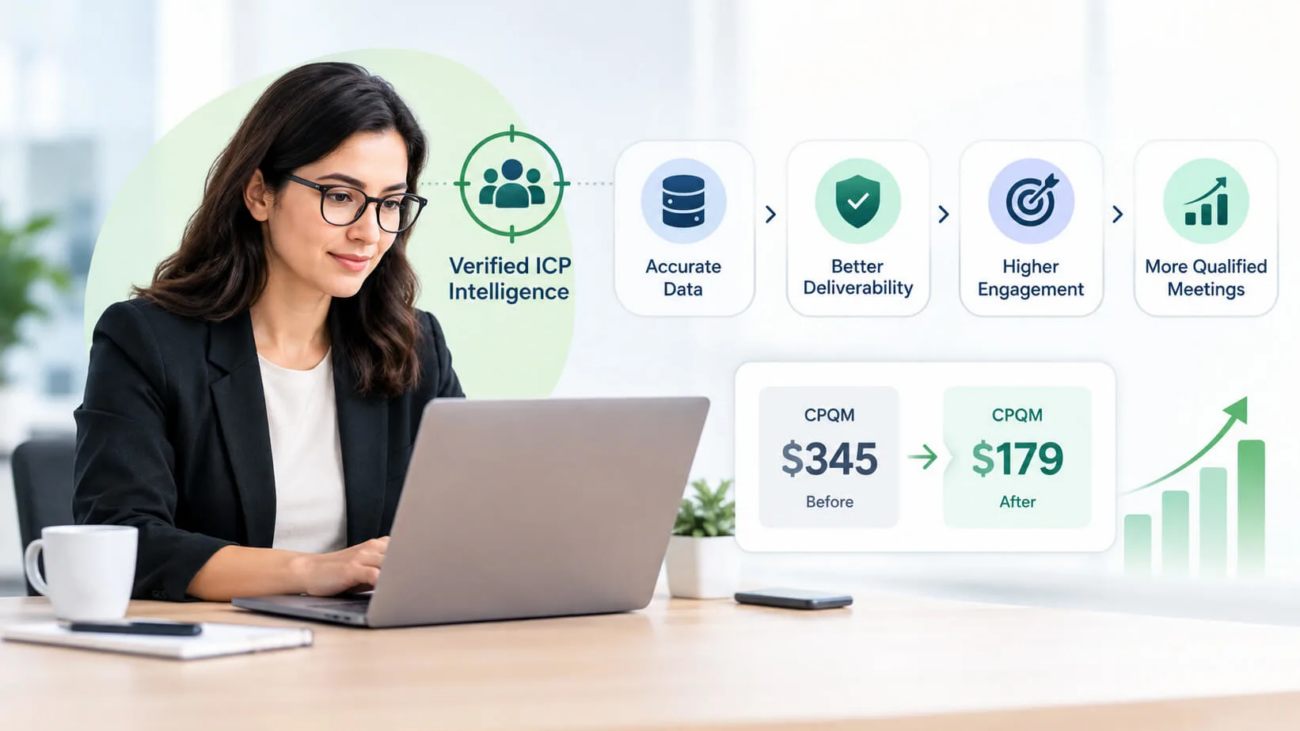
How LogiChannel’s Verified ICP Intelligence Improved Outbound Deliverability and Reduced Cost Per Qualified Meeting

About the Client

The client is a North American Series B B2B SaaS company generating $15M ARR that offers workflow management and process automation to mid-market operations and IT teams. In addition to digital inbound channels, the company has an internal 8-person Sales Development Representative (SDR) team to create pipelines within target mid-market accounts.

The SDR team had problems with the quality of its lists of prospects. Outbound campaigns were based on an unmaintained internal database that had been built over the previous two years that consisted of trade show attendees, web downloads, and legacy directories. Current decision-makers’ direct contact information was outdated, and the database did not include hygiene or technographic qualification of accounts.

The Challenge

Outbound sales efficiency deteriorated due to poor data hygiene. Reps spent considerable time handling delivery failures, researching departed employees, and manually validating phone numbers.

Pre-LogiChannel Baseline: 90-Day Outbound Performance (Before Engagement)

To fairly evaluate performance, the outbound unit’s metrics were measured over the 90 days of operation:

  • Total Contacts Attempted: 3,600 contacts in 90 days averaging 1,200 contacts per month.
  • Successfully Delivered Emails: 2,376 representing a 66.0% deliverability rate with a 34.0% bounce and non-delivery rate.
  • Interested Responses: 72 which is 3.03% of the delivered emails.
  • Discovery Meetings Completed: 28 total (average 9.3 meetings per month; 0.78% contact-to-meeting rate).
  • Sales Qualified Opportunities (SQOs): 10 total (average 3.3 SQOs per month; 35.7% meeting-to-SQO conversion rate).
  • Cost Per Qualified Meeting (CPQM): $345.00 (Calculated as outbound data subscriptions, scrubbing overhead, and sequencing software allocation per completed discovery meeting).

Key Operational Issues:

  • Elevated Non-Delivery Rate: A 34% bounce and failure rate hindered outbound velocity and triggered sender domain reputation warnings.
  • Technographic Incompatibility: Outreach reached organizations operating on incompatible legacy IT architectures, resulting in early demo drop-offs.
  • Elevated Acquisition Costs: High contact failure rates and low meeting volume drove CPQM to an unsustainable $345.00.

The Solution: 3-Phase Data Intelligence & Advisory Engagement

The purpose of tracking these metrics was to understand whether the campaign was producing better prospects and better conversion performance, rather than simply increasing database size.

Phase 1: Rapid Diagnostics & Full Database Delivery (Days 1–5)

LogiChannel fulfilled the core data requirement on an expedited 5-business-day turnaround:

  • Days 1–2 (Audit & Hygiene Diagnostics): Audited a 1,500-contact sample from the client’s CRM, isolating a 34% delivery failure rate caused by obsolete email domains and departed personnel.
  • Days 3–4 (Technographic & ICP Calibration): Screened target accounts between 150–2,000 employees with confirmed installations of compatible software (Salesforce, Workday, Jira), appending direct dials and primary corporate emails verified via live SMTP handshakes.
  • Day 5 (Full Delivery Hand-Off): Delivered all 3,500 verified, CRM-ready decision-maker contacts to the client’s sales operations team.

Phase 2: Sales Enablement & Account-Level Segmentation (Days 6–45)

During the first roll-out by the client’s own SDRs (3,500 records):

  • Persona-to-Tech Alignment: The client’s sales leadership received technographic tags for use by SDRs so that they could customize the messaging of their outreach based on the prospects’ current software stack.
  • Deliverability Monitoring: Tracked bounce telemetry for initial sends, confirming a 97.2% deliverability rate across automated sequences.

Phase 3: Telemetry Feedback & Segment Optimization (Days 46–90)

At the campaign’s midpoint, LogiChannel reviewed engagement patterns with the client’s sales management:

  • Response Rate Analysis: Evaluated reply data across sectors, identifying that Fintech and Logistics accounts converted at higher rates than more regulated niches.
  • Segment Refinement: Recommended reallocating rep bandwidth toward high-response verticals, supporting the team in achieving a final 1.09% contact-to-meeting conversion rate (38 completed discovery calls).

The Results: Documented Outbound Performance

Comparing the 90-day campaign against the client’s equivalent 90-day baseline demonstrates measurable efficiency gains across the outbound funnel:

Funnel Metric90-Day Baseline(Pre-LogiChannel)90-Day Campaign (With LogiChannel)Variance / Absolute ChangeRelative Impact
Contacts Attempted3,6003,500-100 contactsMore targeted prospect cohort
Email Deliverability Rate66.0% (2,376 delivered)97.2% (3,402 delivered)+31.2 percentage pointsSubstantial deliverability improvement
Interested Responses72118+46 replies+63.9% increase in replies
Reply Rate (on Delivered)3.03%3.47%+0.44 percentage pointsImproved messaging relevance
Discovery Meetings Completed28 (9.3 / month)38 (12.7 / month)+10 meetings+35.7% meeting volume lift
Contact-to-Meeting Rate0.78% (28 / 3,600)1.09% (38 / 3,500)+0.31 percentage points+39.7% efficiency gain
Reply-to-Meeting Conversion38.9% (28 / 72)32.2% (38 / 118)-6.7 percentage pointsStricter meeting qualification criteria
Sales Qualified Opportunities (SQOs)10 (3.3 / month)16 (5.3 / month)+6 SQOs+60.0% pipeline addition
Meeting-to-SQO Conversion35.7% (10 / 28)42.1% (16 / 38)+6.4 percentage pointsImproved technology-fit qualification
Cost Per Qualified Meeting(CPQM)$345.00$110.00-$235.00-68.1% cost reduction

Factual Business Observations:

  • Pipeline Growth Enabled by Deliverability Gains: An increase in deliverability of 31.2 percentage points helped to increase outreach to the intended inboxes and helped to grow the number of discovery meetings completed by 35.7% over the last 90 days.
  • Securing 38 discovery meetings from 3,500 targeted contacts (1.09%) reflects dependable mid-market B2B outbound performance.
  • Technographic Filtering Improved Account Relevance: By confirming software compatibility before outreach and narrowing technical discrepancies discovered during demos, the meeting-to-SQO ratio improved to 42.1% (compared to 35.7% at baseline).
  • Cost Per Meeting Down 68.1%: Due to elimination of wasted prospecting hours and increase in meeting yield from target accounts, the allocated data cost per completed discovery meeting went from $345.00 to $110.00.

The client’s Revenue Operations team noted that receiving the fully verified 3,500-record dataset within 5 business days allowed their SDR team to launch targeted cadences without delay. Transitioning from unmaintained internal lists to verified, ethnographically segmented data helped the team increase completed discovery calls from 28 to 38 across a 90-day period, while reducing their allocated cost per qualified meeting by 68.1% (from $345 down to $110).

About LogiChannel

LogiChannel provides verified B2B contact databases, technographic market intelligence, and customized data enrichment services. By combining firmographic segmentation with verified technology user tracking, LogiChannel assists B2B revenue teams in reducing contact data decay, optimizing SDR workflow efficiency, and improving outbound campaign consistency.

Evaluate Your Outbound Data Quality

Identify invalid contact records and discover verified decision-makers within your target market
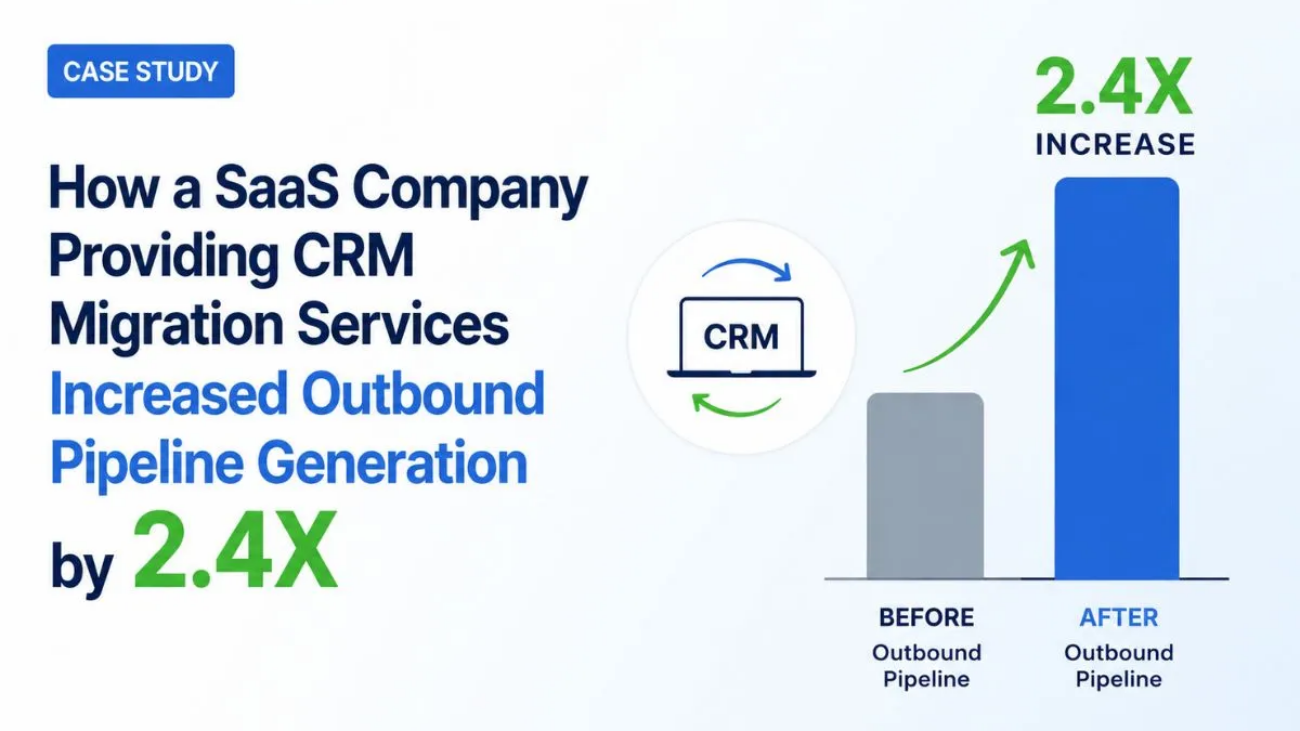
How a SaaS Company Providing CRM Migration Services Increased Outbound Pipeline Generation by 2.4X

How a SaaS Company Providing CRM Migration Services Increased Outbound Pipeline Generation by 2.4X

Client: Mid-Market SaaS Company

The Challenge

This software-as-a-service (SaaS) organization aids medium-sized and large-scale firms with the transition from older customer relationship management (CRM) systems to new ones. The most common endpoint after retirement from previous systems is the Salesforce CRM. 

They had a precise ideal customer profile (ICP). They developed their pitch very effectively, and they applied all of the correct sequences for targeting these organizations. However, the pipeline created by the outbound sales team was stagnant, with no momentum toward growth and new opportunities. 

The company’s director of revenue operations conducted a diagnostic and identified one primary variable that was impacting pipeline growth: data. Their large-scale, generic B2B database did give broad market coverage, but it did not give them the data depth needed to make the right assessments regarding their sales efforts. 

The database did not contain verifiable information that would have allowed them to determine which companies were actually using (and would want to use) the Salesforce CRM, who decided to migrate, or if any of the potential or existing accounts actually had a reason to migrate from their previous CRM system to the Salesforce CRM.

The results of limited data depth were numerous:

  • High bounce rates from email messages being sent to outdated or unverifiable contacts. 
  • Low response rates because their outreach material was not relevant to the person receiving it. 
  • Very low quality of leads, with only a couple of leads converting to sales opportunities. 
  • A considerable amount of the sales reps’ time is being consumed trying to do account research that the database was intended to handle. 
  • The sales team was not deficient in activity; they just did not have accurate and actionable information to base their activity upon.

The Solution

As part of the evaluation process of various data providers, the company chose to work with LogiChannel, where they were able to use our verified, refreshed  Salesforce customers list as a resource to find companies that use Salesforce to enhance their sales system as part of their outbound prospecting efforts.

The data contained for each company includes: 

  1. The vertical of the company
  2. The revenue of the company 
  3. The number of employees
  4. The geographical location of the company and 
  5. The signal that the company uses Salesforce

For each contact within the organization, the data contains: 

  1. The name of the decision maker
  2. The verified job title of the decision maker 
  3. The business email address
  4. The direct telephone number and
  5. The LinkedIn url

For a sales team that sells CRM migration services, this was not simply useful, but it provided a fundamentally different approach to the prospecting process.

The Execution

Using precision segmentation to target new business after conducting a thorough review of the Salesforce Customers List, LogiChannel was able to create a more precise target account universe using 3 filters: companies with 200 – 2000 employees who operate in financial services, professional services, or healthcare technology, and have decision makers such as VP of Sales Operations, CRM Administrators, Director of Revenue Operations, and CTOs. 

The result of these filters was 3,200 tightly defined accounts; this compared to over 15,000 loosely defined contacts before this exercise. Although there are fewer total accounts now, there is a much greater level of specificity.

With a more cleanly defined account list, LogiChannel was able to completely rewrite its outreach sequences. 

The previous messaging was product-focused and explained what they did and why CRM migration was important; the new messaging was context-focused and provided information about the potential pain points for the target based on their role and industry. 

For instance, when reaching out to a VP of Sales Operations within a financial services firm, they were able to discuss the restrictions associated with Salesforce integrations in regulated environments. 

Similarly, when reaching out to a CRM Administrator within a healthcare technology company, they were able to directly address the challenges to maintaining data integrity during platform transitions.

These weren’t just plain old personalization tokens. They were REAL conversations that were personalized due to having access to all that data (which allowed us to have authentic conversations). Our reply rates improved within the first two weeks.

Sales and Marketing Alignment

A less obvious but very significant impact on the data was what it did for cross-team alignment. Before LogiChannel, Marketing would run campaigns to build awareness for one audience and the Sales teams would have no idea that this same group was being given a different marketing message.

With the Salesforce Customers List as a common starting point, both Teams were focused around the exact same list of 3,200 Target Accounts. Marketing created LinkedIn Ad Campaigns and Content Syndication for 100% of the Target Accounts. Sales teams were able to see engagement signals before reaching out. 

The end result was Coordinated Multi-Channel Outbound motion. Every target received consistent messaging at the point they come into contact with the brand.

Data Refresh on a Regular Basis

The team has also pledged to replace their stale contacts, update company records & continuously validate their email addresses with a Data Refresh from LogiChannel approximately every 60 days. Data (B2B) decays very quickly. 

People change jobs. Job function or roles change. A list that isn’t regularly updated slowly loses accuracy every single week. Therefore, continually refreshing their lists ensures that the team is always working with current, deliverable information.

The Results

  • Outbound Pipeline Generated 2.4X increase vs. prior quarter.
  • Email Open Rate increased by +47%
  • Reply Rate increased by +34%
  • Sales-Qualified Leads increased by +41%
  • Email Bounce Rate decreased by -62%
  • Average Sales Cycle Length reduced by -18%

All metrics clearly displayed the benefits 90 days later. More than double the pipeline was generated by the team without any changes made to products or hiring additional employees. 

The 62% decrease in bounce rate had stopped the up-to-that-point negative impact on the sending domain’s reputation due to undeliverable addresses. And the shorter sales cycles showed how prospects would interact with sales organizations if they began to have relevant and contextual conversations from their first touchpoint.

“We did not change our product. We did not change our people. We changed what we knew about who we were speaking to; therefore, everything downstream improved.”- The Head of Revenue Operations

Increase Outbound Pipeline Generation by 2.4X With Our Salesforce Customers List

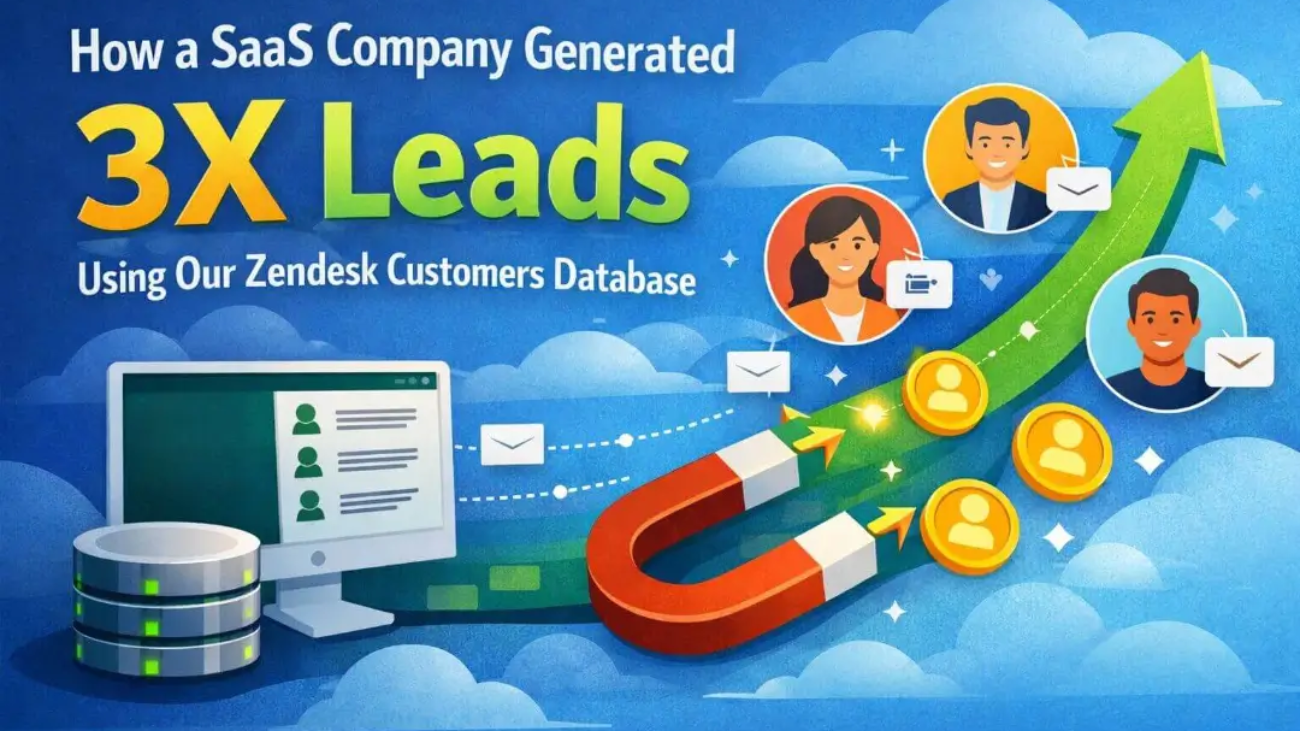
How a SaaS Company Generated 3X Leads Using Our Zendesk Customers Database

How a SaaS Company Generated 3X Leads Using Our Zendesk Customers Database

A SaaS Company with a great tool and a very narrow customer base struggled to scale its revenue. With the awareness that their competitor is Zendesk, but their software is way more affordable and user-friendly than Zendesk’s, they were adamant to stay in the market. That’s when they found their solution: Targeted Zendesk Customers Database, scaling qualified leads by 3X within just three months.

Client Overview

The client is a SaaS Company that has 100+ employees, specializing in cloud-based customer management software. The tool helped them with file-sharing, company operations, sharing private files, and everything happens seamlessly using one dashboard. 

The client caters to small & mid-sized businesses, but really wants to grow to deliver to Big 4 companies. The tool is everyone’s favorite currently because it comes with AI-powered workflows that can be accessed wherever team members are. The sales model is B2B outbound with account-based marketing.

The Challenge

The client was running several multi-channel marketing campaigns, but still struggled with fairly low engagement rates. The sales team was not able to target the right people since they own a database that they verified last in 2014, making targeting very redundant. 

Due to an inactive database, the SaaS company faced low response rates from generic lists, poor targeting, and difficulty identifying companies they could target, causing high customer acquisition costs and long sales cycles. Once, an unsuccessful send-out brought them great open rates, but that was to gain about 50 unsubscribers, and with so much effort, the actions were not driving any positive results.

Our client soon discovered an active database of companies using Zendesk.

Why Zendesk Users Were The Ideal Target

The client always considered Zendesk as a competitor, as they aspired to build products that are as effective as Zendesk, maybe more. Zendesk users pay hefty amounts for using the CRM platform, with no integration capabilities or customizable workflows. Zendesk does not allow companies to build their workflows based on business goals. 

Our client was not Zendesk; it was all of Zendesk, with its disadvantages turned into advantages. In other words, the client’s tool was built on the basis of being more effective than Zendesk, with more room for AI integration and great business outcomes, all at a great package price.

Campaign Strategy Implemented

We asked our client why existing customers were onboarded for the first time. The client said it was because other AI CRM systems are very expensive, and theirs is priced well with great features. Some clients mentioned how they want to switch from Zendesk to us. So together we looked up Zendesk, their offerings, made a few tweaks, and purchased the Zendesk customers database. This way, our client got a reason to communicate to Zendesk users that something better exists in the market. This directly led to 70% conversions and skyrocketed open rates.

Yes, the product the client is selling is the hero here, but there’s more to this: a targeted customer database with data fields including but not limited to verified companies using Zendesk, contact details of decision makers, industry, company size, and other demographic details.

The targeted database of Zendesk users came with details of CIOs / Customer Support Heads, Support Operations Managers, and CX Directors, giving direct, detailed access to prospects. Cold emails with customization are what finally led to 70% conversions from our first marketing campaign using the database!

How the SaaS company used the targeted database of Zendesk users:

Step 1: Building an ideal customer profile

With our customized email list of Zendesk users, the client could uncover businesses with a certain turnover, with 200+ employees, from the USA, working in the tech and trading industries. This built the deal customer persona for the SaaS company while building a clear path for communications.

Step 2: Account-Based Marketing

While doing market research, we realized the tool is closest to Zendesk CRM, which is how we helped clients. We used the Customer database of Zendesk users in the USA alone because the client was just USA-based at the time. 

Step 3: Personalized Outreach

Once the client knew who they were talking to, the messaging focused on providing solutions like CRM AI integrations, strategies to support efficiency, and the benefits of automation based on customer needs.

Customer needs could be determined based on certain data insights, so skimming through the data helped the client understand brands that can be targeted in the USA, based on what pain point, already giving room to explore other audiences with 100% confidence.

Step 4: Multi-Channel Campaign

The client was never limited to the USA, there was always a thought process of the founder, and that’s to find interesting ways to reach out to businesses that needed their solutions.

With our targeted list of Zendesk users, we could adopt multi-channel marketing, and we started Email marketing, LinkedIn outreach, SDR cold calling, hosting webinars, and encouraging the same database to participate, leading to surprising conversions. The database was then filtered from just the USA to all countries for communications.

All the marketing needed became the intent because the right people out there were waiting to be reached, my client had the right database, it’s a match made in favor of success.

Results Achieved

Our client owns a great SaaS solution that the world can enjoy, but nobody to reach out to. With a simple tweak of buying a verified list of Zendesk users, these are the results, quantified: 

  • Qualified Leads: 3X increase
  • Email Response Rate: +42%
  • Meetings Booked: 2X growth
  • Sales Pipeline: $1.5M generated

Why The Strategy Worked

The Zendesk customers database helped our client centralize, organize, and protect vital data for exceptional business performance. Reliable data lead them to personalized marketing, building customer relationships by tapping into pain points with solutions. The key success factors for marketing success the client experienced include: 

  • Highly targeted audience
  • Accurate technology data
  • Personalized messaging
  • Ideal product-market fit

Client Testimonial

“Targeting companies already using Zendesk was a sharp turn we took that switched the business for growth. Instead of generic outreach, we are now in direct talks with companies that truly need our solutions.”

Key Takeaways for SaaS Companies

Do not expect performance on the mercy of just a pre-owned database. Databases your business works with will need to be up-to-date, just like your product. It’s only when the database is set up for the right audience that you will be able to see results, as in the case of our client. 

Own a verified list of customers that works for your business based on industry, location, or even competitor technology, anything that ties up all your prospect audiences (in general, for example, Zendesk users in the case mentioned above). Expect higher open and conversion rates, high engagement rates, and better results during cold outreach as well. 

Make data-driven decisions and expect minimal shocks, only surprises, with the benefits of using an accurate, verified, opt-in database of decision makers. In fact, active databases are a great asset for any marketing team, a blessing more so. Know who you are talking to, concentrate on their pain points while seeing the database compound as results start showing. Beyond acquisition, email marketing increases the lifetime value of customers if utilized well. 

Knowing who to target gives a very good segmentation criterion for the database. The more detailed your persona targeted is, the more streamlined you can use the database, seeing more results that’ll get you understanding your customer more deeply, eventually leading to more and repeat business.

Access Our Zendesk Customers List For Boosting Lead Generation By 3X