
Global Companies Using Workday | LogiChannel

Global Companies Using Workday: Adoption, Trends, Insights & Opportunities

The following statistic is of major significance to professionals in B2B sales and marketing: More than 11,500 organizations currently use Workday around the world, and over 65% of them are Fortune 500 companies. 

In other words, while this represents the commercial success of one platform, it also constitutes a very large, easily identifiable private market segment made up of high-value companies that have made significant investments in technology, have dedicated decision-makers in HR, finance, and IT, and continually evaluate services, tools, and integrations complementary to their existing infrastructure to increase value.

For B2B companies, one of the strategic issues is not whether or not Workday users should be considered a good potential audience; rather, it is whether or not your team has access to the data needed to effectively communicate with these companies.

What is Workday & Why Global Enterprises Choose It

Initially focusing on Human Capital Management (HCM), Workday’s primary functionality was supporting businesses with managing employee-related processes such as payroll, pay and benefit processing, hiring & onboarding, employee performance evaluations, and tracking time & attendance. Useful, of course, but not exactly the type of conversations happening at boards of directors.

However, Workday has transformed over the last several years with aggressive growth into Financial Management, Enterprise Planning, Procurement, and Artificial Intelligence (AI). The platform now provides an integrated view of workforce management and financial management through a single cloud-based solution, allowing leadership teams to have a single source of truth for accurately tracking people and money in real-time (instead of relying on spreadsheets and outdated data).

The ability to have both Human Resource (HR) and Finance systems communicating with each other (using live data) will eliminate the significant information and decision-making friction that would occur when the HR and Finance systems are not in sync. In addition, this capability becomes even more critical for large synchronously-distributed organizations where the cost and productivity advantages associated with efficient workforce management can create a significant competitive advantage.

Understanding company needs using tech data is one of the best ways for business-to-business software companies to identify when companies are most likely to buy. It helps to add additional context about what we already know about businesses based on their firmographics, such as sector or number of employees.

When we see that a company is on the Workday global customer list, we can reasonably guess a number of things about them:

  • They’re generally mid-large companies (generally between 1,000-10,000+ employees, average Workday customer size).
  • They have made a commitment to adopting a cloud-based infrastructure to manage their HR and financial functions.
  • The company has multiple stakeholders in HR, Finance and IT that will work together on the company’s technology purchases.
  • The company is likely to be looking at other products (add-ons, integrations, ancillary services) to optimize their investment with Workday.

For solution providers in HR software, payroll management solutions, compliance solutions, workforce analytics solutions, consulting services for implementing, staffing solutions, and for developing employee skills and training, building a well-curated list of Workday customers is more than just an effective list of prospects; it is the fundamental basis of a go-to-market strategy that is intelligence-/data-driven.

Global Adoption of Workday

To assess where Workday is going with regard to adoption trends, it’s helpful to start with the numbers, which tell a compelling story.

  • More than 11,500 enterprises in 175 countries now utilize Workday; the platform is used by approximately 30% of the Forbes Global 2000 organizations.
  • Workday’s contractual user base exceeds 75 million globally, and Workday processes more than one trillion transactions annually, the volumes of which rank among the largest and most deeply integrated enterprise platforms in use today.
  • For B2B vendors, this degree of integration is critically important; organizations do not typically disengage from Workday quickly because the implementation processes can be lengthy, the cost of switching providers is often prohibitive, and organizations typically increase their utilization of the Workday platform over time, as opposed to decrease.

As such, each company on the Workday customer list represents not a transient sales opportunity but, rather, a long-term, high-lifetime-value account that has sustained purchasing activity.

Across all of these sectors, the strongest trends exist within manufacturing, retail, and professional services, with high customer density also found within Technology & Media, Healthcare, Financial Services, Higher Education, and Government. 

New clients added to the global Workday client list in 2021 are United Airlines, Carrefour (France), Banamex (Mexico), and Masan Group (Vietnam), and existing clients expanding their relationships include: Google, Qantas Airways, Decathlon, and Levi Strauss, providing B2B vendors with cross-industry targeting opportunities that are relevant to nearly every enterprise.

Top Global Companies Using Workday

The worldwide list of clients using Workday includes businesses that exist throughout the globe in most of the major industries. Some of the most popular & well-known clients include Amazon, Netflix & Adobe, Coca-Cola, Pfizer, Chipotle, Toyota, and Levi Strauss. But the total number of clients using Workday goes far beyond the well-known clients listed above.

The companies using Workday range from very large global enterprises with greater than 10,000 employees (about 30 percent of Workday’s total customer base) to mid-size companies with 1,000 to 10,000 employees, who make up the largest segment of the total number of users at over 53%; therefore, the mid-size segment represents the largest user segment of the Workday client list.

Geographically, the U.S. is where most of the Workday clients are located. While adoption rates for Workday are highest in the U.S., the rate of Workday adoption continues to grow at a very rapid pace throughout EMEA and APAC, including locations that are benefiting from new infrastructure in the UK and developing new customers throughout the rest of Europe, Asia and Latin America.

Workday’s popularity among such a broad spectrum of entities is based on one basic characteristic: the ability to integrate finance and human resources into one cloud-based solution, thereby giving companies leadership teams one consistent, up-to-date view of both the company’s employees and its financial condition. As global enterprises with many employees in several countries, regulatory environments and time zones operate better when they have one view of both their people and money, the ability to use that as a basis for making decisions materially increases the efficiency of the decision-making process at all levels of the organization.

So for B2B re-sellers, the benefit is just as clear. In the global market, companies using Workday tend to be more strategic about their technology investments, build long-term value into their partnerships with other providers who support their Workday implementation, and continue to invest in additional solutions that extend or enhance the capabilities of Workday.

Workday Adoption Trends by Industry

While there are many customers that currently utilize Workday, some verticals display much higher rates of growth and urgency than others. Knowing these vertical-level adoption trends will help B2B vendors focus their outreach efforts more effectively.

Healthcare Industry:

by 2025, Workday’s Annual Recurring Revenue (ARR) from the healthcare vertical reached $1B, demonstrating a concerted effort from organizations across the healthcare industry to modernize their outdated HR and financial systems, as well as effectively manage the complexities of the healthcare regulatory environment. As a result, the costs related to implementing and adding on new Workday solutions outpace initial implementation costs significantly. 

As such, vendors providing solutions that address Compliance Management, Credentialing, Clinical Scheduling, and Staffing should consider Workday’s healthcare customers to be one of their top priorities.

Manufacturing

The manufacturing industry also reached Workday’s $1B ARR mark in 2025, largely due to large, multi-site manufacturers managing very complex, diversified, and globally dispersed workforces. Those manufacturers leveraging Workday demonstrate strong demand for Workforce Planning Tools, ERP Integrations, and Operational Analytics as a result of the complexity associated with coordinating production and labor at a large scale.

The Mid Market

The Mid Market is the emerging segment of Workday that is driving adoption at this time. With a strong focus on expanding Workday’s footprint and making it a more attractive option to implement for organizations that have been unable to validate the investment required to implement an enterprise solution, Workday has introduced a new offering called Workday Go. 

This has resulted in substantial new Workday customers who will need assistance with their implementation, user training, system integrations, and ongoing consulting. Gaining early access to validated information on this market is a significant competitive advantage.

The Government and Public Sector

This represent another emerging market for Workday, with the recent establishment of a dedicated subsidiary, Workday Government, making this an area where Workday users around the world will now be able to use Workday for the first time. Many vendors in the B2B space have not been targeting the Government and Public Sector market.

Why Workday Adoption Trends Are Accelerating : The AI Imperative

As a result of Workday’s transformation to an AI-native enterprise system, B2B vendors will have new implications to consider when selling to accounts that are based on Workday.

Workday launched Workday Illuminate, which consists of a suite of AI agents that have been natively integrated into workflows of HR, Financial and Industry-specific applications. In just three months since the mid-year 2025 launch of the Agent Partner Network, more than 50 partners have joined the network to develop AI capabilities that have been natively integrated with Workday. 

There was a 267% increase over the previous year in monthly traffic on the Workday Marketplace, and over 350 new features were added to the Workday platform in the Spring of 2025.

B2B vendors selling to companies that use Workday will have a significant amount of activity by customers currently in a purchasing cycle  when looking for AI-integrated applications, evaluating integration priorities of vendors and making procurement decisions at a much faster pace than what you would typically see with perennial ERP vendors. 

This is a time-sensitive opportunity for B2B vendors to reach, globally, Workday users during a large-time window while evaluating AI application vendors before finalizing their technology decisions.

Any organization that has AI-enhanced Human Resource (HR) Solutions, automated workflows, workforce analytics, financial process automation, or any other capability that increases the organization’s ability to develop within the Workday Ecosystem should focus on conducting outreach to all of the global clients of Workday as soon as possible.

A Strategic Framework for Targeting Workday Users Worldwide

If you’re a B2B company that wants to create an organized marketing campaign to focus on organizations that currently use the Workday platform, this framework provides a good operational structure.

1. Prioritize Based On Fit Rather Than Size

Trying to engage all of the 11,500+ Workday customers at once would be inefficient and not strategic. First, identify the two or three verticals or organizational sizes where you demonstrate the strongest product/market fit and where you can establish the best ROI narrative, either by measurement or client testimonials. High-growth verticals such as Healthcare and Manufacturing and the growing Mid-Market represent good opportunities, but your best starting point will likely be a vertical where you’ve already established credibility.

2. Accurately Define Your Buyer Personas

Clearly identify the primary decision-makers within the Fortune 500 global Workday clients, HR, Finance, and IT, and a combination thereof, so that you can effectively identify the best targets for your outbound campaigns. By targeting by role, your outbound marketing will have a much higher chance of success, as will all of the channels you use to deliver your messages, whether they are outbound, pay-per-click ads, or content

3. Always lead with and be relevant to the Workday platform

Make sure to mention Workday as you reach out to your targets. Whether your marketing approach leverages a native integration, addresses a gap in capability or complements an existing Workday module in some way contextualizing your value proposition using a specific Workday reference will be much more successful than a generic marketing approach it will get you through the competition’s clutter quickly and easily.

4. Implement Account-Based Collaboration

Workday enterprises generally involve numerous decision-makers across departments. More successful coordination occurs across multiple departments (e.g., HR, Finance, IT) when there is already an established relationship with the organization (target) than if the outreach was limited to only one department.

5. Coordinate your outreach with triggers that indicate a current desire to Purchase Workday Services

Current Workday implementations and module expansions and executive changes at the Target Company; in addition, Workday will have additional new platforms  soon being launched and as such increases the overall number of potential Workday users around the globe are elevating their purchase activity. Intelligence-based uploading of these signals will help facilitate outreach at the optimum time when there is the highest level of receptiveness to the message.

Conclusion

There are many new organizations joining the worldwide signup list of Workday every quarter. There are also many existing worldwide signup users of Workday who are expanding into adjacent modules and capabilities. Currently, the AI-Driven transformation throughout the Workday platform is increasing activity by Purchasers throughout the Workday ecosystem; rather than moderating it.

For B2B organizations selling to HR, Finance, and IT decision-makers within large enterprises, Workday users represent one of the most precise targets available in the marketplace today and have the highest commercial value as well. However, to gain this value, the data must be of sufficient quality, recency, and depth to support intelligent, timely engagement.
how-to-leverage-a-nurse-anesthetists-email-list-for-better-conversions

How to Leverage a Nurse Anesthetists Email List for Better Conversions

In today’s very competitive healthcare marketing environment, targeted marketing is no longer an exercise in luxury, it is a requirement for success. Healthcare marketers across the many organizations that make up the healthcare ecosystem  including pharmaceutical companies, medical device manufacturers, healthcare companies creating SaaS products.

B2B service providers are continually searching for new ways to engage niche audiences that influence decision-making about purchasing products and services.

Certified Registered Nurse Anesthetists (CRNAs)  are a highly specialized group of healthcare professionals with great influence on surgical care, anesthesia administration, and patient safety, making them one of the most important stakeholders in clinical settings. 

CRNAs represent an ideal audience for precise, highly focused marketing campaigns.

A Nurse Anesthetists Email List presents a direct and powerful way to communicate with these professionals. However, acquiring this list is only one part of the process. 

The real value of a Nurse Anesthetists list will be achieved based on the strategy you employ in using it to engage the targeted audience and to build and nurture relationships that will ultimately lead to conversion.

This complete guide will provide you with actionable marketing strategies, proven successful techniques, and best practices for optimizing the value of a Nurse Anesthetists Email List to generate higher levels of conversion and return on investment (ROI) over time.

Understanding the Role of Nurse Anesthetists in Healthcare

In order to develop your marketing strategy, you’ll want to take a look at who CRNAs are and understand the importance of having CRNAs as a partner in your business.

Certified Registered Nurse Anesthetists (CRNAs) are advanced practice nurses (APN) that are trained to provide anesthesia to patients for surgical procedures, manage all aspects of the patient’s anesthesia care prior to, during and after the surgical procedure, and provide a variety of services related to anesthesia and pain relief in a variety of healthcare settings, including hospitals, outpatient surgical centers, and private practice.

Why Nurse Anesthetists Are a Valuable Audience

Nurse anesthetists participate in decisions about patient care and the selection of anesthesia drugs/equipment, collaborate with surgeons, physicians, and procurement teams, and continue education regarding the most recent medical technology; because of this, they are decision influencers. 

Targeting nurse anesthetists will have a significant impact on your sales pipeline.

What is a Nurse Anesthetists Email List?

The Nurse Anesthetists Email Lists is a compiled database of verified CRNA contacts which can include individual records containing:

  • Names
  • Email Addresses
  • Job Titles
  • Work History
  • Geographic Location
  • Years of Experience

High-quality lists also could contain behavior and intent data using this, businesses can better personalize, segment and target their marketing efforts towards Nurse Anesthetists.

Benefits of Using LogiChannel’s Nurse Anesthetists Email List

1. Marketing in a Hyper-Targeted Way

Rather than attempting to reach everyone with your marketing effort, you will be able to concentrate on an audience that is very specific and more likely to respond to your messages and calls to action.

2. Higher Engagement Rates

When you are sending emails that are targeted to a niche audience, your emails will tend to perform better. Examples of this would be your email open rate or click-through rate.

3. Cost-Effectiveness

When you send emails as your marketing method, you will get one of the highest returns on investment (ROI) for your dollar investment among all the available digital marketing channels. When you send emails to niche audiences, your cost-effectiveness will increase even more.

4. Building Stronger Relationships

When you are in regular and relevant contact with healthcare providers, you will establish a greater level of trust with them and, therefore, establish long-term relationships.

5. Faster Sales Cycles

By going directly to those who influence purchasing decisions, you will be able to shorten the buyer journey and speed up the conversion process.

6. Demonstrating Visible ROI

Unlike retail, tracking the journey of potential clients from engagement to conversion is complex.

7. Balancing Personalised Messaging with Security:

One of the biggest marketing challenges is using healthcare professionals’ data for personalized marketing while closely adhering to privacy regulations.

Building a High-Quality Nurse Anesthetists Email List

Your email list quality can dramatically impact how successful your campaigns will be. To improve the quality of your email list, there are several sources where you can obtain email addresses. 

Key Characteristics of a High-Quality List

  • Verified and regularly updated data
  • Permission-based (opt-in) contacts
  • Detailed segmentation fields
  • Compliance with data privacy laws

Methods to Build Your List

  1. Content Marketing – Offer people something of value in return for their email address, such as:
  • Whitepapers
  • eBooks
  • Clinical Guides
  1. Webinars/Virtual Events – Host educational sessions that cater to nurse anesthetists and collect registration information.
  2. Industry Conferences – Attend healthcare-related events in order to create new connections and obtain additional email addresses for your list .
  3. Website Lead Capture Forms – Utilize high-converting landing pages on your website to get potential leads.

The Importance of Segmentation

Segmentation is one of the most important factors in better email marketing performance. Examples of where to segment subscriptions are: 

Segmentation Criteria

  • Locations
  • Experience level
  • Type of healthcare facility
  • Specializing in specific fields of healthcare
  • Behavioral engagement 

Why Segmentation Works?

Successful segmented campaigns generate more value through relevant content, yielding: 

  • Open rates are higher
  • Click-through rates increase
  • Conversion rates are better.

A good example would be a campaign for senior CRNAs working in large hospitals versus one for newly employed CRNAs at smaller clinics.

  •  

Personalization Strategies That Drive Conversions

Personalised communications include more than the mere addition of a recipient’s name. For instance: 

Advanced Personalization Techniques

Information that is specifically suited to the job role

Suggestions that are informed by the purchaser’s previous actions

Personalized opening lines for emails

Customized subject line

Example

Current Subject: “Look at our new product for anesthesia.”

New Subject: “Dr. Smith—Increase Patient Safety with Our New Advanced Product.”

Using these types of personalization leads to increased engagement.

Crafting High-Converting Email Campaigns

1. Use a Compelling Subject Line to make an impression

  • Make your first impression with the subject line of your email.
  • Keep it below 50 characters.
  • Use urgency or curiosity to get someone’s attention.
  • Highlight the benefits of your product/service.
  1. Write Engaging Email Copy

Focus on what your product/service will do for the reader.

  1. Provide a Clear Call to Action (CTA): Use strong, actionable CTAs such as:

Download Now, Schedule a Demo, Free Consultation.

  1. Use Visual Appeal

Make sure that your email has a clean layout and uses images or bullet points to make it easy to read 

  1. Ensure Mobile Optimization

Make sure that your email is responsive and can be easily viewed on a smartphone.

Content Strategies for Better Engagement

Educational Material

  • Clinical Insight (Intent)
  • Clinical Case Study
  • Industry trend analysis

Promotional Material

  • New Product Announcement
  • Offer Specials
  • Service Update

Interactive Material

  • Surveys / Polls / Quizzes
  • Posting content that offers value creates trust and develops credibility.

Using Analytics And Data

Data is a key factor in determining the effectiveness of your email marketing campaign. Measuring Key Metrics This includes:
  • Open Rate
  • Click Through Rate
  • Conversion Rate
  • Bounce Rate
  • Unsubscribe Rate
Using Methods For Optimization
  • Testing Using Different Content (A/B Test)
  • Analyzing Behavioral Trends
  • Continuous Refinement Of Last-Based  Strategies
By routinely assessing your email marketing strategy with these 4 methods above, data leading to consistent improvement is gained.

Using Drip Campaigns and Automation

Marketing automation allows you to send the right message at the appropriate time.

Types of Automated Campaigns

  • Welcome Emails
  • Lead Nurturing Systems
  • Follow-ups
  • Re-Engagement Campaigns

Advantages

  • Time savings
  • Increased consistency
  • Improves the User Experience

 A Drip Campaign walks the Buyer through their Buying Journey and improves their likelihood of converting.

Compliance and Data Privacy

Data privacy and compliance in marketing healthcare require strict regulations to be adhered to. There is much regulation on this topic including GDPR, CAN-SPAM, and relevant HIPAA considerations. 

The best way to maintain your reputation and build trust through compliance is by obtaining consent, providing users with the option to unsubscribe at any time, and guaranteeing the

Integrating Email Marketing with Multi-Channel Strategies

Marketing through different channels by utilizing email will have the most success when coordinating these efforts together. Different channels including:

  • social media, 
  • content marketing, 
  • paid advertisement, and 
  • webinars all create one message while providing a greater audience.

Mistakes marketers do frequently

  • Using Old Email Lists
  • Not Using Segmentation
  • Overloading Subscribers with Information
  • Poor mobile optimization
  • Lacking Analytics Tracking.

Elimination of These Mistakes Will Improve Your Results Greatly.

Future Trends in Healthcare Email Marketing

  • Personalization through AI : AI will enable greater personalization through advanced predictive targeting.

  • Interactive Emails: New engagement formats will create new standards, such as; embedded videos and interactive elements (such as click to listen) will all become commonplace.

  • Major focus on privacy: New regulations will be a determined influence in how future strategies develop.

    Being Ahead of the Curve Will Ensure Long-Term Success.

Conclusion

An email list of Nurse Anesthetists is not merely a collection of names and emails; it represents a marketing opportunity that enables targeted connections between you and qualified nurse anesthetists for building relationships leading to conversion.

Though used wisely, email lists of Nurse Anesthetists can accomplish your objectives of creating awareness, identifying talent, engaging with the right people as you identify potential connections, and establishing collaborative efforts through ongoing engagement.

By implementing the strategies in this guide for email list building and enhancing the quality and performance of your marketing, our Nurse Anesthetists Mailing List can potentially provide the necessary resources to build upon and continue to use effective marketing to meet your goals.

verified surgeon semail list blog

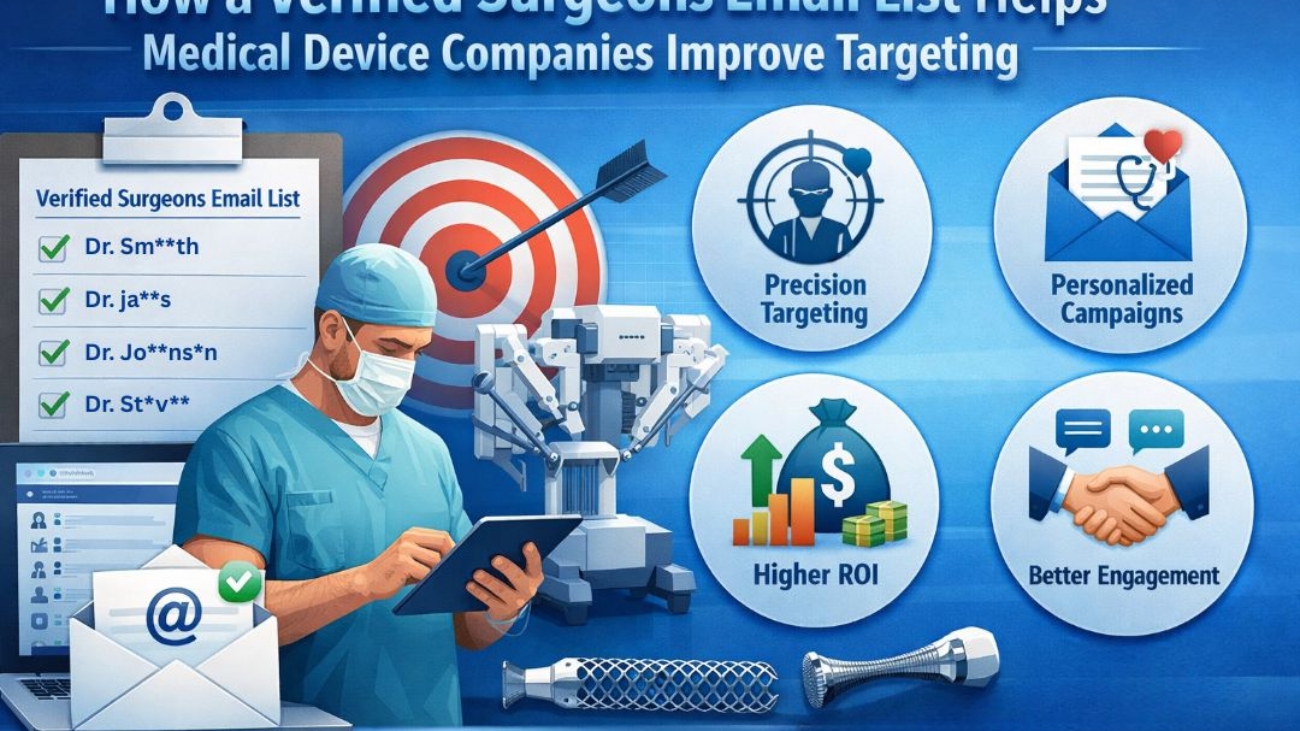
How a Verified Surgeons Email List Help Medical Device Companies To Improve Targeting

To be successful in the medical technology field, medical device companies need to reach the specialists. This is not a goal, it is something that must be done. For a medical device company, the difference between a good quarter and a failed product launch often depends on the quality of the outreach data.

In this guide, we will look at how a verified surgeon’s email database helps medical device manufacturers target the people and connect with the decision-makers who matter most.

Effective marketing is no longer about reaching a lot of people; it is about targeting specific people. Surgeons are hard to reach because they spend their days in the operating room, not checking media or answering cold calls.

A verified Surgeons email list provides a professional way to communicate with surgeons. The verified data ensures that the list is accurate and up-to-date. In the healthcare industry, professionals often move to different hospitals or change their contact information, so it is important to have a list that is regularly updated.

Why Surgeons Are a High-Value Target Audience

Surgeons play such a critical role in the decision-making process, the evaluation of products, and advocating for new technologies. In addition to having hands-on interaction with the devices in the operating room, surgeons’ preferences and experiences strongly influence the purchasing decisions made by hospitals and surgical centers for the devices they use.

The main reason that surgeons are valuable to device manufacturers is that they are perceived to have authority. Surgeons are experts and have a strong voice with their colleagues, procurement departments, and hospital administrators

When a surgeon believes in a device or has a preference for a device, that surgeon will often use the device consistently, have a longer-term contract with the manufacturer, and advocate for the device’s adoption in the hospital or surgical center where they practice. 

Additionally, many of the surgeons undertake product trials, provide feedback during development, and participate in the collaborative process of creating new products.

Surgeons are known as early adopters, so they seek out advanced technologies that offer better patient outcomes, increased accuracy, and decreased time in the operating room. For this reason, hospitals consider them essential constituents when trying to introduce any new advancements in surgical devices, including robots, minimally invasive instruments, and artificial intelligence (AI)-based technologies. 

Their expertise in testing and evaluating these technologies can lead to more rapid acceptance by their peers and a larger market share for the product.

In addition, surgeons bring a great deal of economic value to the healthcare system because high-volume surgeon procedures yield ongoing revenue from the continual use of disposable items, implants, and special-use equipment. Compared to a broader market, targeting surgeons results in a higher return on investment due to their concentrated buying power and the large number of procedures they will perform.

Many surgeons also function as educators and influencers in the medical community. They are often speakers at conferences or authors of peer-reviewed articles and serve as mentors to less experienced practitioners. If a surgeon gives an endorsement to a new device, this can create a cascade effect that changes the way the medical community perceives this device and determines whether or not they will use it. 

Therefore, surgeons are not simply end users of medical devices, but they also serve as some of the strongest advocates for building credibility for a brand.

Challenges Medical Device Companies Face When Targeting Surgeons

Despite the great importance of surgeons, there are numerous challenges for medical device manufacturers when trying to reach them. The most significant of these challenges is getting to see a surgeon.

1. Work Environment of Surgeons

Surgeons are required to work in very structured environments with time constraints. Because of this, surgeons will only be engaged for brief moments throughout the day. 

In addition, they will only have a few open time slots throughout their busy schedule filled with; surgeries, consultations with patients, and administrative duties, which makes it more difficult for companies trying to engage with them.

2. Decision-Making Hierarchy

Although surgeons are known to have a lot of influence in their organization, they often do not hold full decision-making power. Procurement committees, hospital administrators, and regulatory requirements are just a few of the players involved in the decision-making process related to the purchase of medical devices. 

Thus, medical device companies must navigate the multiple layers required for the approval process for new products, while at the same time ensuring the support of the surgeon for the product that is being sold to the hospital.

3. Building Trust and Credibility

Surgeons are primarily influenced by evidence-based clinical validation. Surgeons tend to be less influenced by traditional marketing and instead prefer peer-reviewed evidence and previous real-world data in addition to personal hands-on experience. 

Consequently, medical device companies should build trust and credibility among surgeons by investing some money in clinical trials, patient-focused data, and education programs.

Furthermore, different specialties within surgery make the process of engaging with the surgical community multilayered; surgeons have many specialty areas like orthopaedic, cardiology, neurology, general surgery, etc., each having its own unique procedure types, needs or preferences. 

Therefore, a standardised strategy will not work; therefore, medical device companies must develop their specific strategies and messaging specific to each specialty.

4. Regulatory and Compliance Restrictions

Medical device companies must comply with a variety of regulations and restrictions concerning their interactions with healthcare professionals. 

These restrictions can limit the types of communication that occur and the areas in which they can communicate with surgeons, which requires significant planning to comply with regulations while ensuring effective outreach occurs.

5. Change Resistance

Change resistance is also a major challenge when working with surgeons. Surgeons have established preferences for tools or devices they have used over a long period and are reluctant to make changes without clear benefits and assurance of safety. Learning curve and efficiency in procedure delivery are met when introducing new devices.

6. Demonstrating Visible ROI

Unlike retail, tracking the journey of potential clients from engagement to conversion is complex.

7. Balancing Personalised Messaging with Security:

One of the biggest marketing challenges is using healthcare professionals’ data for personalized marketing while closely adhering to privacy regulations.

How a Verified Surgeons Mailing List Can Help Medical Device Companies:

1. Precision Targeting by Specialty and Sub-Specialty

Not all surgeons are the target audience for every medical device company. If a company is launching a cardiovascular stent, it would not make sense to send information to an orthopedic surgeon. A high-quality verified surgeons mailing list allows companies to target specialties and sub-specialties such as neurosurgery or pediatric orthopedics.

By narrowing focus to specialties, companies can tailor their messaging to address the specific clinical challenges of that niche, significantly increasing the likelihood of engagement.

2. Navigating the Complex Hospital Hierarchy

Medical device sales often involve working with procurement departments. Surgeons are the primary decision-makers. With a verified surgeon’s email database, medical device companies can bypass gatekeepers and go straight to the surgeons.

When we talk about a list we are talking about data that is compliant and accurate. This is important for reasons:

  • Enhancing Deliverability and Reputation: Email service providers monitor the reputation of senders. If a company frequently sends emails to invalid addresses its reputation will suffer.
  • Cost Efficiency: Marketing to an unverified list is expensive and using a verified list can help companies reduce wasteful spending.

How to Use a Verified Surgeons Email List to Improve Targeting?

Account-Based Marketing Support:

For companies targeting hospital networks a verified list is essential. It allows companies to map out every surgeon within an institution and coordinate a multi-pronged approach.

Personalized Content Delivery

Surgeons respond to evidence and peer-reviewed studies so using a verified surgeons email list allows companies to send targeted and relevant information.

Shortening the Sales Cycle

The sales cycle for devices can be long but direct email communication can help nurture leads over time.

Compliance and Privacy:

Regulations like GDPR and HIPAA are important in healthcare marketing, and a verified surgeon’s email database from a reputed provider like LogiChannel ensures that data is gathered through opt-in methods.

To get the most out of a verified surgeons email list medical device companies should follow these practices:

  1. Lead with Clinical Value: The first email should focus on the benefits of a device, not the price.
  2. Time Your Outreach: Surgeons often check their emails at times so companies should use email analytics to identify the best time to send emails.
  3. Integrate Multi-Channel Touchpoints: Email should be one part of a larger marketing strategy that includes multiple channels.

Why Choose Logichannel for Your Verified Surgeons Email List?

At Logichannel, we understand that data is important for medical device companies. Our verified Surgeons email lists is built through a process of manual verification, frequent updates, and global reach. 

We include fields such as primary specialty, hospital affiliation and years of experience to help companies target the right surgeons.

Here’s what our Surgeons Email List consists of: 

  • Full name 
  • Practice type and Hospital
  • Years of Experience
  • Certificate and License
  • Email Address
  • Phone number 
  • Speciality/ expertise

Conclusion

Although surgeons provide significant value, medical device companies must overcome several hurdles to effectively engage this important audience. Access challenges, trust, institutional dynamics, specialty differences, compliance issues, and resistance to change all present unique challenges for medical device companies as they work towards establishing relationships with surgeons as key opinion leaders in their respective specialties.

Frequently Asked Questions

1. What is a Verified Surgeons Email List?

A Verified Surgeon Email List is a comprehensive collection of currently practicing surgeons with verified contact information, including email addresses. At Logichannel, we periodically update the list, verify the deliverability of each email address, and segment the list by various factors like specialty, geographic region, and type of practice. This ensures medical device manufacturers target only confirmed, qualified individuals instead of outdated or irrelevant contacts.

2. How does a verified surgeon’s email list improve targeting?

A verified and custom built surgeons email list helps medical device companies to connect with appropriate surgeons nased on speciality, level of expertise, and local area. The result is targeted communication that aligns with a surgeon’s clinical need, thereby decreasing outreach waste and increasing the probability of effective communication when the surgeon is able to use the device.

3. Why is targeting surgeons important for medical device companies?

Surgeons have been key in assessing and choosing medical devices to be used in clinical environments. When surgeons influence the purchasing decision-making process of hospitals and surgical centres by their choices of products. Therefore, medical device companies are able to establish direct relationships with surgeons and develop trust, prove the value of their products and motivate the adoption process. Logichannel provides support for medical device companies by providing a means for direct communication with decision-making individuals who play a role in both product use & product procurement.

4. What are the benefits of using a verified email list over a generic database?

Typically, generic databases are filled with out-dated and incorrect or irrelevant contact information, which adversely affects the overall success of marketing campaigns. A verified, updated Surgeons email list will have a much higher degree of accuracy, better segmentation, and greater deliverability; thereby providing a greater possibility for high open rates, lower bounce rates, and improved communications. This saves both time and money while creating a higher return on investment on your marketing dollars.