top-7-dos-and-donts-of-email-marketing

Top 7 Do’s and Don’ts of Email Marketing

Let’s rewind to the moment you wake up. What’s the first thing you do? 

Multiple studies reveal that around 60% of people take a look at their emails. They may be checking emails for multiple reasons; for email marketers, this sounds like an incredible opportunity to make a conversion. 

Email marketing has proven to be a cost-effective strategy to drive traffic and ensure conversions for your products and services. 

Top 7 Do’s of Email Marketing

Email marketing is the core of a business’s marketing activity because it enables personalization, rapport-building, and consistent customer engagement.

Establish a direct line of communication with your customers through segmented email lists based on demographics, preferences, and more. Review the email marketing do’s and don’ts to learn the best practices for your business, and begin applying them today!

1. Build a Permission-Based Email List

Opt-in subscribers are essential for any business because they enable you to reach an interested audience from the start. This, in turn, yields high open and click-through rates. But, how to acquire these subscribers? By rolling out fun offers, sharing your story, and encouraging them to become your customer, you can acquire 100% opt-in details in compliance with GDPR and CAN-SPAM. This way, your database will always protect the brand or sender’s reputation. 

2. Personalize Your Email

Studies show that cold emails personalized with a simple first name in the subject line achieve 22% higher open rates! This means your business gets a chance to be seen and read about, and maybe convert, too!

3. Do Write Compelling Subject Lines

First impressions matter. Your email subject line is the first thing a user sees. If left untapped, your open rates will be low; more importantly, you won’t notice any ROI. Craft your email subject lines with a hook, an offer prospects can’t say no to, and inform them about your service that can evolve the way they function! Write your subject lines clearly, with precision and consistency. 

4. AI and Machine Learning

A crucial marketing activity is owning an active, segmented database. Segmentation is another way of targeted marketing. A good email subject line can give up to 50% click-through rates in comparison to non-segmented email campaigns. Acquire segmented data based on interests, behavior, geo-location, company age, and company size, among other perspectives.

Target best when you know your target audience. Write relatable pieces that directly address customers’ needs, optimize the funnel, and drive positive results.

4. Segment Your Audience

A crucial marketing activity is owning an active, segmented database. Segmentation is another way of targeted marketing. A good email subject line can give up to 50% click-through rates in comparison to non-segmented email campaigns. Acquire segmented data based on interests, behavior, geo-location, company age, and company size, among other perspectives.

Target best when you know your target audience. Write relatable pieces that directly address customers’ needs, optimize the funnel, and drive positive results.

5. Provide Valuable Content

The content you send to your customers must provide value, such as by educating them or sharing news. Sometimes, avoid direct selling and concentrate on building customer loyalty, building a brand voice, and driving real traffic organically. 

At the end of the day, marketing is about sharing, building a community, and enjoying the journey of the brand, its launches, growth, and improvements.

6. Optimize Emails for Mobile

Create mobile-optimized emails and ensure every email communication is accessible, actionable, and legible. Statistics show that about 50% of people today check their email on their phones, meaning you have about half the chance of turning a visitor into a customer with a high-quality customer journey from the email through to the end.

Good email design can increase open rates, leading to multiple visits and building brand loyalty. Over time, the customer will get used to your interface, and you can be confident they will be locked in to your service for the long term. 

Think about your communication strategy, encourage selective use of email marketing, and make room for more targeted marketing with segmented email lists. Prevent email fatigue and unsubscribes.

7. Track and Analyze Performance

Track and analyze your email marketing efforts; there is no point in rolling out a campaign and seeing a 90% open rate if you don’t know what drove the open but no conversion, for example. Align your team with brand goals while building and see each communication’s performance and responses. Always strive to improve, drive continuous improvement, and regularly track analytics to determine whether your strategies are working for the business, and adjust accordingly. Some of the many ways to get started with analytics include checking open and click-through rates for each email, tracking conversion rates, and running A/B tests by rolling out versions of the same communication to segmented audiences.

Be authentic with your readers and build rapport with them, rather than ending up in the spam folder due to being too forceful without being vested in their interests.

It is crucial today to adhere to CAN-SPAM and GDPR laws. All data you own must be opt-in or reach out to database providers who own verified, authentic contact details only, keeping you away from being marked as spam while you are reaching out to people who are going to be interested in your business. 

Top 7 Don’ts of Email Marketing

Email marketing is effective, easy to adapt, and reliable for communicating with potential leads. But the simplest of mistakes and they can take you from someone’s inbox to someone’s trash without being seen, or even worse, end up in the spam folder! Learn from the expert, take a look at some email marketing mistakes you must avoid:

1. Don’t Purchase Unverified or Non-GDPR-Compliant Compliant Email Lists:

A quick and easy-to-deploy tool, the AWS Fintech Blueprint is a great platform for startups and new products. It is secure and compliant and comes along with a pre-configured infrastructure.

2. Don’t Send Too Many Emails

Email marketing is a great tool, but when you send too many communications too often, your brand image and lead progress may be affected. If emails are sent too often, the recipient may view them as low priority, and it’s very stressful to be spammed by marketing emails. Find a way to communicate at certain times, a particular way, with some hook.

Think about your communication strategy, encourage selective use of email marketing, and make room for more targeted marketing with segmented email lists. Prevent email fatigue and unsubscribes.

3. Don’t Use Subject Lines that Sound Too Salesy

The last thing you want your business email to face is the spam folder. One way to end up in customers’ spam folders is when the wording is misleading or the subject line is in all caps. Avoid vague communications, excessive spammy words, or direct sales lingo in the subject line, or sending an incomplete subject line.

Be authentic with your readers and build rapport with them, rather than ending up in the spam folder due to being too forceful without being vested in their interests.

4. Don’t Ignore Email Design

After the subject line’s impact comes the quality of the email; a poor email will show extremely low clicks for multiple reasons: a CTA not highlighted, an email that looks too pushy, or no brand language. Sometimes, even an email that is not optimized becomes unsuccessful. 

Your brand should aim for clean, enhanced, high engagement emails, test with text but, jpg emails work wonders too.

5. Don’t Forget a Clear Call-to-Action

A clear CTA guides the user to take an action like ‘Get Started’ or ‘Sign up for free’, experiment to see what action works best, reduce confusion, help the customer navigate the user experience; and increase satisfaction.

A bad CTA means low conversions, and it’s mostly caused by bad visual hierarchy, terrible UX, or just playing around with the button copy instead of using analytics to determine what kind of CTA truly works for conversions. 

6. Don’t Ignore Compliance Laws

It is crucial today to adhere to CAN-SPAM and GDPR laws. All data you own must be opt-in or reach out to database providers who own verified, authentic contact details only, keeping you away from being marked as spam while you are reaching out to people who are going to be interested in your business. 

7. Don’t Neglect Testing

Neglecting your email testing today means not caring about what the customer is going to see. You’d want to taste a dish for any less salt, add any if needed, and then enjoy. Similarly, emails must be tested before actual rollout. It’s a matter of millions of customers, among other factors. 

Test your links, buttons, check for any grammar issues, examine visual elements or even verifying personalization elements; they’re all a part of email testing that must not be neglected.

Your brand should aim for clean, enhanced, high engagement emails, test with text but, jpg emails work wonders too.

Quick Checklist for Email Marketing Success

Conclusion

Email marketing plays a big role in brand success, whether B2B, B2C, or D2C. Emails are a great way to connect with your customers while offering them a little something extra to stay in touch with your business via email.

Follow the 7 primary and crucial do’s and don’ts of email marketing given above, keep the checklist handy, and see your brand and communications cultivate a trusted, reputable relationship with your audience. See a dramatic improvement in open rates with these simple and effective email marketing rules.

Found this article helpful? Share it with someone who can benefit from this, too.

FAQs: Email Marketing Do’s and Don’ts

The do’s and don’ts of email marketing emphasize the best practices businesses should follow to run effective marketing campaigns. Marketers should build GDPR approved email lists, write personalized emails, segment audiences, and share valuable, mobile-optimized content while tracking performance. At the same time, marketers must avoid buying redundant email lists, spamming users, ignoring testing, or violating compliance laws.

Email is a great channel for communicating with existing and prospective customers because it is a direct channel for building customer relationships and keeping customers engaged, too. The power of communication, email marketing delivers high ROI, drives traffic and conversions, with customer loyalty if everything is analyzed and positive results are consistently followed. A business can personalize and segment campaigns based on segmented email lists to target the right audience with relevant content.

Some of the most common and critical email marketing mistakes one must avoid are ignoring compliance laws like GDPR/CAN-SPAM, not caring about email’s aesthetic and CTA placement, and skipping testing before sending campaigns. Avoid these email marketing mistakes to enjoy the perks of email marketing for your business.

Consider writing clear, compelling subject lines. Adding personalization to your email to customers and consistently testing open and conversion rates are some of the ways to improve open rates of your email communications.

Email marketing is a tough nut to crack, but once you do, the benefits are unbelievable. Sharing some tips for beginner email marketers: Curate a permission-based email list, personalize emails, and write clear, engaging subject lines that are rarely clickbait-like. You can also segment your audience, provide valuable pieces of information instead of direct selling, optimize emails for mobile, and, most importantly, regularly track performance to improve results.

Optimally speaking, email marketing communications frequency changes based on the industry and the target audience. However, emails twice a week at different timings will at first help you understand what time someone opens their emails, and what truly works. Make tweaks in your email strategy according to analytics after a month of email rollouts.

Email segmentation allows targeted communications that most likely lead to a great following. Email segmentation gives you insight into users segmented based on certain common factors, and emails are written on a very narrow, targeted basis. When an email here runs well, the open and conversion rates are definitely going to be sky-high.

The CAN-SPAM Act is a law that protects people. The act says a business must always give clear, accurate information with no misleading subject lines. A company address is crucial in any communication, so the user knows you are authentic. Every contact must be used if it’s opt-in, and opt-out users must be honored within 10 days of informing. 

The success of an email campaign is measured based on brand objectives. For example, if you need more sales than just followers, the open rate is not as important as the conversion rate. If your objective is brand awareness, then open rates click through rates are great metrics to show success in the campaign.

email Personaization

How Personalization Can Enhance Your Lead Generation Efforts

“You’re out of business if you don’t have a prospect “– ZIG ZAGLER

Lead generation is an important part of marketing strategy. It can be classified as a Business to Business (B2B) and Business to consumer (B2C). The former describes the business that directly sells to other businesses while the latter one can be described as selling products & services directly to consumers. The B2B lead generation process is a good start to any sales process or marketing funnel filtration.

Though there are numerous ways to generate leads, the quality of leadership determines the prospect who can likely become your potential customers. Similarly, there is a huge number of techniques, tools & options to improve your lead quality. Despite various options, there is a big focus for marketers to generate better quality leads.

Marketing and Measurement survey from Google & Econsultancy states that 90 percent of the leading marketers say personalization plays a key role in business growth. Personalization has become an integral part of every business and the level of relevance expected by any prospect when they interact with the brand goes beyond the general interest. In today’s digital era almost all the consumers have become an important part of every company’s personalized lead nurturing strategy. This is considered a key element as lead nurturing paves the way to target a specific group of buyers.

What is a lead?

Lead is nothing but an individual or organization which shows interest in your products or services. There are higher chances that they can be your potential clients. By collecting holistic data you can easily analyze & understand the behavior of the target market.

Why personalization is the key factor here?

A study from HubSpot suggested nearly three fourth of the online customer get frustrated with ads, offers, promotions & pop-ups that has nothing to do with their interest. It is quite surprising, right? Hence it is important to nurture your leads by building relationships with them over a period of time. If lead nurturing is your ultimate goal, then adding personalization to your lead nurturing strategy can improve your sales. Yes, you read it right. Over the period of time, you understand your prospect & build strong relationships to convert your prospect into customers.

Here are basic principles of how lead generation strategy works:

They consist of five R’s: Retrieve, Recognize, Remember, Relevance and Retain.

Target your audience based on the type of campaign requirement & get to know about them. Interact with your prospects to know about their preference & reach the right prospect with the right message to nurture them for future engagement.

Communicate with your leads often:

With one conversation you can get closer with a potential lead. One on one conversation takes you one step closer with leads. Once you get to know about their business requirements, you can pick the conversation more easily. With the available communication channels, you can use live chat to connect with potential leads. Having a real conversation with your prospects or website is highly recommended to address their needs instantly. A relationship should be established in order to push them gently to try your products and services.

Personalize your website:

Creating a customized experience for your visitor is important for any business. Every business is shifting its sales from traditional to digital platforms. Thus providing a broad range of experience allows companies to present a unique ability to their attract visitors. As the concept of website personalization has become more prominent. This area is explored in recent times with the idea of providing a good user experience for visitors. A visitor can turn into loyal customers if you address your needs effectively.

Benefits of website personalization:

  • Well optimized landing pages
  • Better Qualified Leads
  • Improved user experience
  • High Brand Affirmity

Smart Database:

The Internet has brought tremendous change in the way we do business. Having a strong database in places like CRM or Marketing automation can help companies to collect customer information & track their actions. Keeping track of prospect’s actions and behaviors are essentials for any lead nurturing strategy. Even small actions such as searches, visits, clicks can be tracked to study the prospect.

Design your database in a fashion that fits your strategy & can create custom contact records based on the insights. Create a contact and accounts list based on the targeted list, which can be customized according to your business or marketing goals. The inclusion of basic details such as location, demographics & behaviors can create a strong buyer persona.

For example: capturing location can help many location businesses& improve their online presence to promote products and services.

Do you find anything in common among your leads? Then it is time to pay attention to those details & pitch offers according to their likes and dislikes.

Benefits of having a Smart Database:

  • Integrates marketing & sale team better
  • Gives proper insights about prospects
  • Segment prospects based on their demographics
  • Verified contact details

Use of AI for Lead generation process

Artificial Intelligence is one of the booming technologies which make our life easier. And no one is against it. We must agree. The only concern of using AI is that must work properly & improve business-standard. Use AI-powered chatbots to help businesses in building powerful conversations. This information helps the bot to understand the basic question by visitors & analyze their business requirements at the initial level. In a similar way automate all repetitive tasks to create a more personalized experience for the leads.

Having well-optimized opt-in forms & Thank you Pages:

Every business follows different methods and strategies to gather information& understand their behaviors from a lead. But almost 96% of the business agrees email is mandatory and plays a crucial part. For an effective lead nurturing strategy one must have the best practice that encourages visitors to hand over their email or phone numbers. Having personalized information about a prospect or customer allows marketers to craft their marketing messages based on the visitor’s specific interest.

On the other hand, thank you pages are an additional opportunity to build trust& deep relationships with prospects. Thank you pages can be used to capture conceptual data of visitors without any third-party intervention and it also improves website traffic organically.

How thank you pages can improve website traffic?

  • Thank you pages can have a direct link to high performing content
  • Improving social media followers
  • Providing exclusive promotional offers
  • Adding client testimonials to enhance your credibility and trust

Lead Tracking:

Turn your unknown visitors into hot leads by tracking their online behaviors and virtual identities. Score leads based on their requirement, behavior and the time they spend on your website. Over the period enrich your profile with meaningful information collected from various sources. This in turn empowers the sales team to establish personalized experience and build trusted conversation with potential leads. Alternatively, it helps the sales team to keep a close eye on high-quality leads to follow the prospect journey until they become customer and their decision-making process.

Creating Engaging Content:

A study by Demand Gen Report shows a 20% increase in sales opportunities through tailored content. By personalizing you can create content for different types of lead. As a marketer, you can prioritize and segment your marketing communication effectively through lead nurturing programs. As we all know content marketing plays a huge role in lead nurturing strategy. In order to utilize content marketing effectiveness as a company must focus on what is important to your prospects.

With a crystal clear landing page, blog post & other resources, you can create engaging content & show interest in communicating with prospects which can be a big step for them to become your customer. Also, include Call to Action which helps prospects or visitors to view more relevant information.

Can personalization boost lead generation?

Of course yes. Lead generation strategy offers a whole new level of customer experience with numerous benefits for marketers to understand their prospects better. And most importantly at every stage of the lead generation process, marketers need to leverage their capabilities to engage with prospects to get relevant information about prospects. The more you personalize the creamy part of your marketing campaign the more you relate to your prospects.


Top Benefits:

  • Improved Conversion Rate
  • Improve ROI
  • High Customer Retention
  • Improves engagement
  • Improves trust in the brand

Conclusion:

With growing trends and patterns, it is easy to generate more leads, but there comes a question of what percent of quality leads are developed which is highly recommended for your business & their conversion rate. Attracting & nurturing leads that are more likely to buy will see a drastic improvement in your sales and ROI. Creating a personalized experience gives immediate assistance to access relevant resources which in turn focus on customer satisfaction and achieve better results.

Looking for more strategies to personalize your conversion with leads? Then collaborate with LogiChannel to grow your business with quality leads.

The Future of Social Media in B2B: Key Trends Shaping 2025

The Future of Social Media in B2B: Key Trends Shaping 2025

Social media was formerly a supportive tool for B2B businesses, a useful but not necessary thing. lots of people saw it as a ground for trending rather than a serious business. But now, it has become a mighty tool that does so many things besides linking individuals. It generates sales, establishes trust, and influences industry chatter. Whether it’s posting insights on LinkedIn, applying AI to make customer interactions more intelligent, or conversing directly with prospective clients, social sites have become an essential component of business expansion and standing out in a competitive business environment.

What comes next, then? In 2025, B2B social media is about more than just selling; it’s also about establishing credibility, resolving actual issues, and demonstrating expertise in ways that decision-makers find valuable. Although platforms such as Reddit, LinkedIn, Twitter, etc., are the same, how businesses use them is evolving. There are generic marketing messages available. Insightful, tailored discussions are in.

The successful companies will be those that hear their audience, engage rather than merely advertise, and provide helpful information instead of irrelevant posts. Social media is no longer a platform where one goes to advertise products; it is now a means to establish trust, assist customers, and solidify a company’s reputation.

In this article, we’ll analyze the major social media trends influencing business-to-business (B2B) in 2025, and more significantly, how companies can leverage them to stay ahead of the competition.

The Changing Role of Social Media in B2B

Social media in B2B no longer means simply building brand awareness, it means driving actual business outcomes. What began as a place to post company updates and industry news has evolved into a powerful lead generation, relationship-building, and even deal-closing tool. Companies now know that social isn’t only for visibility, it’s a driver of revenue.

From Awareness to Revenue Generation

Traditionally, B2B businesses employed social media to remain “visible,” trying to draw the correct audience in. But today in 2025, mere visibility won’t do. Businesses are employing data-driven marketing, AI-generated content, and precision campaigns to convert followers into paying clients. Social selling, sponsored postings, and influencer collaborations are making sites like LinkedIn, Twitter, and even TikTok necessary for top-line growth.

The Rise of Community-Driven Engagement

B2B purchasing professionals don’t want sales presentations, they want substance. Companies that are creating communities, whether on LinkedIn groups, Slack channels, or members-only forums, are taking a competitive advantage. These are building trust, allowing for dialogue, and establishing brands as thought leaders. Brands are no longer talking at their audience; they are now talking to them.

Shift from Traditional to Conversational Marketing

Impersonal, cold messaging is giving way to real-time interaction. Chatbots, social DMs, and live Q&A are enabling brands to engage with prospects in a more human manner. Rather than waiting days for an email reply, buyers now anticipate instant, interactive dialogue. The brands that are adapting to this trend are forging stronger relationships and securing more business.

Key Trends Shaping B2B Social in 2025

1. AI in B2B Social Media

Artificial Intelligence (AI) is here and changing how business-to-business (B2B) brands communicate on social media. Automation seeks to make human communication more intelligent, quicker, and more personalized never to substitute it.

  • Chatbots & AI Customer Interactions

Imagine having a 24/7 assistant who sleeps not at all and answers queries in an instant that’s what AI chatbots are doing for companies. By responding to frequently asked questions, scheduling appointments, and leading qualification, they are shortening and making customer interactions simpler. They aid human interaction by performing mundane tasks so that teams can focus on critical conversations instead of replacing it.

  • Predictive Analytics for Content Personalization

AI now assists companies in anticipating what their audience wishes to view even before they ask. Through user behavior analysis, AI recommends the appropriate content at the appropriate time, boosting engagement and conversions. Brands can now provide hyper-personalized content that addresses their audience’s needs directly, rather than generic posts.

2. LinkedIn’s Dominance & Emerging Platforms

Though LinkedIn has served as the source of business-to-business (B2B) advertising for a decade or so, in 2025, it will be greater than being a hub to connect; it is a hub where business takes place. LinkedIn is making sure it is as simple as it ever was to make connections between brands and decision-makers using advanced AI-based suggestions, interactive content formats, and more precise ad targeting. Experts are leveraging LinkedIn newsletters, live sessions, and personal branding to establish trust, and thought leadership is emerging as a key engagement driver. Purchase decisions are increasingly being driven by actual conversations and individual voices instead of company pages.

3. Video Content Strategy

Video is no longer an extra marketing tool, it’s the force behind B2B interaction in 2025. Brands are tapping into the potential of short-form and long-form video to command attention and educate their audience. Bite-sized, punchy videos on LinkedIn, Twitter are demystifying complex ideas into manageable morsels, and long-form video like in-depth explainers and customer success stories are helping brands establish credibility. The secret isn’t necessarily creating videos, it’s creating the right type of videos for every phase of the buyer’s journey.

Live streaming and webinars are also increasingly becoming lead generation tools. Rather than passive presentations, companies are conducting live Q&As, product demonstrations, and panel discussions that facilitate real-time interaction with prospects. Such formats induce a perception of reality and urgency, making trust building and lead nurturing that much simpler.

4. Relationship Building

B2B marketing is more than just selling, it’s about building relationships. By 2025, companies are shifting away from generic outreach and toward personalized engagement. LinkedIn, Twitter, and even Instagram DMs are becoming the initial touchpoints, allowing brands to have real conversations with potential clients. Instead of cold, templated emails, businesses are using AI-powered insights to tailor their outreach, so it feels organic and relevant. A well-thought-out, timely message can open doors mass emails never had a chance of doing.

Meanwhile, employees are emerging as among the most influential brand ambassadors. People trust people more than logos, that’s why thought leadership and employee advocacy are revolutionizing B2B engagement. If employees share perspectives, experiences, and expertise about their industry on social channels, they humanize the brand and attract relevant connections. Those businesses encouraging their employees to be active voices within their industry aren’t simply building visibility, they’re establishing credibility and sustained trust.

5. Data Privacy and Compliance

Protecting customers’ information isn’t only a regulation to abide by, it’s a significant aspect of gaining trust in B2B social media. As laws become more stringent and privacy worries increase, businesses must be more prudent about collecting and utilizing information. Those that are transparent and honest in regards to their data practices will establish deeper connections with their public.

Here's how B2B companies are keeping up

  • Keeping Up with Regulations – New data privacy regulations are cropping up across the globe, from GDPR renewals to tougher local policies. Companies need to remain compliant or face fines and lose customer trust.
  • Opt-in Marketing: Companies are focusing on opt-in strategies to ensure users willingly share their information.
  • Managing Privacy and Personalization: While personalized content raises engagement, excessive personalization may feel intrusive. Transparency in the collection process and the use of first-party data in an ethical way are key.
  • Cybersecurity: Businesses should be transparent about data collection and use customer information in a fair, ethical way.

Conclusion

B2B social media is not about posting updates anymore, it’s about establishing genuine connections and trust. In 2025, companies that are open to change will succeed, while those mired in outdated approaches will find it difficult to keep up. Shoppers today expect substance, not necessarily sales content. Brands that communicate genuinely, add value, and design interactive experiences will be noticed.

AI and automation are making marketing more efficient and intelligent, yet human-touch is needed. Video marketing, live chats, and discussions involving communities are leading the digital marketing future. With that comes even greater concerns regarding privacy and transparency. Consumers will only trust those brands which provide them with how their information is being used, and then participate.

The secret to B2B social media success is straightforward: be genuine, flexible, and relationship-focused rather than reach-focused. Companies that place a high value on sincere interaction will set the standard.

Navigating Marketing Challenges

Navigating Marketing Challenges: Strategies for Resilience

Marketing offers a challenge and an opportunity. As businesses try to gain traction in the market, they face numerous issues. These include fast-changing customer preferences, the latest technology and economy, and strong competitors. This means that no one strategy will work at all times, and hence, one must adopt new strategies to succeed.

All marketers face challenges, from limited budgets to algorithm changes and moving consumer trends. Marketing strategies employed are what make success or failure. Active planning, data-driven choices, and trend forecasting are all part of robust marketing. It includes knowing when to adapt, realizing how to connect with your audience, and applying imagination to convert hurdles into opportunities.

In this article, I will take you through top strategies that enable companies to sustain marketing momentum in the face of adversity.

Why Do Marketing Challenges Happen?

Technologies, consumerism, and market trends influence the dynamic marketing landscape. Companies are struggling due to the need to constantly change to keep up with constantly shifting algorithms, market fluctuations, competition, and consumer demands. What worked a year ago may not work today.

Technological disruption is also one of the key drivers of marketing woes. As algorithms keep changing on social media, organic reach is getting increasingly tough to achieve. Paid advertising costs keep fluctuating, and AI-driven solutions are continuously transforming how users interact with brands. Any business that fails to evolve risks lagging behind.

The second challenge is transforming consumer behavior. Consumers are better informed than ever before, with access to infinite options. Conventional marketing messages only succeed unless they are value-driven, engaging, and personalized. A business that does not comprehend the needs and preferences of its audience will not be able to maintain customer loyalty.

Why Do We Need Strategies for Resilience?

Resilience in marketing refers to coping with adversity, transforming, and even increasing further. Businesses lose customers and risk investing in worthless pursuits if no clear strategy has been considered beforehand. Successful strategies provide a path through the blocks, a navigation for long-term increase.

A good plan provides clarity and direction. Businesses that have strategic marketing plans are able to change course and make wise decisions instead of furiously reacting to problems. An effective marketer, for example, will analyze the data, determine what went wrong, and make adjustments rather than scrapping the entire campaign if an advertising campaign doesn’t work.

Strategic marketing also maximizes productivity and maximizes return on investment. Having a strategy prevents you from taking random, time-wasting trial-and-error methods, whatever your influencer, social, or content marketing. It serves to enable enterprises to concentrate on high-impact projects and set effective budgets.

Top 10 Highly Effective Strategies

1. Keep Up with the Trends

Consumer habits and trends in the industry evolve quickly. Last year’s winning strategy may not work anymore.  Be a step ahead by reviewing industry reports on a regular basis, tracking the competition, and tracking customer interests.  Google Trends, social media analytics, and surveys are some tools that can alert you early about changes. With a proactive approach instead of a reactive one, you can modify your strategies before issues become problems. 

2. Develop a Powerful Brand Identity

Even in tough times, having a well-known and reliable brand makes you stand out. Emphasize straightforward communication, consistent visuals, and a distinctive tone that connects with your audience. Whether new competition enters the fray or the market changes, customers with faith in your brand will remain loyal.

3. Prioritize Customer-focused Marketing

Selling is only one aspect of marketing; another is problem-solving and adding value for your clients. Listen to what they have to say, engage with them on social media, and customize your messages. Companies that prioritize customers’ needs build stronger relationships with them, which drives more engagement and brand loyalty.

4. Leverage Multi-Channel Marketing

Dependence on a single platform or channel is dangerous. If a change in algorithm occurs or a platform loses popularity, your whole strategy may be hit. Diversify your marketing across social media, email marketing, SEO, influencer marketing, and offline channels instead. A multi-channel strategy keeps your business in the limelight and responsive.

5. Adapt to Advances in Technology

Marketing is constantly being revolutionized by technology. AI-powered chatbots and automation software are just two examples of how implementing technology can improve productivity, improve customer relations, and personalize user experiences. 

6. Crisis Management Plans

Unpredicted circumstances, like economic downturn or social media outcry, can interfere with marketing campaigns. A clear crisis management plan guarantees that your company acts efficiently. Outline precise steps for managing PR crises, unexpected market changes, or budget reductions so your marketing remains steady in uncertain times.

7. Enhance Community and Audience Engagement

A loyal audience will be your strongest asset in hard times. Use user-generated content, live streams, and Q&A to connect with your audience rather than just marketing products. By creating a community around your brand, you nurture trust and build interest that thrives even through marketing troubles.

8. Innovate and experiment

Success in marketing is a result of experimenting with new things, learning from mistakes, and iterating strategies. No matter whether it’s experimentation with new content types, new platforms, or partnering with influencers, companies that innovate remain competitive. Even minor experiments such as A/B testing headlines or refining ad creatives can make dramatic differences.

9. Make Your Brand More Relatable through Storytelling

Humans relate to stories, not products. A brand that shares an engaging story creates trust, loyalty, and emotional connection. Instead of posting sales-driven material, post behind-the-scenes photos, customer feedback, and your brand narrative.

Nike, for example, doesn’t just sell shoes; they sell narratives of hardship and success. Similarly, companies that focus on their mission, vision, values, and the people behind the company cultivate a stronger bond with their consumers. Telling stories makes your brand more authentic and memorable, even if the market is full of options.

10. Invest in Employee Advocacy and Internal Marketing

Your employees are your brand’s greatest champions. When they are motivated and passionate about the company, they automatically advocate for it through personal networks. Get them to share company posts, engage in brand initiatives, and share ideas.

A robust internal marketing strategy also improves morale and corporate culture, which results in improved customer interactions. When staff believe in the brand, their passion is expressed as authentic, positive marketing through customer service, social media, or industry networking.

Conclusion

Every business has its share of challenges. But not all businesses are faced with the same set of challenges. The businesses that survive are not those that face challenges but rather those that overcome challenges. You can convert challenges into opportunities by understanding market changes, welcoming technology, and keeping customers at the core of your strategy. 

A strong marketing plan is one that is guided by a vision for the long term, not by tactics for the short term. Even though customer preferences, competition, and trends will all change, your brand will remain steady in adversity if you make data-driven decisions, adopt multi-channel marketing, and ensure honest engagement. Marketing resilience also includes being open to change.

The best brands experiment and evolve. Brands that remain flexible in their budgeting, adopt new digital tools, and engage with their audience more, learn and adapt; it all pays off in the end. In the end, marketing is less about sales and more about relationships and trust. If you focus on these, nothing will be too big an obstacle.

Challenges are not what determines your success, but rather learning how to overcome them!

Top B2B Marketing Tactics to Maximize Your Business Growth

Top B2B Marketing Tactics to Accelerate Your Business Growth

The marketing in the B2B industry has changed tremendously over the years, from traditional marketing like the telemarketing and direct mail to a highly digital and personalized approach. With the demanding needs of the customers and evolution in the marketing landscape, marketers are majorly relying on the modern marketing strategies such as social media, content marketing, and targeted advertising. All while focusing on the buyer behavior, and utilizing data to deliver tailored messaging that resonates with the targeted audiences.  

The rise of the internet, increased dependence on digital platforms, and the need to engage with sophisticated B2B buyers online have contributed to the change in marketing approach today.

  1. AI powered personalization: Leveraging AI completely to personalize content based on individual user to and create highly customized experience.
  2. First party data dominance: Prioritizing and leveraging first-party data collection and analysis to get deeper insights into customer behavior and preferences.
  3. Account based marketing: Prioritize ABM strategies to focus on deeper engagement with key accounts throughout the entire customer lifecycle. ABM marketing lowers marketing budgets while reducing time and energy spent on irrelevant marketing.
  4. Intent data utilization: Leveraging intent data to identify potential buyers actively looking for solutions and target them proactively.
  5. Focus on customer experience: Providing seamless customer journeys across all touch points, including sales and support to build long term relationships and retain them.
  6. Multichannel engagement: Reaching customers across multiple channels such as social media, emails, mobile marketing and more with consisting messaging.

1. Email Marketing

Email Marketing is one of the best marketing strategies which has been implemented by 90% of marketers to reach business customers. Effective email marketing campaign can help you reach more customers. Leveraging high quality b2b email list of your ideal customers and sending tailored content that highly resonates with them can yield marketers better engagement and quality leads.

2. Content Marketing

An effective content marketing strategy is an essential factor need to be consider for the success of an organization. As content gives credibility to your business, most of the b2b buyers prefer to look at the content before making any purchasing decisions. So, give the information to your audience for which they are looking for. Providing quality content to niche market always help in promoting your brand with customer trust and loyalty.

3. Social Media Marketing

Social media is another good marketing medium you can consider while promoting your brand. It helps you to build relationships with key-decision makers holding purchasing authorities. Posting quality content on social media may attract people and turns them into visitors. Social media is not only the place to fetch leads but also the place where you can get to know about your audience interests. 

4. Mobile Marketing

Mobile Marketing is a must for B2B marketers or businesses to drive growth. In this modern era, most of the people use smart phones to check daily updates. Make sure your website is mobile friendly and update your content regularly to provide best mobile experience.

5. Niche Targeting

The more specific a message to your niche, the more chances it will generate better responses. One of the best practices in niche targeting is to segment your b2b email list based on the right audience. This approach allows you to send your email to a specific audience and personalize your message that aligns with their interests.

Conclusion

Creating multichannel marketing strategies across channels is crucial to identify what combination has the most impact on your industry, therefore you should have a balanced mix.  Marketing mix is on high raise and creating opportunities with every technological development in the market.

Use these smart tactics in the B2B marketing to reach audience through cross channel promotion and drive business growth.

data Quality

Proven Email Tactics Help Improve Customer Retention

With increased competition, retaining customers has become a challenging task for most modern businesses. In current scenarios, it is a nerve-wracking task to retain or re-convince a customer to buy your product or service.  As a business owner, you might prefer to focus on expanding your customer base, but it’s also important to sustain the interests of your current customers.

In recent studies, it was found that the success rate of selling to current customers is 60-70%, whereas the success rate of selling to a new customer is 5-20%. Although customer retention consists of many metrics to focus on but overall it depends on increasing engagement and deepening your customers’ connection to your brand. Here are some metrics that shows reasons why do customers opting-out your services:

Customer Retention through Email Marketing

Amid the dominance of social media and other marketing channels, email marketing continues to be the most effective way of marketing to strengthen your bonds with customers. Also, it is extremely cost-effective while connecting with your existing customers as they’re already on board with your brand and you have all the information you need to reach out to them with targeted retention email campaigns.

If you are facing the challenge of retaining your customers, do not lose hope. Remember there many tactics and approaches to engage the customers in the best possible ways.

Here are some of the unique tactics that would surely help in the customer retention process:

Database Segmentation

Database segmentation is one of the best practices that involves dividing your huge customers’ database into small groups based on various factors such as age, gender, buying preferences, location, and more. Segmenting your database allows you to create better offers for a specific group of audiences. Additionally, it can increase click-through rate (CTR), engagement, and page visits.

As each company has different products and diverse buyer groups, divide your database and develop your email marketing content strategy as per your segmented data. Database segmentation allows your marketing department to send the right email to the right person at the right time. Also, it allows your emails to stay relevant and gives you a chance to understand the needs of your customers. So that, you can offer products that are actually needed and deliver superior service to retain your customers.

Create Valuable Content

Providing high-value content is always helpful to increase your credibility and win the trust of your customer. Although, nurturing a customer is a long-term process but one has to toil hard to understand the mindset of the customer. However, analyzing the needs of the customer is a complex task, but when you understand the needs of your customer, creating engaging content becomes easy.

Sending an email with the right content that aligns with your customer needs is the most important aspect in nurturing a relationship with them. Also, use eye-catching subject lines while sending emails that make recipients open your email and consequently increases your click-through rate.

Personalization

Sending personalized emails is the ever-green tactic to be used in e-mail marketing, whether it is to acquire new customers, or to retain the existing customer. The data shows that personalizing your emails can boost sales.

In fact, 33% of marketers believed that personalization will be the most important marketing capability in the future. While you can’t afford to make each and every email unique, you can send automated personal messages based on their gender, products purchased, engagement level, and location.

Send Special Offers To Your Customers

The more you know about your customers, the better you can tailor your email marketing approach to each individual. Hence, review your customer’s purchase history and determine what kind of offer will be the most appealing to each individual that will keep your brand in your customers’ minds.

All you need to do is identify ways to revive their interest and convert it into an actual purchase! Using your CRM software, build a list of all customers who haven’t bought anything for a longer run, and compare it with a list of all contacts who subscribed to your newsletter. The result is a list of contacts that are actively interested in your product and others who didn’t make a single move.

Finally, send them a special offer deal or a discount on new products that align with active customers’ interests and make them feel that you care and haven’t forgotten about them.

Send Email Newsletters

Sending email newsletters is one of the proven customer retention strategies that work for sure. The right email newsletter can help you train your customers – especially when you’re totally focused on educating them with branded content. According to Nielsen Norman Group, “Newsletters are great for maintaining good relationships, even when people aren’t actively making purchasing decisions.”

Sending educational emails has become a smart method of educating your customers – and giving them choices to consider buying from you other than your competitors. In some instances, if they can get valuable content from you at the earlier stages, they will remain your customers. Hence, show them a step-by-step process on how to use your product, the benefits, and behind-the-scenes video or pictures. And nurture your existing customers with loyalty programs.

Send Regular Re-Engagement Emails

Re-engagement emails are designed to bring back your previous customers who are not interacting with your business currently. For this, you can use your customer relationship management (CRM) tool to track customer engagement.

You can also send out re-engagement emails to someone who unsubscribed your service, in an effort to get them to change their mind. Most of the re-engagement emails include some kind of special offers or discounts. Note that, the discount doesn’t have to be permanent, just give them something to get them active again, like 15% off of on a service or two months free subscription.

Bottom Line

If there is anything that is more important than customer retention, it is maintaining your customers’ email database up-to-date and duly segmented by measuring the performance of each of your email marketing campaigns.

In addition, on your website, you can also conduct periodic audits to verify whether the plug-ins and add-ons of your website, such as shipping suite, SEO extension, and search extension, operate according to your expectations.

The key is to provide your users with a clean, stable, and, most importantly, superior website experience. If your clients feel confident and pleased to trade with you, and you have a great product to sell, then they are already persuaded and will be interested in buying from you over and over again.

CRM Data

Top Email Marketing Trends for Successful Lead Generation in 2024

Faced with the booming popularity of social media marketing and acquisition, Email Marketing still serves up distinct benefits than other media streams struggle to match. With the total number of email accounts growing at a faster pace, email marketing is a great tool for most of the businesses to reach out to target audience, deliver a brand message and acquire customers.

Most of the marketers consider email as their top lead generation strategy. If you’re still wondering that email is still relevant in 2024, then you’re missing out on powerful lead generation and nurturing tool. So, it is highly recommended to make email marketing as a part of your 2024 digital marketing strategy.

Interested in making most out of email marketing? Read on to learn about the top trends that can help you drive more sales.

Personalization

In 2024, email personalization isn’t only a good gesture — subscribers consider it.

In general, consumers receive hundreds of emails each day, so you need to send personalized emails to get your campaigns outstanding. Personalized emails allow you to cater to the particular needs and interests of customers, while leading them to the next phase of the sales funnel. In addition to personalized email campaigns, things like personalized email timing, personalized sending frequency will become more prominent as the year unfolds.

Mobile-First Optimization

In this modern digital era, people rely on mobile phones from reading emails to making purchasing decisions. The number of smart phone users is gradually increasing and it is predicted to reach 7.25 billion in coming years. Therefore, it is important to run email campaigns that are optimized for mobile devices to earn more leads.

A well-optimized email is clean and simple to view great on smartphones. Once you’ve optimized your emails for mobile, you’re more likely to increase the email click-through rate. Hence, optimizing your email campaign for mobile devices is a must if you want to deliver your brand message and increase sales.

Minimalist Copy and Design

Since users receive many number of brand emails, it’s crucial for any business to stand out from the crowd. The main purpose of sending emails is to be read, attract people and convert them into qualified leads. However, it’s not mandatory to create eye-catching emails but most of the people believe that attractive email templates and design can drive maximum customer’s attention.

Minimalist Email Design helps to optimize email load time and deliver a completely-focused brand message. In addition to this, it aligns with your marketing efforts and delivers enhanced success rate.

Automation

Email automation is not a new strategy but you need to add it to your portfolio if you want to succeed in new marketing arena. With email automation, you can easily use data to send customized email campaigns — and concentrate more time on your business provided by automated sending. Since automatic emails are connected to subscriber actions, they are highly personalized and a highly effective way to engage leads and clients.

Segmentation

Segmentation is one of the best email marketing strategies helps in splitting the whole list of subscribers into small groups according to their distinguishing features and similarities. Segmentation has proven to set new standards in email campaign success rate. In recent searches, it has become more evident that segmented email marketing campaigns have increased revenue by 70%.

Brand Storytelling

One of the most powerful trends in today’s email marketing strategies is the use of relevant content and maintaining a focus on the customer journey with each campaign. Email content will feature more storytelling and authentic messages than standard sales content which works effectively throughout 2024 and beyond.

With quality brand story and authentic content, your business can attract more targeted audience. This will allow you to improve your connections and ultimately boost lead generation.

Videos

One of the most email marketing trends is videos embedded within emails. Give your emails a professional appearance by incorporating videos rather than regular text email. Emails with video content enable you to become familiar with your costumers.

Moreover, using videos in email campaigns can earn you more credibility with increased click rate and ultimately, it makes subscribers more likely to engage with your brand and purchase.

As technological innovation has been improving continually, email marketing remains one of the most powerful tools to generate leads. Hence, it is essential to understand the current trends in email marketing to build the campaigns that reach more audience and in turn leads to higher conversion rates.

Data Appending Solution

10 Actionable Tips For Running Successful Email Marketing Campaigns

Whenever you want to communicate something about your brand or sell your products & services, email marketing is one of the most cost-effective ways to do so. As email gives a direct line of communication with your audience, it has become one of the best ways to promote all other marketing strategies. In terms of ROI and Sales also, email marketing campaigns help generate more sales than other digital channels as shown in the following figure.

For every $1 you spend on email marketing, you can able to generate $40 in return. To get the most out of your email marketing strategies, you have to go beyond just sending several emails to your list. For that, you have to take the right steps to make your email marketing campaigns stand out from the rest.

To maximize the potential of email marketing for your business, here we are providing ten essential tips to run a successful email campaign.

Know Your Target Audience

Know Your Target Audience

To be successful with email marketing, it is crucial to know about your target audience along with their interests and challenges. This also suggests that sending the same email content to the entire mailing list is not successful as multiple audiences have different interests. Therefore, make sure that you have ample data on your target audience and how best you can reach them.

The goal of email marketing is to nurture and build relationships with your audience based on the information they would like to have from your company. In recent researches, it was found that emails relevant to the recipient tend to drive 18 times more revenue when compared to general emails. Hence, implementing a targeted approach can definitely make a difference.

Segmentation

As a marketer, you should understand that not all customers are interested in all of your marketing emails. Hence, you must segment your email list based on the audience’s purchase history, location, and interests. This makes segmentation one of the essential elements that help increase the response rate for your email campaigns. Segmentation is all about dividing your email list into smaller, more targeted sub-groups. Here, in this picture, you can see on what basis you can segment your customers’ database.

Segmenting your customer list will let you target your consumers based on their personal preferences. Also, it enables you to promote your products or services in a personalized manner.

Here are some of the positive outcomes you can expect from customer database segmentation:

Customer database segmentation allows your marketing teams to send the right email to the right person at the right time. Furthermore, it allows your emails to stay relevant and gives you a chance to understand the needs of your customers. So, you can offer specific products that are actually needed by your customers.

Enhance The Response Rate Of Your Email Campaign With Well-segmented Data

Personalization

Personalization

Your email marketing strategies work well when it comes to creating a unique experience for your prospects. By leveraging the power of personalization, you can make your customers feel exclusive or unique, which ultimately leads to sales conversion. According to the email marketing company “Campaign Monitor”, emails with a personalized subject line are 26% more likely to be opened than emails with a generic, non-personalized subject line. Here, you can view some interesting facts about personalization in the following figure.

So if you have access to your email recipient’s first name, it makes sense to use it in both the subject line and in the body of the email. To give a personalized touch, you can also go about asking simple and appropriate questions in the email. As a B2B marketer, you should recognize the significance of adding a personal touch to your email marketing, as it has a direct impact on the number of conversions you get.

A/B Testing

Running an A/B test is one of the best email marketing practices as it generates good results. The only strategy that eliminates guesswork from your email marketing is A/B testing and gives you a road map of what modifications you need to make. Here, you can see the significance of A/B testing in the following image.

A/B split testing is nothing more than a way of splitting your email audience into different segments or classes and figuring out which version of your email offers the best conversion performance. By testing out different versions of your emails, you’ll be able to optimize your overall campaign and get better results.

Provide a Dedicated Landing Page for Your Campaign

Most of the time your subscribers visit your homepage, product page or specific landing page through email. To get good conversions and the best return on your investment, it is always recommended to create a dedicated landing page and direct your email traffic to it. A dedicated landing page is much more relevant and targeted, which makes your email campaign really effective.

Keep Your Layout Simple & Short

Don’t overload your email layout with flashy graphics, huge fonts and other elements. It is always crucial to keep your email layout clean and simple. Maintain your email layout look like a professional and easy to navigate as complex email layouts will turn your recipients off and enables them to throw off your email campaign or newsletter right into the trash file. To increase your chances of getting responses from customers, you have to stay concise and clear.

Hence, it is important to keep your content shortly and clearly so that they can easily take action. To keep your messages simple & short, it can be smart to use bullet points. Also, be sure to stick to a clear call-to-action (CTA) as it conveys the information in a way that makes your email recipients want to click through to your website to learn more.

Use Scannable Content

Use Scannable Content

When it comes to rolling out effective email marketing campaigns, your email structure needs to have scannable content. In other words, you need to keep your email layout with short paragraphs, effective subheadings along with any mentionable facts. That’s how you can get the undivided attention of your prospects and increase your chances of converting them through your email campaigns. Here, in this image – you can see how scannable content enhances readability while comparing with paragraph blocks.

When compared to paragraph blocks, scannable content is more readable which can indirectly improve your reader’s experience and leads to better sales in the longer run. For this, you can use several email service providers such as MailChimp, AWeber, ConstantContact, GetResponse and more. Also, you can consider the checking of HTML version of your email before sending them out.

Use Mobile-Responsive Designs

If your emails are not optimized for mobile devices, it’s possible that your message won’t get the attention it deserves. The most important factor for effective mobile email marketing is mobile-friendly design. In fact, according to Blue Hornet, 80 per cent of users would delete an email if it does not look good on their mobile devices.

Clean Your Email Lists

You need to clean the bad email addresses in your list as it will impact your credibility and your overall deliverability to get good results from email marketing. Most of the marketers only concentrate on expanding their email list while ignoring the reach of their email campaigns.

Hence, don’t invest all your time and resources in trying to get more individuals on your list, instead of that, steer some of your resources to hit your subscribers’ inboxes.

Pay Attention to Your Metrics

One of the major keys to improving the effectiveness of your email marketing campaigns is to analyze the results of your each email marketing campaign. Here are some of the most useful metrics you need to monitor for email marketing performance:

To optimize your email campaigns for success, monitoring open rates, click-through, conversions, and other significant variables help you to derive a clear picture on what needs to be corrected, changed, and/or eliminated within your email marketing strategies.

Final Thoughts

Email marketing is a process which takes time to get successful outcomes, but it is worth spending time and working on. Not only it is a perfect way to connect and keep your clients updated, but statistics show that email marketing provides marketers with the highest ROI.

As a marketer, if you are trying to make most out of your email marketing campaigns, don’t forget to pay attention to the above-mentioned email marketing tips!

Best email designs for email marketing campaigns

Examples of Unique and Best Email Designs for Email Marketing Campaigns

Regardless of industry type and business size, you can use email marketing to promote your business on a rapid scale. Although there are many different ways to reach your target audience, from social media campaigns to influencer marketing and paid ads, email marketing remains one of the most effective ways to cut through the competition and enables you to speak directly to your customers.

To maximize the effectiveness of your email marketing strategies, you need a great design that grabs the attention of customers. Hence, most of the brands are turning to email design and new creative solutions that gain the attention of customers and increase the click-through rate for their email.

Based on the type of industry and email purposes, email marketing campaigns can be divided into several categories. In this article, we will focus on four types of email campaigns that marketers in all industry segments use most often:

  • Product promotion
  • Upselling
  • Cart abandonment
  • Product updates

In a general email, the design varies concerning the type of email campaign. Here, we are providing the best examples of email designs developed by top brands based on the type of campaign they used:

Product Promo Email Campaign Examples

Along with email newsletters, the most common email marketing campaign used by most businesses and brands when they launch a new product or service is product promotion. Here are a few examples of the best email designs used by top brands for product promotion.

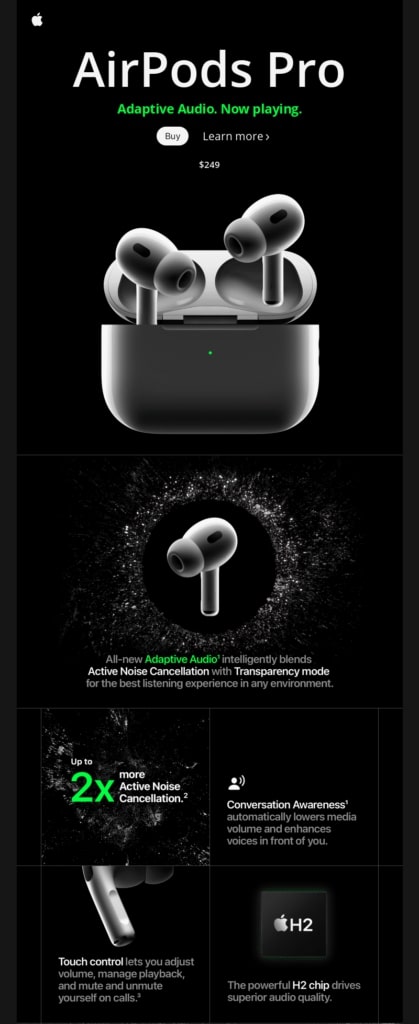
Apple AirPod Pro

Apple’s email product campaign for the launch of AirPods Pro earphones is in line with the brand’s style and visual characteristics. If you look at the image below, it is simple, predominantly monochrome, with a large, high-quality photo of a product that is dominating the main screen.

This email campaign has well-structured headings, which help readers to understand what exactly they are looking for.

Contrasting images of AirPods pop against the dark background is eye-popping and can grab users’ attention.

Also, the numerous calls-to-action, such as “Learn more”, “Buy”, may lead readers to visit their landing pages and enable users to make a purchase.

Apple AirPod Pro Email design

Source: https://venturestream.co.uk/blog/email-design-examples-the-brands-getting-it-right/

Great Jones’ Salt & Pepper

Great Jones’ is a company specializing in producing home products such as kitchen appliances and furniture. If you look at the image below, their Salt & Pepper product launch campaign completely relies on simplicity and attention-grabbing animation.

Great Jones’ email campaign is all about selling one product, which was displayed in the email template.

This makes their email campaign strikingly concise and direct.

Great Jones’ Salt & Pepper Email Design

Source: https://reallygoodemails.com/emails/salt-pepper

Frame.io

Another example in simplicity and direct marketing – is about a product launch email campaign during a conference conducted by Frame.io.

Using email design with a solid black background is very attractive and can grab the user’s attention

Also, they clearly mentioned their CTA as “Reserve Your Seat” for the conference related Final Cut Pro X Creative Summit.

Upselling Email Campaign Examples

Whenever a customer buys a product from a particular brand, it can send upsell campaigns to their customers. Hence, most of the businesses usually send upselling email campaigns that can steer the buyer’s attention towards more products that might interest them and buy.

Here are examples of best email designs used by a few brands for Upselling Email Campaigns:

Dollar Shave Club

Dollar Shave Club Email Design

Source: https://reallygoodemails.com/emails/where-did-you-go

With a carefully executed and beautifully crafted e-mail campaign, this beauty and personal care brand upsells its products based on its customers’ interests, as shown in the above email template.

The “Dollar Shave Club” campaign invites a consumer to add more items to their shopping cart before hitting the order button.

The email campaign portrays potential purchases in two columns, with a very striking contrast between the product and the background.

To grab users’ attention, they used vivid orange CTAs for “ADD” which are very visible and eye-popping.

WeTransfer

WeTransfer is a company specializing in File transfer services. It is trying to upsell its bandwidth package through a uniquely designed email campaign that markets the WeTransfer Plus package

With a perfect and concise email design, they opted to market their product with a magazine-style email campaign.

They used a lot of white space and a few vibrant colours to make their email campaign stand out.

Also, with a single call-to-action button, they are trying to invite readers to learn more about the package and make a well-informed purchasing decision.

Grammarly

Another example of an upselling-related Email Campaign is Grammarly. If you look at the email design below, created by Grammarly, which is very personable and attractive.

They mentioned “Highlights of Your Year” in the newsletter with yearly writing stats.

This creates an immediate effect of familiarity and reliability, along with a personalized touch.

Furthermore, their email campaign follows its brand’s style guidelines with clean white space and gentle, pastel colours.

Also, they mentioned the CTA button at the top of the newsletter, which invites them to upgrade to the Premium account.

Source: https://moosend.com/blog/email-marketing-examples/

Cart Abandonment Recovery Email Design Examples

Cart Abandonment is the most common scenario when it comes to e-commerce. Most of the customers visit an eStore, add an item or a few items into their cart, and then leave without completing the purchase. This leads to Card Abandonment. Here are some of the best examples of email marketing campaigns that remind customers about the items they have abandoned in their cart.

BluDot

 BlutDot is a company specializing in Home decor and furniture brands. It reminds their visitors of items they have viewed in their online store by sending them a very concise cart abandonment recovery email campaign.

To grab the attention of users, Bludot provided furniture images in a neutral colour along with simple lines, “Taking another look? We saved your items.” and CTA as “Complete my order.”

The email campaign is very precise about reminding their readers of the items they lookedat  and abandoned in their carts previously.

Just below the CTA, they provided the items with a direct Checkout button next to them.

Moschino

The cart abandonment recovery email campaign executed by Fashion and Apparel Brand – Moschino is quite interesting.

This email design features a black and white photo of a model with a caption “You left something behind” and a “Return to checkout” call-to-action – which is quite exciting.

Right under this large central part of an email, there is a list of items the user has left in their shopping carts.

Also, they included “Complete my order” button which enables readers to return and complete the purchase.

ASICS

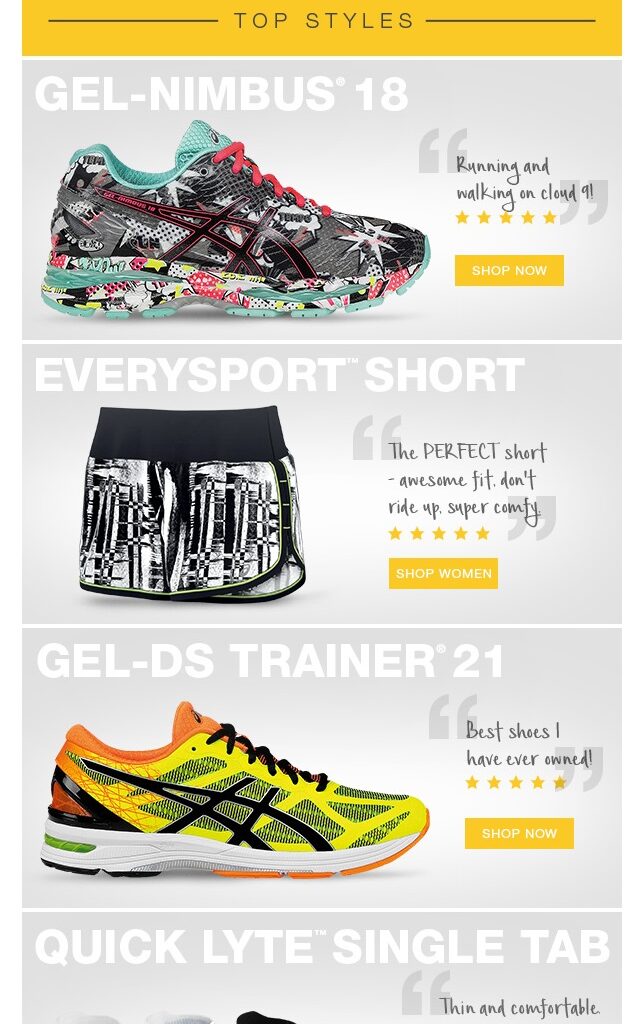
Here is one more example for Cart Abandonment Recovery email campaign executed by Exercise and fitness brand – ASICS. If you look at their email design mentioned below, they remind visitors who have looked at items in their store, placed them in a shopping cart and abandoned them.

ASICs cart abandonment recovery email campaign mainly highlights the product that has been viewed by the users who visit their website.
Also, they mentioned CTAs in an email that encourages them to complete the purchase.

Email design created by ASICS

Source: https://mailbakery.com/blog/examples-sport-retailers-emails/

Product Update Marketing Campaign Examples

Updates to the products or services help satisfy consumers and create more interest in those products. Marketing campaigns for product updates educate the subscribers about products and typically include a lot of information, both in copy and design. And here are some examples for Product Update Marketing Campaigns:

BluDot’s Stack’em Up

Home and decor brand Blu Dot’s “Stack ‘em up” product update email campaign is quite narrative as it incorporates design of their upgraded product as shown in the below image.

Checklist for Email Design Best Practices

A Complete Checklist for Email Design Best Practices

Although the marketing landscape changes at an incredibly fast pace, email marketing is still the most important and effective way to reach your targeted audience. When it comes to successful email marketing, you need to consider Email Design as one of the most underlying factors. Hence, it is essential for B2B marketers to adapt best practices in Email Design to increase more visibility, drive high sales conversion and get more business opportunities.

Before diving into Email Design Best Practices, let’s start with the basics!

What is Email Design?

Email design is a process of strategically designing and generating an email that resonates with your target audience, specifically your current email subscribers and clients. Hence, having a great email design is important as it engages your recipients and captures attention of your targeted audience.

When it comes to designing marketing emails, there is no magic formula that will get you impressive results all at once. But while setting up an email marketing campaign, the design of your email is definitely a significant aspect to consider. If your design does not relate to your email subscribers, then most of your emails get marked as spam, deleted, or completely ignored. To make sure your marketing emails are as effective as possible, you have to consider several different aspects of your email design carefully.

Checklink of of Email Design Best Practices

Use Interesting Subject Lines

Your email subject line should be something that grabs the attention of your subscribers and gets them interested enough to keep reading. Hence, make it relatively short but as informative as possible. The ideal email subject line should be a good, interesting summary that determines people what they can expect from reading your email in the fewest possible characters. Therefore, always aim to limit your email subject line to 50 characters or less. Here you can see average read rate of emails based on the length of subject lines.

If your subject line includes too many characters, it may get truncated in some of the email mailbox providers. Because of this, your email may lose its meaning and impact or even end up looking like funny or awkward at some instances. Hence, to make sure your message comes across all mailbox providers, you need to keep your subject lines relatively short.

Use Perfect Pre-Header

From a recipient’s point of view, pre header is the next thing they look after a subject line. Hence, it should be optimized for mobile, desktop, web mails as it’s the second most important thing readers make a decision to open & read the email further. It can provide useful context to the subject line and assist in increasing the open rates.

Here are the best practices for formatting a Pre-Header:

  • It should be concise and clearly convey the exact point.
  • Limit Pre-header length within 40-70 characters.
  • The Pre-header text and the subject line should complement each other for better performance.

Use Right Fonts

The fonts you choose in the emails can define the look and feel of your message. While there are hundreds and thousands of fonts available on the internet, not all of them will be the right fit for email communication. In general, you can use any font that fits your visual brand identity in static images and GIFs. But in text, you have to stick for system fonts and web fonts.

System fonts are the types of fonts that can be displayed on all devices or within any application. These include Georgia, Times New Roman, and Verdana.
Web fonts are widely supported, and can be rendered differently on your recipients’ device. These include: Roboto, Lato, and Montserrat.

Hence, it is highly recommended – either stick to system fonts, or use web fonts. Ideally, you have to use up to two different fonts while designing email templates – one for the header section and one for the main text and CTAs.

Use Mobile-Responsive Emails

With more than half of your recipients opening your emails on mobile, it’s essential to optimize your email design to work for both desktops and smartphones. You can optimize your emails for small screens by implementing these design best practices:

  • Implement a Minimalistic design
  • Don’t use complex headers, extra calls-to-action (CTAs), or clutter
  • Use a High-contrast design set at low brightness for mobile screens
  • Use a single-column layout
  • Place Easy-to-view content
  • Set mobile-friendly links
  • Keep Smaller image files

Incorporate Unique Visual Content

As most of the audience doesn’t show interest in reading lengthy promotional emails, make sure to use visual content that exposes your brand identity. Visual content plays a key role in attracting & converting prospects into customers. Hence, keep your customers interested in your message by incorporating images, videos, GIFs, animations, and more that resonate with your brand.

Here are some best practices on how to incorporate visual content:

  • Make sure that images and other graphics have excellent resolution
  • Use high-quality images to get a point across
  • Don’t use large image-sized files as they slow down your email’s load time
  • Also consider whether the images add something essential to your emails.

Personalization

When you customize an email and tailor it according to your recipient, it’ll feel more thoughtful, professional, and personal. Email personalization helps you foster a relationship between your business and customers, which eventually boosts retention rates. Here, in the following images, you can see how personalization increases open rates by 26% by grabbing users’ attention.

Personalization of email includes everything – right from the subscriber’s name to demographic, behavioral, and other contextual data. Adding the company’s name, last purchase, and other information in your email design helps you to personalize the email in the best possible way that aligns with each customer.

Use Right Tone That Aligns With Your Brand

When your email recipients clicks on your message, they should know that the email was sent from your company. So, it’s essential, the language and the voice you use in your emails can create a feeling and brand image that can make your emails stand out from your competitors. Hence, vary your tone depending on the subject of your email.

For example, if you’re sharing some news about your company’s biggest promotion, you can sound more excited than usual. But, note that your general voice should be consistent throughout your emails and other marketing materials as it matters most for your business.

Make Your Call-To-Actions (CTAs) Stand Out

As a B2B marketer, there will always be one goal behind sending emails to your targeted audience, whether it can be a sign-up for a new trial service or promoting a new product, or trying to sell older products as part of a clearance sale. You can make your marketing goal clear by incorporating CTAs within your email. Call-To-Actions are used to convert your email recipients into loyal customers.

In some instances, most of the audience may not find the Call-To-Action even when you include it in your email. Hence, always make sure the link you include in your CTA is visible and eye-popping. Also, you can use colorful buttons and bold text that can bring attention to your calls to action.

Bottom Line

With great email design, you can reach and resonate with your audience more effectively, helping you to grow better. Eye-catching and impactful emails will help you build long-lasting customer relationships and turn more individuals into paying consumers and brand advocates. So, start designing your emails while keeping this checklist aside.