Introduction
You’ve probably experienced frustration when attempting to sell an HR solution before. You write a compelling email; you create a massive list of prospects; you launch a campaign only to receive no response. The HR industry is one of the most saturated industries in B2B marketing, and it continues to get more competitive every year to find new customers.
The root cause of this issue isn’t necessarily the solution itself, but rather your target. A majority of marketers still use broad industry lists or simply search for job titles to find the “right” person at the “right” time. While this tactic may work at times, it leaves a huge amount of potential business untapped. What if there was a way to skip the guesswork altogether and go directly to the people who have experience using enterprise HR solutions? These are the people who are interested in improving their HR processes and systems.
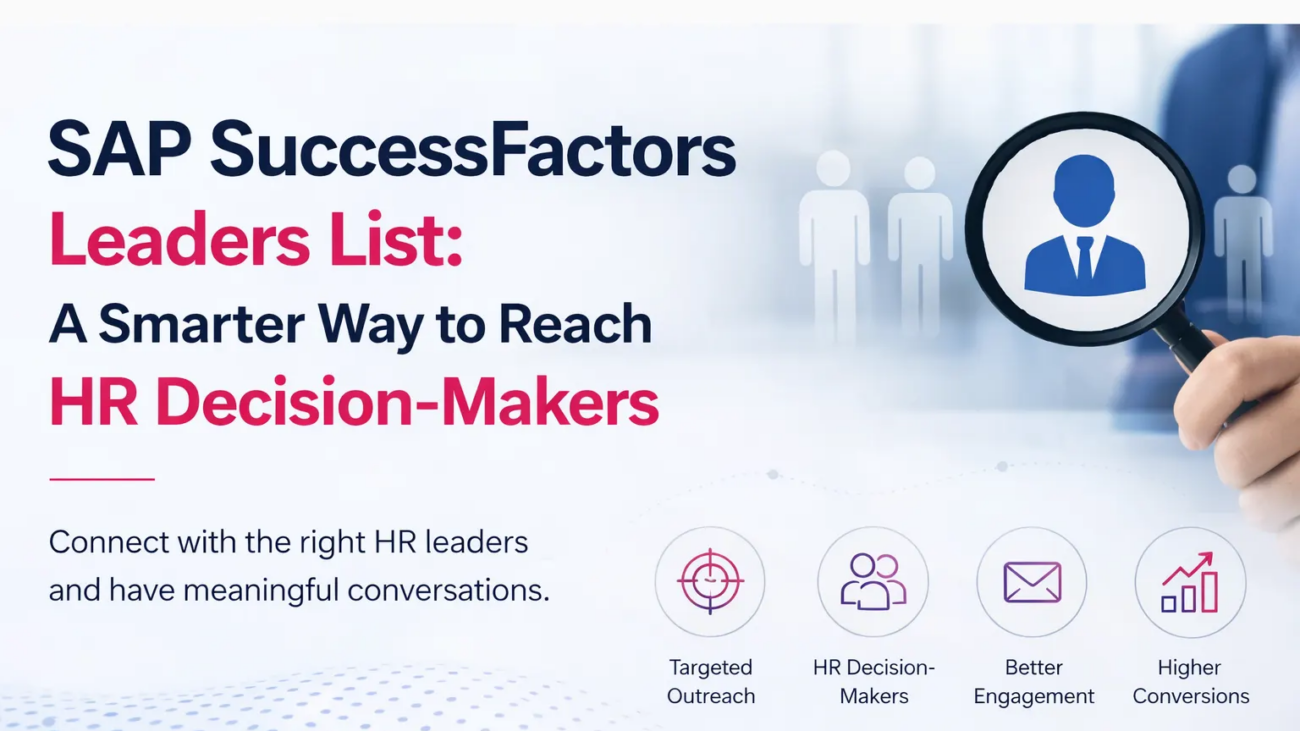
This is the reason why companies buy SAP SuccessFactors Users Lists. It provides a targeted, data-driven approach to reach HR decision-makers who do not merely have an affinity for your space, but rather actively have it in their daily work life.
A Quick Understanding on SAP SuccessFactors
Companies using SAP SuccessFactors are the largest and mid-sized organizations that are seeking a cloud-based solution to support their HR operations. Through its Employee Central module, customers can manage all elements of HR, including the following: the hiring process, developing talent, and managing employee learning.
Regardless of whether an organization is managing a workforce of 250 or 100,000 people, SAP SuccessFactors provides HR leaders with the data visibility, compliance coverage, and process structure to manage their modern workforce. Purchasing the platform demonstrates a company’s commitment to investing in long-term HR technology as well as providing insight into the company’s identity as a customer.
Who Actually Uses It?
SAP SuccessFactors is used by large corporations but would not be classified as an enterprise-only solution. The system is also being deployed by many rapidly growing medium-sized companies, global companies, and industries where the HR strategy plays a significant part in their overall business strategy (e.g., IT and software, healthcare, manufacturing, banking and financial services) all have a high level of dependence on SAP SuccessFactors to manage their workforce because of the complexity of managing their workforce, compliance, and the relationship of their workforce with their business’s success.
The types of people you will want to reach out to at these types of companies include HR Directors, Chief Human Resource Officers, Talent Acquisition Leaders, and HR Technology Managers. They are not just screening your inquiries but are active buyers with a budget allocation and specific objectives to improve how their organization manages their employees.
What exactly is an SAP SuccessFactors Users List?
In short, it is a database that is made of businesses that utilize SAP SuccessFactors and their decision-makers’ information. A quality list includes the following data: business name, industry, size, revenue; as well as the decision-makers’ first and last name, title, email address and in some instances telephone number.
The distinction between this database and a generic B2B mailing list is the underlying technology signal to which they are all committed; i.e., they all have made a decision to use enterprise HR software which enables you to understand their priorities, how comfortable they feel with their budget, and how open they are to HR-related discussions than any of the other data points you have might have.
Consequently, you are not cold-calling someone who has not previously had an interest in HR technology; instead, you are calling someone who has evaluated HR technology, has made a decision to utilize it, and has signed a contract with a vendor. Therefore, this provides you with a very different context for making your outreach.
The Real Benefits of The SAP SuccessFactors Users List
Using a verified list of SAP SuccessFactors users provides you with many benefits. You improve your targeted marketing because you identify and connect with the right HR professionals immediately instead of sifting through irrelevant information. You enhance your leads’ quality since they have all been developed based on context rather than chance.
You accelerate your sales pitches since you are dealing with people who already understand your language. You increase the return on investment from your campaigns, as more personalized, relevant information sent to a warmer audience will perform at a higher level.
The most important benefit of understanding a prospect’s technology stack allows you to perform large-scale personalization. You can provide further clarification on their platform, discuss potential integrations, and use your solution in conjunction with what the prospect currently utilizes and trusts.
Making the Most of the List
SAP SuccessFactors is a great tool to help you get in touch with your target audience, but having the right customer list is half the struggle. The combination of using email campaigns to target their current HR platform provides a higher engagement rate than just doing an email blast or sending out mass spam emails.
Connecting with HR leaders on LinkedIn is a perfect way to reach out directly and run targeted sponsored posts that would be relevant to them. If you are looking to target a specific account with a full Account-Based Marketing (ABM) strategy, the most successful way to do this is to coordinate your efforts between email marketing, LinkedIn, a strong piece of content, and a direct salesperson for those accounts.
When developing content for your target audience in HR, show them examples of the successful ways in which companies similar to theirs solved similar issues. By showing your audience, credibility will be established quickly.
You accelerate your sales pitches since you are dealing with people who already understand your language. You increase the return on investment from your campaigns as more personalized, relevant information sent to a warmer audience will perform at a higher level.
The most important benefit of understanding a prospect’s technology stack allows you to perform large-scale personalization. You can provide further clarification on their platform, discuss potential integrations, and use your solution in conjunction with what the prospect currently utilizes and trusts.
What Separates a Good List from a Bad One?
The quality of data from one supplier to the next may differ significantly. If you want to evaluate a list of SAP SuccessFactors users, look for suppliers who refresh their databases on a regular basis; provide GDPR-compliant records; and can be segmented by various attributes such as industry, geography, company size, or job function.
Validated contact information is extremely important as an email address or title which has gone “dark” (bounced back) is an inefficient use of your team’s time as well as making you appear less credible to your sender’s reputation as a sender.
Lastly, you should consider the ability to customize your list. The best data suppliers will offer to work with you in developing a list targeted to meet your specific needs as opposed to providing you with a generic export file.
An Honest Look at the Challenges
Every data-driven marketing strategy includes multiple points of friction within it, most commonly due to outdated records. Outdated records generally cause the greatest frustration in this industry due to the constant changes of roles within the workspace. Low engagement can occur from messaging turning repetitive and sounding too much like a sale. Also, compliance can become an issue when running campaigns targeting contacts or possible contacts in Europe or other regulated areas.
For most of these points of friction, there is a simple fix. You should partner with a reliable vendor, continually keep your records current, use different channels for each of your communications, and always focus on adding value to your audience without coming on too strong as a salesperson. Personalization is more than just “nice to have”; it is the key differentiation between campaigns that generate replies or are ignored.
Real World Cases
For example, a SaaS firm offering workforce analytics that originally planned to contact general HR was able to run a targeted campaign aimed exclusively at SAP SuccessFactors users. They put the product into context to build a conversation around what the product would allow them to do with their current HR data, making it easier for their target audience to see the value in the product.
Also, consider an example of a staffing agency trying to grow its client list by reaching out to HR leaders at companies already using workforce management systems. This strategy allows the agency to contact organizations already thinking about talent management rather than trying to move those not currently engaged in that thought process.
This could be done in the same way for HR technology vendors, implementation consultants, and training providers. Not only does the list provide the needed contacts, but it also provides context for those contacts so that outreach efforts can be successful.
Conclusion:
Broad-based marketing for HR typically costs a lot of money and it is getting less effective than it used to be. The SAP SuccessFactors Users List not only provides you with a large list of contacts, but it also provides you with an audience of HR decision-makers who have been through the process and have expressed their interest in your products or services.
If your products or services fit into the HR technology space, then you should consider starting with a sales pitch.