About the Client
The client is a North American Series B B2B SaaS company generating $15M ARR that offers workflow management and process automation to mid-market operations and IT teams. In addition to digital inbound channels, the company has an internal 8-person Sales Development Representative (SDR) team to create pipelines within target mid-market accounts.
The SDR team had problems with the quality of its lists of prospects. Outbound campaigns were based on an unmaintained internal database that had been built over the previous two years that consisted of trade show attendees, web downloads, and legacy directories. Current decision-makers’ direct contact information was outdated, and the database did not include hygiene or technographic qualification of accounts.
The Challenge
Outbound sales efficiency deteriorated due to poor data hygiene. Reps spent considerable time handling delivery failures, researching departed employees, and manually validating phone numbers.
Pre-LogiChannel Baseline: 90-Day Outbound Performance (Before Engagement)
To fairly evaluate performance, the outbound unit’s metrics were measured over the 90 days of operation:
- Total Contacts Attempted: 3,600 contacts in 90 days averaging 1,200 contacts per month.
- Successfully Delivered Emails: 2,376 representing a 66.0% deliverability rate with a 34.0% bounce and non-delivery rate.
- Interested Responses: 72 which is 3.03% of the delivered emails.
- Discovery Meetings Completed: 28 total (average 9.3 meetings per month; 0.78% contact-to-meeting rate).
- Sales Qualified Opportunities (SQOs): 10 total (average 3.3 SQOs per month; 35.7% meeting-to-SQO conversion rate).
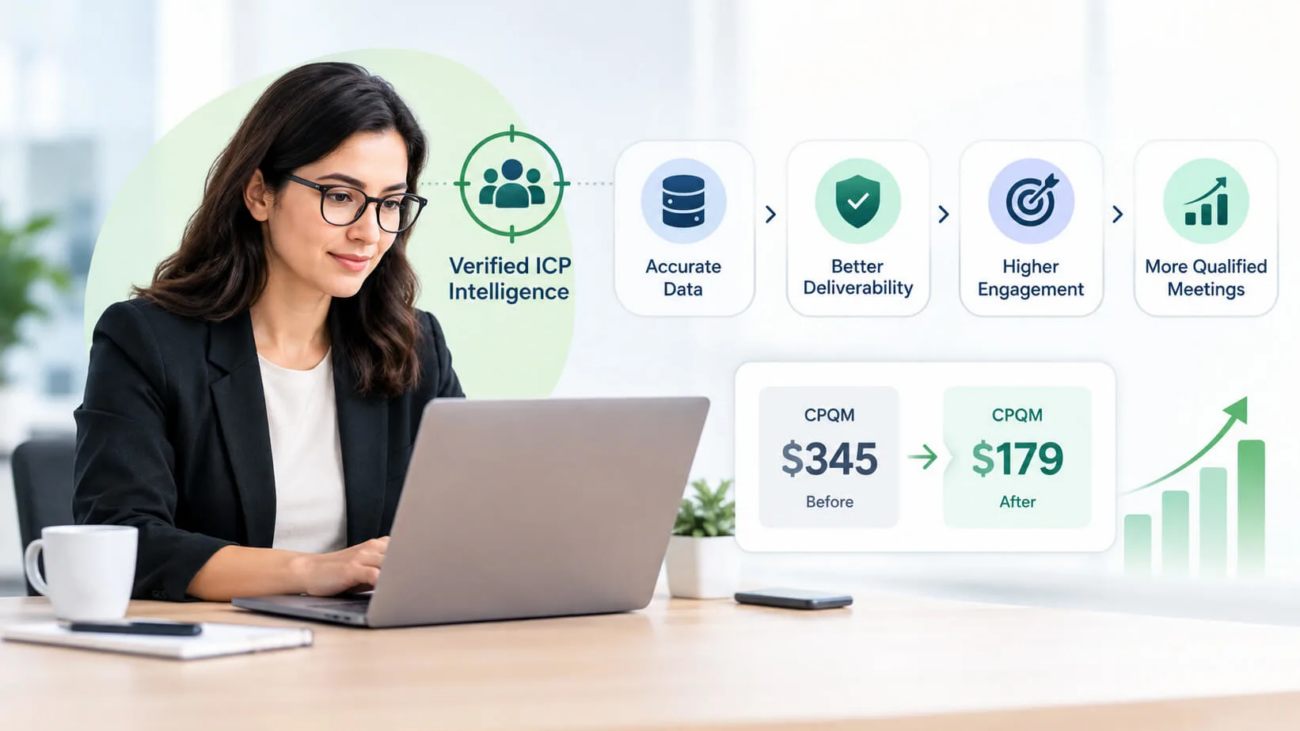
- Cost Per Qualified Meeting (CPQM): $345.00 (Calculated as outbound data subscriptions, scrubbing overhead, and sequencing software allocation per completed discovery meeting).
Key Operational Issues:
- Elevated Non-Delivery Rate: A 34% bounce and failure rate hindered outbound velocity and triggered sender domain reputation warnings.
- Technographic Incompatibility: Outreach reached organizations operating on incompatible legacy IT architectures, resulting in early demo drop-offs.
- Elevated Acquisition Costs: High contact failure rates and low meeting volume drove CPQM to an unsustainable $345.00.
The Solution: 3-Phase Data Intelligence & Advisory Engagement
The purpose of tracking these metrics was to understand whether the campaign was producing better prospects and better conversion performance, rather than simply increasing database size.
Phase 1: Rapid Diagnostics & Full Database Delivery (Days 1–5)
LogiChannel fulfilled the core data requirement on an expedited 5-business-day turnaround:
- Days 1–2 (Audit & Hygiene Diagnostics): Audited a 1,500-contact sample from the client’s CRM, isolating a 34% delivery failure rate caused by obsolete email domains and departed personnel.
- Days 3–4 (Technographic & ICP Calibration): Screened target accounts between 150–2,000 employees with confirmed installations of compatible software (Salesforce, Workday, Jira), appending direct dials and primary corporate emails verified via live SMTP handshakes.
- Day 5 (Full Delivery Hand-Off): Delivered all 3,500 verified, CRM-ready decision-maker contacts to the client’s sales operations team.
Phase 2: Sales Enablement & Account-Level Segmentation (Days 6–45)
During the first roll-out by the client’s own SDRs (3,500 records):
- Persona-to-Tech Alignment: The client’s sales leadership received technographic tags for use by SDRs so that they could customize the messaging of their outreach based on the prospects’ current software stack.
- Deliverability Monitoring: Tracked bounce telemetry for initial sends, confirming a 97.2% deliverability rate across automated sequences.
Phase 3: Telemetry Feedback & Segment Optimization (Days 46–90)
At the campaign’s midpoint, LogiChannel reviewed engagement patterns with the client’s sales management:
- Response Rate Analysis: Evaluated reply data across sectors, identifying that Fintech and Logistics accounts converted at higher rates than more regulated niches.
- Segment Refinement: Recommended reallocating rep bandwidth toward high-response verticals, supporting the team in achieving a final 1.09% contact-to-meeting conversion rate (38 completed discovery calls).
The Results: Documented Outbound Performance
Comparing the 90-day campaign against the client’s equivalent 90-day baseline demonstrates measurable efficiency gains across the outbound funnel:
| Funnel Metric | 90-Day Baseline(Pre-LogiChannel) | 90-Day Campaign (With LogiChannel) | Variance / Absolute Change | Relative Impact |
|---|---|---|---|---|
| Contacts Attempted | 3,600 | 3,500 | -100 contacts | More targeted prospect cohort |
| Email Deliverability Rate | 66.0% (2,376 delivered) | 97.2% (3,402 delivered) | +31.2 percentage points | Substantial deliverability improvement |
| Interested Responses | 72 | 118 | +46 replies | +63.9% increase in replies |
| Reply Rate (on Delivered) | 3.03% | 3.47% | +0.44 percentage points | Improved messaging relevance |
| Discovery Meetings Completed | 28 (9.3 / month) | 38 (12.7 / month) | +10 meetings | +35.7% meeting volume lift |
| Contact-to-Meeting Rate | 0.78% (28 / 3,600) | 1.09% (38 / 3,500) | +0.31 percentage points | +39.7% efficiency gain |
| Reply-to-Meeting Conversion | 38.9% (28 / 72) | 32.2% (38 / 118) | -6.7 percentage points | Stricter meeting qualification criteria |
| Sales Qualified Opportunities (SQOs) | 10 (3.3 / month) | 16 (5.3 / month) | +6 SQOs | +60.0% pipeline addition |
| Meeting-to-SQO Conversion | 35.7% (10 / 28) | 42.1% (16 / 38) | +6.4 percentage points | Improved technology-fit qualification |
| Cost Per Qualified Meeting(CPQM) | $345.00 | $110.00 | -$235.00 | -68.1% cost reduction |
Factual Business Observations:
- Pipeline Growth Enabled by Deliverability Gains: An increase in deliverability of 31.2 percentage points helped to increase outreach to the intended inboxes and helped to grow the number of discovery meetings completed by 35.7% over the last 90 days.
- Securing 38 discovery meetings from 3,500 targeted contacts (1.09%) reflects dependable mid-market B2B outbound performance.
- Technographic Filtering Improved Account Relevance: By confirming software compatibility before outreach and narrowing technical discrepancies discovered during demos, the meeting-to-SQO ratio improved to 42.1% (compared to 35.7% at baseline).
- Cost Per Meeting Down 68.1%: Due to elimination of wasted prospecting hours and increase in meeting yield from target accounts, the allocated data cost per completed discovery meeting went from $345.00 to $110.00.
The client’s Revenue Operations team noted that receiving the fully verified 3,500-record dataset within 5 business days allowed their SDR team to launch targeted cadences without delay. Transitioning from unmaintained internal lists to verified, ethnographically segmented data helped the team increase completed discovery calls from 28 to 38 across a 90-day period, while reducing their allocated cost per qualified meeting by 68.1% (from $345 down to $110).
About LogiChannel
LogiChannel provides verified B2B contact databases, technographic market intelligence, and customized data enrichment services. By combining firmographic segmentation with verified technology user tracking, LogiChannel assists B2B revenue teams in reducing contact data decay, optimizing SDR workflow efficiency, and improving outbound campaign consistency.
Evaluate Your Outbound Data Quality
Identify invalid contact records and discover verified decision-makers within your target market