sales Growth

10 Proven B2B Sales Strategies for Building A Better Sales Pipeline

They say “Change is the only thing which never changes”. It is applicable to sales.B2B sales also changed over the years. Visualizing the B2B sales funnel is a baseline for growing any business.  Hence it is a proven method that sales pipeline is a crucial role for any business to be successful. So what keeps you ahead of your competitor is consistent review meetings &follows up on leads in sales pipelines.  And the advent of the internet connected us digitally led to sales teams being more data-driven.

So what is Sales Pipeline?

A sales pipeline gives virtual representation or a simplified structure of potential buyers at every stage of the buying prospect in the sales process. The sales pipeline is often divided into various stages of a company’s sales process as shown in the above figure. This depicts the movement of customers at each stage of the sales process & gives clear clarity on how the prospect is qualified. This virtual presentation gives sales person crystal clear idea to analyze where money, deals & other efforts are available with respect to prospects. More importantly, sales managers can dwell on data to understand how well their sales process is working & keeping track of their progress to get maximum ROI.

Here are few things which need to be considered to build your own sales pipeline

  1. Getting the list of prospect buyers
  2. Progress on your sales process
  3. Revenue targets

Getting The List of Prospects:

The first & foremost thing is getting a potential list of buyers who want to buy from you. This list should be detailed & it should be able to give complete details. This stage holds active information such as names, contact information, company, position, communication channel & more who can get in touch with you & liked to be interested in your product or services. So when you have all the basic details you can try to establish a business conversation & establish a sales pipeline that helps reps to keep track of their progress.

Sales Process:

A Sales Process is the complete guide that is clear & structured to exactly guide you on what activities are required to close a deal. When you have a well-established sales process, reps can easily win deals with formulating procedures & policies.

Revenue Targets:

Your sales pipeline is a tool to meet your revenue goals which allow you to design a successful pipeline to fulfill your business goals. This will help you to ensure how many deals are required to make your objective? How many of your leads come into the final stages of the pipeline & how many deals are getting closed & more.

What Are The Benefits of Having a Sales Pipeline?

  • Easily track all your leads
  • Predictive revenue
  • Establishing integrated & marketing strategy
  • Ensuring Systematic growth
  • Helps you to monitor teams progress
  • Improves total sales volume & revenue
  • Gives a more accurate forecast

Why Sales Pipeline is Important?

Sales pipeline plays a crucial role in identifying & closing potential deals well suited for your company in aligning with your objective.  This is directly proportional to effective management of leads & improving growth. Additionally, companies that have a well-defined sales process evaluate & improve the process. With the focused allocation of available resources, you can connect with prospects at each sales pipeline & take a further step closer to create a closed-won opportunity. It paves the way to examine your sales strategy planned for the whole year.

In general, the sales pipeline can be divided into different levels, such as Top funnels, middle funnels& Bottom funnels. The top of the funnel is considered as the initial phase of nurturing which consists of blog contents, Infographics & more. Middle of the funnel considered as post initial phase of nurturing which consist of research reports, case studies, podcast & more. The bottom of the funnel is considered as the final phase of nurturing which is used to convert leads from the opportunity to the close phase.

Establish An Effective B2B Sales Pipeline for The Best Outcome:

Building a strong foundation:

Having a good selling base is essential for any B2B sales. This comprises of 3 P’s Product, Person & Pitch.

You must be well known to tackle all questions & answers relating to your product & services with full confidence. This enables you to establish a sales conversation with a prospective customer without any delay. Similarly, a good salesperson knows in & out about your product. This helps them to connect with the right prospect in an efficient manner through the direct pitch.

Determine your Sales pipeline Stages:

Any company would love to bombard your sales pipeline with fresh contacts. This complete sales process goes through various processes in deciding buying decisions. And this also differs from company to company. Based on your company goals & objectives this sales pipeline keeps on growing.

Classify your prospects:

Improve the chances of conversions with the crucial segmentation of your prospects.  Grouping of prospects can be based on several prospects such as demographics, Behavioral, Geographic & more.

Demographics segmentation allows you to group leads based on factors like age, gender, income & more

Behavioral segmentation classifies leads based on factors such as buying patterns, brand patterns & frequency.

Grouping leads based on the location where they live helps you to understand their values & preferences.

Approach your audience with a clear pitch:

As a salesperson, it is important to present, explore & appreciate specific components of the solution before approaching the target audience. With the help of additional technographic information, tools & technologies you can understand better & act accordingly.

Create a follow-up plan with Lead Scoring Metrics:

This may be quite hectic for many salespeople. But yes creating a perfect follow-up plan might be the topmost priority job of any business.  Whenever half of the salesperson doesn’t follow up it may end up missing some opportunities to close a business deal. Always following up with a lead after the first approach is a good move. Being consistent touch tells them how you value them & it is the perfect way to get attention.

Prioritize leads by establishing best practices for scoring. Lead scoring can be one of the smart mechanisms to assign lead points based on key attributes. The calculated score will be evaluated based on various attributes is associated with the lead’s engagement ratio.

Develop a Lead Nurturing plan:

The ideal business will generate an enormous amount of leads & not necessary that all loads must be converted. If you approach them today, there is a high possibility for them to become your client. Hence this process must be well established across organizations to make sure every company has its own lead nurturing plan or process to grow up on the sales ladder. Being in touch with the leads will help you to build key business relationships.

Benefits of Lead nurturing plan:

  • High-quality leads are generated
  • Improves customer base
  • Reduces customer acquisition cost
  • It helps you to maintain & grow the relationship
  • Bring new sales opportunities

Identify & Track key metrics:

Metrics help you to get most of the information about prospects & track them to show significant growth over the period. Below are few metrics which can be used effectively to win the battle against any prospects with proper planning.

  • Average time spent on each stage of lead.
  • Cost per opportunity
  • The average return on Investment
  • Amount of deals closed
  • Lead conversion rate

Account-Based Marketing:

It is a proven myth that your prospect or lead can determine how good you are at sales.  Instead of generating leads in every industry, you cater for. You can formulate an approach to pick account-based market tracking. This will fine-tune your sales strategies & generate good ROI in return. Account-based marketing helps to bind contact associated with that particular account in an effortless manner. This can be one of the key metrics in monitoring or establishing account & contact-based sales metrics.

Optimize your funnel:

In today’s fast-moving world, leads are exposed to a variety of content that differs from a landing page, blog post, social media clips, Infographics & more. Hence it is important to identify which buyer persona is really interested in your product or services. As the sales funnel narrows down it becomes easy for B2B marketers to provide better information about the prospect and their interests.

Refine Your Sales Process:

Ask yourself better questions to bring more sales than you’ve ever dreamed of. First, you need to evaluate your current process & find out which channel will produce quality leads for you. Take a close look at successful deals that have been closed so far. And analyze how they are different from each other. And the internet has made it incredibly easy for everyone to build their personal brand & engage with their peers & prospects through insightful content.

Use LinkedIn for prospecting:

LinkedIn is one of the well-established platforms to connect with prospects across the globe. It can be used as one of the excellent resources for networking & research. This can be used efficiently to identify prospects based on company, location, industry & more. Alternately, it can be one platform specifically to engage with thought leaders in the industries that are looking for your product or services.

Conclusion:

The heart of any sales cycle is the sales pipeline. This helps any sales team in starting the sales process, monitoring, managing the flow to check if the process is moving in the right direction.  This guide from Logichannel will help you in building the sales pipeline which can be used to start your sales cycle & manage it effectively. Build a strong pipeline to jump-start the top of the funnel & close deals effectively. Logichannel always delivers unique cost-effective strategies & ideas when it comes to building effective B2B sales strategies.

neuromarketing

What is NeuroMarketing? How Modern Marketers Can Use It to Trigger Sales

Companies must invest investments in innovative strategies to engage customers and strengthen their brand if they want to be competitive and relevant in their sector. The same principle also holds true for moving companies that desire to develop and grow. But did you know that customers define their requirements and wants subconsciously based on what appeals to them in their daily lives? Based on this idea, they determine what they do and how much they are willing to spend on various goods. Nowadays, advertisers and marketers are more interested in strategies that will produce greater results with less and less money.

In order to fill that demand, neuromarketing has come in and proved successful. You can use neuromarketing to better understand how your clients’ brains function and how your marketing techniques will influence them. Using neuromarketing, businesses and marketers have developed smarter, better marketing tactics that will produce fantastic results and effectively support their initiatives. Regardless of your familiarity with the word, you’ve definitely read about or heard about some of the insights marketers have gained from neuromarketing by now. However, what exactly is neuromarketing and how much do you really need to know about it?

This article provides a comprehensive overview of neuromarketing and explains how to integrate it into your marketing plan.

What is Neuromarketing?

neoMarketing

Neuromarketing, often known as consumer neuroscience, is the study of the human mind to more correctly foresee and maybe even affect consumers’ cognition and behavior. Neuromarketing is a discipline with fifteen years’ worth of recent studies to illustrate its potential for marketing campaigns, not merely a catchy moniker that a particularly astute salesperson developed. Although it is acceptable to provide a quick theory explanation, the best way to understand any special skill is through practice.

Additionally, it is a current marketing trend to examine how the brain reacts to marketing stimuli using medical technology like functional magnetic resonance imaging (MRI). This marketing tactic aids in the identification of decision-making processes in the brain and their causes in consumers. Applying neuromarketing tactics to your company is one of the simplest and most efficient ways to understand and learn about the behavior of your customers. The traditional customer survey was defeated by neuromarketing methods. With the help of technology, you can identify the parts of your consumers’ brains that are active during the decision-making process and during the actual purchase.

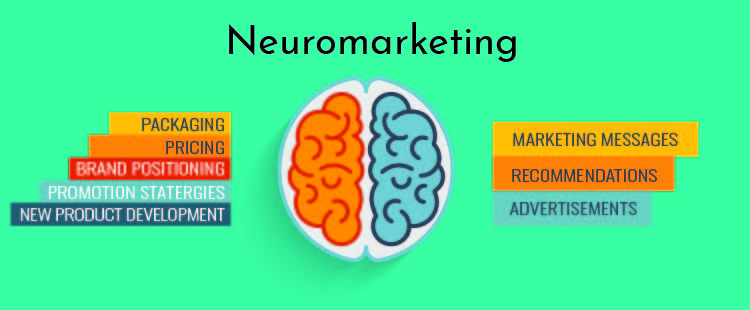
Utilizing the understanding of neurology, the neuromarketing approach identifies the needs, interests, and aspirations of your customers. Customers’ subconscious responses to certain marketing messages, advertisements, packaging, and recommendations are the subject of neuromarketing research. All of the information is done to create marketing campaigns and plans that are successful and efficient and appeal to your target demographic. Neuromarketing is a young and developing field of study that can assist marketers in better understanding consumer behavior to:

  • Packaging
  • Pricing
  • Brand positioning
  • Promotion strategies
  • New product development

Traditional and neuromarketing research can help us understand how people think and act, both consciously and unconsciously. Future research should yield more trustworthy outcomes as neuromarketing science advances.

The information from both sources must always be used intelligently and strategically, taking into account the specific target market, products, and objectives of each organization. In order to determine what is truly effective, it will also be necessary to test out best practices in particular circumstances.

How Modern Marketers Can Use NeuroMarketing to Trigger Sales?

neoMarketing

Targeting customer attraction, appeal, satisfaction, and retention is the focus of Neuromarketing. It appeals to clients’ emotions to elicit a favorable response. When executed well, your brand becomes instantly recognizable and you are more likely to gain their loyalty. So how do you profit from this?

Here are some crucial marketing factors influenced by Neuromarketing to address that:

Brand Positioning

It takes more than just putting a product on display and flaunting it to position a business for success. As a marketer, you must use emotional branding and marketing to create a strong brand identity. This implies going beyond the obvious when developing and positioning your brand.

With the aid of Neuromarketing, you may concentrate on learning how the brain reacts to various stimuli. That information can be used to create a plan that will enhance consumer satisfaction or increase brand recognition. It aids in the efficient creation of goods, services, logos, and marketing campaigns that resonate with the correct target market.

Advertising

It goes without saying that how an advertisement is presented greatly influences the consumer’s choice. The ventromedial prefrontal cortex and ventral striatum, which are in charge of emotions in the decision-making process and the cognition of rewards, are activated by attractive commercials, claims a study.

So it is feasible to determine whether or whether an advertisement is seen as attractive by using Neuromarketing techniques and thereby determine its effectiveness. Testing multiple appealing iterations of an advertisement to see which one has the best response may also be helpful.

Consumer Buying Behavior

neoMarketing

The brain is in charge of all of our purchasing habits. To forecast or affect consumer behavior, a marketer must first have a thorough understanding of how the brain functions. Understanding and modeling consumers’ cognitive reactions to marketing messages have long been a methodological difficulty since emotions are potent mediators of how consumers receive messages. Neuromarketing can help you understand the thought processes that lead to the choices that customers make while making purchases. From there, you can successfully alter the positioning of your goods and services.

Pricing

A persistent and divisive issue is how to set product prices in a way that tempts customers. Fixing prices is one of the appearances in marketing that matters most. Pricing actually plays a significant role in how a product is presented to consumers and how it looks. In other words, whether a consumer sees the price or the product first affects their decision-making process.

Because of this, applying Neuromarketing approaches can be useful in figuring out consumers’ willingness to pay (and price elasticity), enabling you to alter pricing accordingly. For instance, one exciting new finding used by Neuromarketers is that more complex numbers perform better with emotional decision-making whereas rounder figures are more likely to function with them.

Product Design and Packaging

While marketing is undoubtedly essential for influencing consumer behavior, product design can also play a significant role. Brand value can be elevated to a completely new level by attractive packaging and aesthetic appeal. Thus, it is simple to apply Neuromarketing research methods to the process of product design and packaging.

You may revitalize both product and packaging design by employing this strategy. You can determine which brain regions are active when particular brands are shown by using techniques like fMRI, EEG, or any other Neuromarketing approach.

Website Layouts

It’s true what you just read! Website design is being influenced by Neuromarketing strategies as well. Neuromarketers are researching how humans like websites in terms of color schemes, layouts, text size, and more. When building websites, there are now certain clear guidelines to follow. The use of social media widgets, endorsements, and certifications, for instance, will undoubtedly increase client attraction.

By utilizing particular cognitive biases in the layout and content of the website, Neuromarketing in web design seeks to enhance conversion rates and the proportion of visitors who engage with the message. Therefore, you can take use of this to significantly impact the situation!

Conclusion

Today, cutting through the clutter is a problem of growing concern, and marketing professionals are constantly seeking a competitive advantage. Grasp a consumer’s purchasing behavior requires an understanding of the most basic components of human emotion.

Neuromarketing has the advantage of being applicable to both inbound and outbound marketing methods. From providing a warm beverage and a comfortable seat during a sales session to using baby photos in advertisements. These are all techniques to which our brain reacts unconsciously.

Data Appending Solution

10 Actionable Tips For Running Successful Email Marketing Campaigns

Whenever you want to communicate something about your brand or sell your products & services, email marketing is one of the most cost-effective ways to do so. As email gives a direct line of communication with your audience, it has become one of the best ways to promote all other marketing strategies. In terms of ROI and Sales also, email marketing campaigns help generate more sales than other digital channels as shown in the following figure.

For every $1 you spend on email marketing, you can able to generate $40 in return. To get the most out of your email marketing strategies, you have to go beyond just sending several emails to your list. For that, you have to take the right steps to make your email marketing campaigns stand out from the rest.

To maximize the potential of email marketing for your business, here we are providing ten essential tips to run a successful email campaign.

Know Your Target Audience

Know Your Target Audience

To be successful with email marketing, it is crucial to know about your target audience along with their interests and challenges. This also suggests that sending the same email content to the entire mailing list is not successful as multiple audiences have different interests. Therefore, make sure that you have ample data on your target audience and how best you can reach them.

The goal of email marketing is to nurture and build relationships with your audience based on the information they would like to have from your company. In recent researches, it was found that emails relevant to the recipient tend to drive 18 times more revenue when compared to general emails. Hence, implementing a targeted approach can definitely make a difference.

Segmentation

As a marketer, you should understand that not all customers are interested in all of your marketing emails. Hence, you must segment your email list based on the audience’s purchase history, location, and interests. This makes segmentation one of the essential elements that help increase the response rate for your email campaigns. Segmentation is all about dividing your email list into smaller, more targeted sub-groups. Here, in this picture, you can see on what basis you can segment your customers’ database.

Segmenting your customer list will let you target your consumers based on their personal preferences. Also, it enables you to promote your products or services in a personalized manner.

Here are some of the positive outcomes you can expect from customer database segmentation:

Customer database segmentation allows your marketing teams to send the right email to the right person at the right time. Furthermore, it allows your emails to stay relevant and gives you a chance to understand the needs of your customers. So, you can offer specific products that are actually needed by your customers.

Enhance The Response Rate Of Your Email Campaign With Well-segmented Data

Personalization

Personalization

Your email marketing strategies work well when it comes to creating a unique experience for your prospects. By leveraging the power of personalization, you can make your customers feel exclusive or unique, which ultimately leads to sales conversion. According to the email marketing company “Campaign Monitor”, emails with a personalized subject line are 26% more likely to be opened than emails with a generic, non-personalized subject line. Here, you can view some interesting facts about personalization in the following figure.

So if you have access to your email recipient’s first name, it makes sense to use it in both the subject line and in the body of the email. To give a personalized touch, you can also go about asking simple and appropriate questions in the email. As a B2B marketer, you should recognize the significance of adding a personal touch to your email marketing, as it has a direct impact on the number of conversions you get.

A/B Testing

Running an A/B test is one of the best email marketing practices as it generates good results. The only strategy that eliminates guesswork from your email marketing is A/B testing and gives you a road map of what modifications you need to make. Here, you can see the significance of A/B testing in the following image.

A/B split testing is nothing more than a way of splitting your email audience into different segments or classes and figuring out which version of your email offers the best conversion performance. By testing out different versions of your emails, you’ll be able to optimize your overall campaign and get better results.

Provide a Dedicated Landing Page for Your Campaign

Most of the time your subscribers visit your homepage, product page or specific landing page through email. To get good conversions and the best return on your investment, it is always recommended to create a dedicated landing page and direct your email traffic to it. A dedicated landing page is much more relevant and targeted, which makes your email campaign really effective.

Keep Your Layout Simple & Short

Don’t overload your email layout with flashy graphics, huge fonts and other elements. It is always crucial to keep your email layout clean and simple. Maintain your email layout look like a professional and easy to navigate as complex email layouts will turn your recipients off and enables them to throw off your email campaign or newsletter right into the trash file. To increase your chances of getting responses from customers, you have to stay concise and clear.

Hence, it is important to keep your content shortly and clearly so that they can easily take action. To keep your messages simple & short, it can be smart to use bullet points. Also, be sure to stick to a clear call-to-action (CTA) as it conveys the information in a way that makes your email recipients want to click through to your website to learn more.

Use Scannable Content

Use Scannable Content

When it comes to rolling out effective email marketing campaigns, your email structure needs to have scannable content. In other words, you need to keep your email layout with short paragraphs, effective subheadings along with any mentionable facts. That’s how you can get the undivided attention of your prospects and increase your chances of converting them through your email campaigns. Here, in this image – you can see how scannable content enhances readability while comparing with paragraph blocks.

When compared to paragraph blocks, scannable content is more readable which can indirectly improve your reader’s experience and leads to better sales in the longer run. For this, you can use several email service providers such as MailChimp, AWeber, ConstantContact, GetResponse and more. Also, you can consider the checking of HTML version of your email before sending them out.

Use Mobile-Responsive Designs

If your emails are not optimized for mobile devices, it’s possible that your message won’t get the attention it deserves. The most important factor for effective mobile email marketing is mobile-friendly design. In fact, according to Blue Hornet, 80 per cent of users would delete an email if it does not look good on their mobile devices.

Clean Your Email Lists

You need to clean the bad email addresses in your list as it will impact your credibility and your overall deliverability to get good results from email marketing. Most of the marketers only concentrate on expanding their email list while ignoring the reach of their email campaigns.

Hence, don’t invest all your time and resources in trying to get more individuals on your list, instead of that, steer some of your resources to hit your subscribers’ inboxes.

Pay Attention to Your Metrics

One of the major keys to improving the effectiveness of your email marketing campaigns is to analyze the results of your each email marketing campaign. Here are some of the most useful metrics you need to monitor for email marketing performance:

To optimize your email campaigns for success, monitoring open rates, click-through, conversions, and other significant variables help you to derive a clear picture on what needs to be corrected, changed, and/or eliminated within your email marketing strategies.

Final Thoughts

Email marketing is a process which takes time to get successful outcomes, but it is worth spending time and working on. Not only it is a perfect way to connect and keep your clients updated, but statistics show that email marketing provides marketers with the highest ROI.

As a marketer, if you are trying to make most out of your email marketing campaigns, don’t forget to pay attention to the above-mentioned email marketing tips!

lead Generation

Lead Generation Strategies For SaaS Companies

A software-as-a-service company understands how difficult it is to create leads and then convert them. To generate leads, businesses can use a variety of marketing methods; however, not every strategy is appropriate for all types of enterprises. When it comes to customer acquisition for SaaS enterprises, a fresh set of marketing methods is necessary.

With 85 percent of marketers prioritizing lead generation and sales as their primary aim, SaaS marketers spend an absurd amount of time developing content and then marketing it. The reason for this is fierce competition and the need for a steady stream of leads to stay in business.

What is SaaS Lead Generation?

In simple terms, it’s the process by which SaaS companies create a list of people or organisations who are interested in their software. The list could be an email list, a social media audience, or a phone list of ready-to-call sales leads. They may not be ready to purchase right now, but the lead you produce may be interested in a SaaS solution in the near future.

If you’re a B2B SaaS marketer planning for 2023, we hope this roundup of B2B lead generation best practices is useful.

Start With Content Marketing

In the SaaS industry, content marketing is the most effective strategy for attracting customers, engaging with them, and eventually converting them into leads. Content marketing is used by brands all over the world to build their brand, attract visitors, and, of course, convert them into leads.

PPC may bring fast results, but they are limited to the amount of time you spend on it, whereas content marketing benefits you in the long run without costing you anything. According to statistics, 61% of people say that reading a blog has influenced their decision to purchase a product or service. Content marketing, on the other hand, isn’t only about writing blogs and advertising them; it may also include making videos, infographics, or anything that can entertain or educate your audience.

Implement SEO Strategies

An SEO strategy isn’t effective without a content marketing strategy. Search engine optimisation, or SEO, is a back-end technique that determines where your content appears on search engine results pages. But why do you need it in the first place? According to statistics, Google receives over 6.3 billion searches each month, with the first five organic results receiving 67 percent of all clicks. While pay-per-click advertising is an effective marketing approach, the majority of searchers ignore the ads on the SERP.

To keep ahead of the competition and reach out to potential clients, you must present your company in front of them, which is where SEO comes in. There are two types of SEO:

On-Page SEO: You have full control over the SEO aspect. Keyword strategy, internal linking, meta description, title use, website UI, and page load time are all examples of on-page SEO.

Off-Page SEO: The links you create from other related websites are referred to as off-page SEO. However, it’s not just about the number of links you create; it’s also about their quality. Aside from that, social media is important because influencer shares and likes represent the content’s quality.

Use LinkedIn To Connect & Interact

LinkedIn can be a lead generation powerhouse for you if you’re in the B2B SaaS business. According to statistics, B2B marketers use LinkedIn to distribute their content in a remarkable 94% of cases. Begin by providing relevant content on LinkedIn Pulse, then cultivate a specific audience and engage with them regularly. This engagement will foster trust between you and your audience, which will eventually lead to consumers purchasing your product or service.

Provide Free Trials

Apparently, this is the most common lead generation strategy utilised by SaaS companies. After all, “test drives” help customers to determine whether or not your product is a good fit for them. That is why you should make a trial version available on your website for potential clients.

A trial version is an excellent lead grabber, especially for companies that cater to a tech-savvy demographic. Before making a purchase choice, your potential customers want to experience the goods. However, before you can persuade individuals to try your product, you must first raise awareness about it. That’s when the tactics outlined above come in handy.

Leverage AdWords

Promoting your content on Google has its own set of advantages; you gain immediate exposure in front of your audience without having to put out any work. It also helps you to reach out to a very specific demographic and increase traffic to your website.

The easiest method to get the most of AdWords is to perform a series of experiments and see which one delivers the best return on investment. You’ll learn which types of adverts appeal to your target demographic the most this way. If done correctly, it can become your SaaS company’s principal source of lead generation.

Implement Chatbots

Did you know that more than half of clients want a business to be available to them 24 hours a day, seven days a week?

Your program can be perplexing to users, particularly those who are unfamiliar with it, and you must respond to their questions and assist them in any manner feasible. One option is to recruit a large number of humans to help clients, while another is to use a chatbot.

A chatbot will let you and your team focus more on development rather than support by automating the customer assistance process. And if you can handle questions, both current and new consumers will think of you first.

Bottom Line

These are the most effective SaaS lead-generating tactics currently in use by leading SaaS firms. However, in order to maintain a steady flow of leads for your SaaS business, you must create reasons for potential clients to use your service or product. Create a buyer’s journey and use the tactics listed above to try to influence your clients at each stage. As a result, you’ll raise brand awareness and continue to generate a considerable quantity of leads.

Managing Remote Team

Ultimate Guide to Managing Remote Marketing Teams

Ultimate Guide to Manage Remote Marketing Teams

In response to the global pandemic of the Covid-19 and all the uncertainties, remote working or working from home–has become common across most of the industries. As a result, thousands of team leaders and managers are suddenly finding themselves running a totally remote team.

As a manager of a remote team, you need to be tactical and coordinated to make sure that your colleagues feel involved in the loop and how they can be effective in your company. It takes extra time, a lot of communication, and a good sense of inclusion and empathy. Whether you’re a new or an experienced manager, moving from leading in-office to a dispersed team can be a major transition. To assist you on how to manage remote teams, here I have mentioned some tips below:

Create an Efficient Remote Recruiting and Onboarding Process

Before managing a remote team, you need to hire and onboard the new talent. To get started with this, use digital platforms like Indeed or LinkedIn to announce and promote about new job role. If you are hiring for a role that is open to being remote or in the workplace, conduct all the interviews by video call to eliminate any location bias in your recruiting panel. In addition to virtual onboarding, each employee has daily check-ins, career chats and ongoing training with his or her supervisor to ensure that their job is progressing.

Schedule Effective Virtual Team Meetings

Schedule Effective Virtual Team Meetings

When you have a remote or global team, team meetings will be a crucial means of communication. Conducting weekly standup virtual meetings via Zoom and other standard video calling applications enable teammates to talk about projects or goals. Once you’re about to arrange the meeting, make sure to pick a time that fits in various timezones for team members. Stick to this meeting time and stop canceling to make sure remote workers who have not received a notice of cancellation.

Before going ahead with virtual meeting, send an email and calendar invitation to your team. Also, include meeting login information or a number they can call, if they face any technical issues. Just before you start the meeting, make sure that your computer’s sound and video are working properly. Also, ensure that the environment around you is calm and not distracting from your teammates.

Conduct Regular Check-Ins with Individuals on Your Team

While you or your team members are working remotely, you can’t quickly turn to them to ask them a question, or have a casual conversation about work. That is why you should always consider scheduling one-on-one calls with your team mates, in addition to your list of remote meetings.

Regardless of whether it’s a progression of one-on-one calls with employees working autonomously or a group call with the people whose work is exceptionally collective, the most significant thing is that these calls are normal and predictable.

Consider the Implementation of Digital Productivity Tools

In addition to the video calling app, there are other useful resources you can use to handle remote or distributed teams. Here are few types of digital productivity tools to start implementing:

Scheduling Tools

When everyone in your team is remote, it would be difficult to schedule a meeting. Fortunately, there are plenty of tools for requesting, managing and scheduling meetings with your team. For example, if you’ve Microsoft Outlook or GSuite, you can see the schedules, working hours and availability of your teammates. You may then send an invitation to a meeting for a time when they are free. Them your teammate will approve, deny, or suggest a new time for an event from there itself.

Task Management Systems

You can create a collaborative team project with a task management system like Trello or Asana, and digitally assign the tasks to various team members. You can also set deadlines for the tasks and check to see if they are marked as complete.

Instant Messaging Applications

Have you ever been caught up in a giant email thread where multiple people replied to the same message? With instant messaging applications, you will be able to create group threads to discuss projects, upload conversation assets, and see when other team members have responded clearly. This is also a useful way to communicate topics that don’t require a full video call to discuss with your team.

Be Aware of Time Zones and The Boundaries of Remote Employees

As a remote team manager, navigating around the different working hours of your teammates is important, while also encouraging teammates to be aware of other remote teammate schedules in your time zone.

As you onboard employees or implement a team calendar, ask remote teammates to mark their working hours on their schedule. They should also have an informal meeting with teams and clarify time zones and regular work hours, just to make sure all team members are up-to – date about who should work when.

Plan Virtual Chats to Align with Other Teams

At an organization with remote or scattered employees, you shouldn’t simply concentrate on your own team. You should also be sure to regularly communicate with other departments to see where your collaboration can line up with there’s and where you can profit the greater business.

As a marketing manager, you should try to plan virtual chats with sales managers and other teams to discuss goals and where your team can align with theirs. You can also use digital resources, such as marketing attribution apps, to get an understanding of how your work impacts the company. In the long run, these meetings would encourage you to think about the business with a broader perspective, rather than constantly concentrating on the efforts about your team.

Consider Virtual Opportunities for Team Bonding

In order to create a better team, consider virtual opportunities which allow teammates to get to know each other on a more human level. If your schedule is extremely limited, you can also find space in daily team meetings for virtual bonding. In addition to allowing teams to get to know each other through virtual events, you can also identify opportunities where you can more personally get to know the individuals in your team.

Provide Encouragement And Emotional Support To Your Team

Encouragement And Emotional Support

It is crucial, as a remote team manager, to consider the difficulties that your employees may face and give them any other guidance when required. If you have any in-office teammates, you should also encourage them to regularly consider the challenges a remote employee may be going through.

When you make good use of emotional intelligence, your teammates will feel more confident coming to you with questions and concerns. They will build a greater sense of faith in you as their boss, too. Most of all, a person who knows their emotions and other people’s emotions will handle teams in a variety of different situations.

If you’ve never worked remotely or supervised remote teammates, it could take time to develop the perfect dispersed team management strategy. As you develop your management strategies, your most important goals will be to help the team run efficiently, create an inclusive work climate that encourages employees to excel at all times and use emotional intelligence.

Best email designs for email marketing campaigns

Examples of Unique and Best Email Designs for Email Marketing Campaigns

Regardless of industry type and business size, you can use email marketing to promote your business on a rapid scale. Although there are many different ways to reach your target audience, from social media campaigns to influencer marketing and paid ads, email marketing remains one of the most effective ways to cut through the competition and enables you to speak directly to your customers.

To maximize the effectiveness of your email marketing strategies, you need a great design that grabs the attention of customers. Hence, most of the brands are turning to email design and new creative solutions that gain the attention of customers and increase the click-through rate for their email.

Based on the type of industry and email purposes, email marketing campaigns can be divided into several categories. In this article, we will focus on four types of email campaigns that marketers in all industry segments use most often:

  • Product promotion
  • Upselling
  • Cart abandonment
  • Product updates

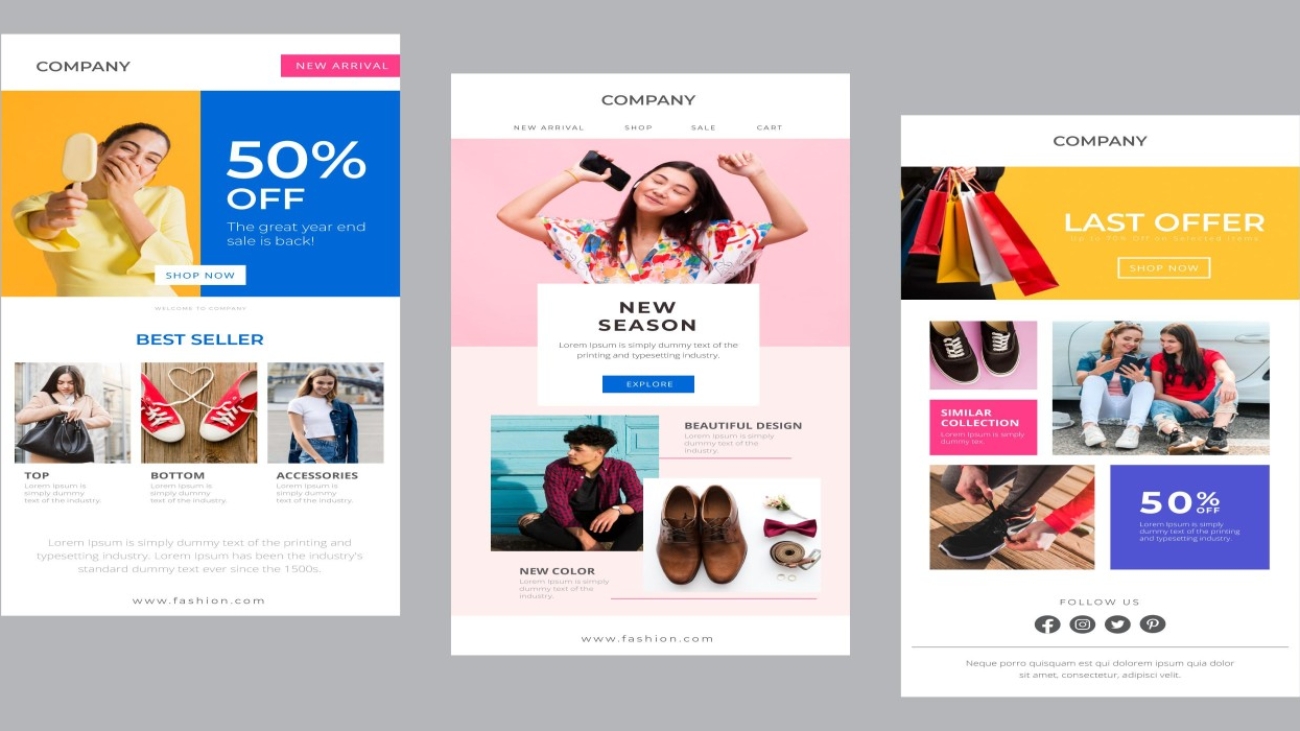
In a general email, the design varies concerning the type of email campaign. Here, we are providing the best examples of email designs developed by top brands based on the type of campaign they used:

Product Promo Email Campaign Examples

Along with email newsletters, the most common email marketing campaign used by most businesses and brands when they launch a new product or service is product promotion. Here are a few examples of the best email designs used by top brands for product promotion.

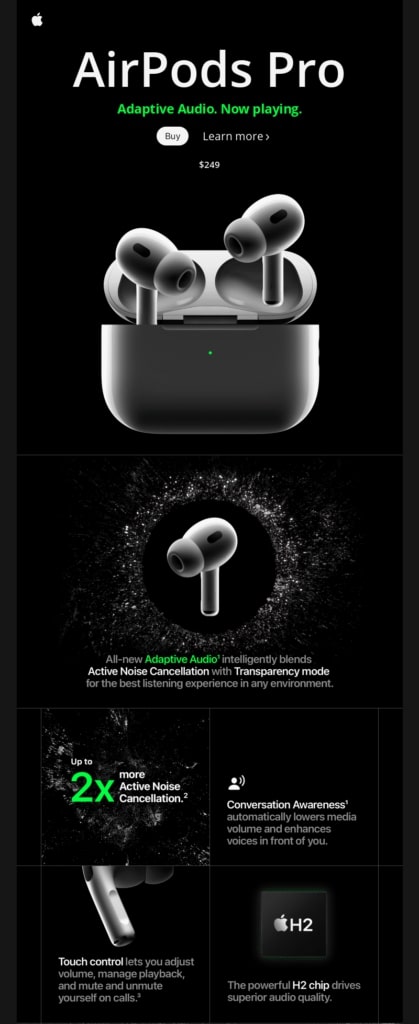
Apple AirPod Pro

Apple’s email product campaign for the launch of AirPods Pro earphones is in line with the brand’s style and visual characteristics. If you look at the image below, it is simple, predominantly monochrome, with a large, high-quality photo of a product that is dominating the main screen.

This email campaign has well-structured headings, which help readers to understand what exactly they are looking for.

Contrasting images of AirPods pop against the dark background is eye-popping and can grab users’ attention.

Also, the numerous calls-to-action, such as “Learn more”, “Buy”, may lead readers to visit their landing pages and enable users to make a purchase.

Apple AirPod Pro Email design

Source: https://venturestream.co.uk/blog/email-design-examples-the-brands-getting-it-right/

Great Jones’ Salt & Pepper

Great Jones’ is a company specializing in producing home products such as kitchen appliances and furniture. If you look at the image below, their Salt & Pepper product launch campaign completely relies on simplicity and attention-grabbing animation.

Great Jones’ email campaign is all about selling one product, which was displayed in the email template.

This makes their email campaign strikingly concise and direct.

Great Jones’ Salt & Pepper Email Design

Source: https://reallygoodemails.com/emails/salt-pepper

Frame.io

Another example in simplicity and direct marketing – is about a product launch email campaign during a conference conducted by Frame.io.

Using email design with a solid black background is very attractive and can grab the user’s attention

Also, they clearly mentioned their CTA as “Reserve Your Seat” for the conference related Final Cut Pro X Creative Summit.

Upselling Email Campaign Examples

Whenever a customer buys a product from a particular brand, it can send upsell campaigns to their customers. Hence, most of the businesses usually send upselling email campaigns that can steer the buyer’s attention towards more products that might interest them and buy.

Here are examples of best email designs used by a few brands for Upselling Email Campaigns:

Dollar Shave Club

Dollar Shave Club Email Design

Source: https://reallygoodemails.com/emails/where-did-you-go

With a carefully executed and beautifully crafted e-mail campaign, this beauty and personal care brand upsells its products based on its customers’ interests, as shown in the above email template.

The “Dollar Shave Club” campaign invites a consumer to add more items to their shopping cart before hitting the order button.

The email campaign portrays potential purchases in two columns, with a very striking contrast between the product and the background.

To grab users’ attention, they used vivid orange CTAs for “ADD” which are very visible and eye-popping.

WeTransfer

WeTransfer is a company specializing in File transfer services. It is trying to upsell its bandwidth package through a uniquely designed email campaign that markets the WeTransfer Plus package

With a perfect and concise email design, they opted to market their product with a magazine-style email campaign.

They used a lot of white space and a few vibrant colours to make their email campaign stand out.

Also, with a single call-to-action button, they are trying to invite readers to learn more about the package and make a well-informed purchasing decision.

Grammarly

Another example of an upselling-related Email Campaign is Grammarly. If you look at the email design below, created by Grammarly, which is very personable and attractive.

They mentioned “Highlights of Your Year” in the newsletter with yearly writing stats.

This creates an immediate effect of familiarity and reliability, along with a personalized touch.

Furthermore, their email campaign follows its brand’s style guidelines with clean white space and gentle, pastel colours.

Also, they mentioned the CTA button at the top of the newsletter, which invites them to upgrade to the Premium account.

Source: https://moosend.com/blog/email-marketing-examples/

Cart Abandonment Recovery Email Design Examples

Cart Abandonment is the most common scenario when it comes to e-commerce. Most of the customers visit an eStore, add an item or a few items into their cart, and then leave without completing the purchase. This leads to Card Abandonment. Here are some of the best examples of email marketing campaigns that remind customers about the items they have abandoned in their cart.

BluDot

 BlutDot is a company specializing in Home decor and furniture brands. It reminds their visitors of items they have viewed in their online store by sending them a very concise cart abandonment recovery email campaign.

To grab the attention of users, Bludot provided furniture images in a neutral colour along with simple lines, “Taking another look? We saved your items.” and CTA as “Complete my order.”

The email campaign is very precise about reminding their readers of the items they lookedat  and abandoned in their carts previously.

Just below the CTA, they provided the items with a direct Checkout button next to them.

Moschino

The cart abandonment recovery email campaign executed by Fashion and Apparel Brand – Moschino is quite interesting.

This email design features a black and white photo of a model with a caption “You left something behind” and a “Return to checkout” call-to-action – which is quite exciting.

Right under this large central part of an email, there is a list of items the user has left in their shopping carts.

Also, they included “Complete my order” button which enables readers to return and complete the purchase.

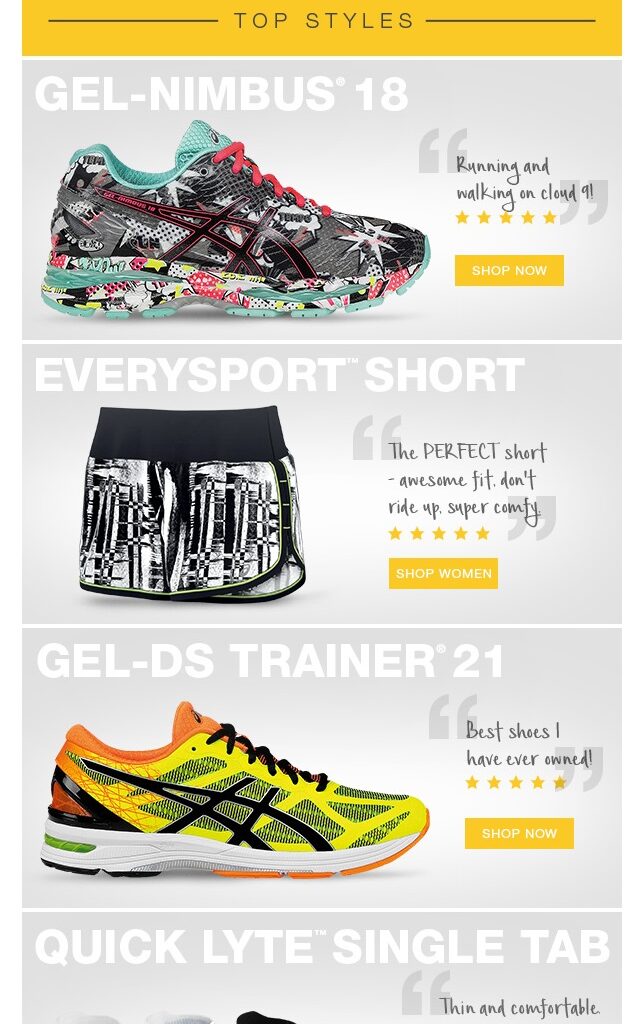
ASICS

Here is one more example for Cart Abandonment Recovery email campaign executed by Exercise and fitness brand – ASICS. If you look at their email design mentioned below, they remind visitors who have looked at items in their store, placed them in a shopping cart and abandoned them.

ASICs cart abandonment recovery email campaign mainly highlights the product that has been viewed by the users who visit their website.
Also, they mentioned CTAs in an email that encourages them to complete the purchase.

Email design created by ASICS

Source: https://mailbakery.com/blog/examples-sport-retailers-emails/

Product Update Marketing Campaign Examples

Updates to the products or services help satisfy consumers and create more interest in those products. Marketing campaigns for product updates educate the subscribers about products and typically include a lot of information, both in copy and design. And here are some examples for Product Update Marketing Campaigns:

BluDot’s Stack’em Up

Home and decor brand Blu Dot’s “Stack ‘em up” product update email campaign is quite narrative as it incorporates design of their upgraded product as shown in the below image.

Checklist for Email Design Best Practices

A Complete Checklist for Email Design Best Practices

Although the marketing landscape changes at an incredibly fast pace, email marketing is still the most important and effective way to reach your targeted audience. When it comes to successful email marketing, you need to consider Email Design as one of the most underlying factors. Hence, it is essential for B2B marketers to adapt best practices in Email Design to increase more visibility, drive high sales conversion and get more business opportunities.

Before diving into Email Design Best Practices, let’s start with the basics!

What is Email Design?

Email design is a process of strategically designing and generating an email that resonates with your target audience, specifically your current email subscribers and clients. Hence, having a great email design is important as it engages your recipients and captures attention of your targeted audience.

When it comes to designing marketing emails, there is no magic formula that will get you impressive results all at once. But while setting up an email marketing campaign, the design of your email is definitely a significant aspect to consider. If your design does not relate to your email subscribers, then most of your emails get marked as spam, deleted, or completely ignored. To make sure your marketing emails are as effective as possible, you have to consider several different aspects of your email design carefully.

Checklink of of Email Design Best Practices

Use Interesting Subject Lines

Your email subject line should be something that grabs the attention of your subscribers and gets them interested enough to keep reading. Hence, make it relatively short but as informative as possible. The ideal email subject line should be a good, interesting summary that determines people what they can expect from reading your email in the fewest possible characters. Therefore, always aim to limit your email subject line to 50 characters or less. Here you can see average read rate of emails based on the length of subject lines.

If your subject line includes too many characters, it may get truncated in some of the email mailbox providers. Because of this, your email may lose its meaning and impact or even end up looking like funny or awkward at some instances. Hence, to make sure your message comes across all mailbox providers, you need to keep your subject lines relatively short.

Use Perfect Pre-Header

From a recipient’s point of view, pre header is the next thing they look after a subject line. Hence, it should be optimized for mobile, desktop, web mails as it’s the second most important thing readers make a decision to open & read the email further. It can provide useful context to the subject line and assist in increasing the open rates.

Here are the best practices for formatting a Pre-Header:

  • It should be concise and clearly convey the exact point.
  • Limit Pre-header length within 40-70 characters.
  • The Pre-header text and the subject line should complement each other for better performance.

Use Right Fonts

The fonts you choose in the emails can define the look and feel of your message. While there are hundreds and thousands of fonts available on the internet, not all of them will be the right fit for email communication. In general, you can use any font that fits your visual brand identity in static images and GIFs. But in text, you have to stick for system fonts and web fonts.

System fonts are the types of fonts that can be displayed on all devices or within any application. These include Georgia, Times New Roman, and Verdana.
Web fonts are widely supported, and can be rendered differently on your recipients’ device. These include: Roboto, Lato, and Montserrat.

Hence, it is highly recommended – either stick to system fonts, or use web fonts. Ideally, you have to use up to two different fonts while designing email templates – one for the header section and one for the main text and CTAs.

Use Mobile-Responsive Emails

With more than half of your recipients opening your emails on mobile, it’s essential to optimize your email design to work for both desktops and smartphones. You can optimize your emails for small screens by implementing these design best practices:

  • Implement a Minimalistic design
  • Don’t use complex headers, extra calls-to-action (CTAs), or clutter
  • Use a High-contrast design set at low brightness for mobile screens
  • Use a single-column layout
  • Place Easy-to-view content
  • Set mobile-friendly links
  • Keep Smaller image files

Incorporate Unique Visual Content

As most of the audience doesn’t show interest in reading lengthy promotional emails, make sure to use visual content that exposes your brand identity. Visual content plays a key role in attracting & converting prospects into customers. Hence, keep your customers interested in your message by incorporating images, videos, GIFs, animations, and more that resonate with your brand.

Here are some best practices on how to incorporate visual content:

  • Make sure that images and other graphics have excellent resolution
  • Use high-quality images to get a point across
  • Don’t use large image-sized files as they slow down your email’s load time
  • Also consider whether the images add something essential to your emails.

Personalization

When you customize an email and tailor it according to your recipient, it’ll feel more thoughtful, professional, and personal. Email personalization helps you foster a relationship between your business and customers, which eventually boosts retention rates. Here, in the following images, you can see how personalization increases open rates by 26% by grabbing users’ attention.

Personalization of email includes everything – right from the subscriber’s name to demographic, behavioral, and other contextual data. Adding the company’s name, last purchase, and other information in your email design helps you to personalize the email in the best possible way that aligns with each customer.

Use Right Tone That Aligns With Your Brand

When your email recipients clicks on your message, they should know that the email was sent from your company. So, it’s essential, the language and the voice you use in your emails can create a feeling and brand image that can make your emails stand out from your competitors. Hence, vary your tone depending on the subject of your email.

For example, if you’re sharing some news about your company’s biggest promotion, you can sound more excited than usual. But, note that your general voice should be consistent throughout your emails and other marketing materials as it matters most for your business.

Make Your Call-To-Actions (CTAs) Stand Out

As a B2B marketer, there will always be one goal behind sending emails to your targeted audience, whether it can be a sign-up for a new trial service or promoting a new product, or trying to sell older products as part of a clearance sale. You can make your marketing goal clear by incorporating CTAs within your email. Call-To-Actions are used to convert your email recipients into loyal customers.

In some instances, most of the audience may not find the Call-To-Action even when you include it in your email. Hence, always make sure the link you include in your CTA is visible and eye-popping. Also, you can use colorful buttons and bold text that can bring attention to your calls to action.

Bottom Line

With great email design, you can reach and resonate with your audience more effectively, helping you to grow better. Eye-catching and impactful emails will help you build long-lasting customer relationships and turn more individuals into paying consumers and brand advocates. So, start designing your emails while keeping this checklist aside.

blog

Utimate Benefits of Web Traffic for Business[Infographic]

The vast majority of website visitors suddenly vanish. Your marketing department becomes instantly more effective if you can learn more about the visitors to your site already. Why? because they figure out where to focus their efforts.

Additionally, before engaging them, sales teams will have more qualified leads and be better prepared. To generate fresh leads, they won’t need to continually invest in new channels. Furthermore, why would you spend money on other channels when you can connect with warm prospects who have already viewed the website?

To continually innovate the sales process, in this infographic – we are providing the key benefits of web traffic for your business:

blog

Analyze online traffic

You may evaluate the online traffic to your website with the use of web traffic based on the number of people and potential clients who visit and peruse your website. It also reveals where the majority of potential buyers come from, what they did on your website, and how long they stayed there. You can quickly determine what and which activities provide better outcomes and revenues as a result of this and the manner in which the data is displayed.


Track The Bounce Rate

The number of times a visitor has browsed through or even visited your website without engaging with your webpage is known as the bounce rate of your website. If your website has a high bounce rate, it likely has a poor user experience overall and the visitor did not believe the material was appropriate for their needs or what they were looking for. Additionally, it is quite difficult for your organization to do well in sales, quality leads, and any kind of conversions when you have a high bounce rate.


Reach The Right And Ideal Audience

To maximize the value of your efforts, it is crucial for every organization to identify the right audience and make sure that your content reaches them. Web traffic support businesses by providing information on how to develop the right audience, find the right audience, and where to find the right audience. With the correct audience, you can create more effective marketing campaigns that can boost sales, increase conversions, and significantly improve your website.


Monitor And Evaluate Your Advertising Campaigns

By monitoring the effectiveness of your marketing initiatives, you may learn how users responded to them, whether they were successful, and whether the campaign as a whole was profitable for both you and your website. You may also ensure that you can always end a campaign if it is performing poorly by using tracking URLs that are exclusive to each campaign.


Optimized And Enhanced Web Services

With the aid of some of the top web analytics tools to raise the ranking of your website, a business can identify the potentially dangerous issues on its website. Don’t forget to make distinct landing pages for other uses as well, since this will help your website’s user interface. Monitoring how effectively your website performs on mobile devices also helps to enhance the user experience as a whole.

Optimized Conversion Rate

Make sure that users complete the tasks that have been allocated to them by optimizing your website’s conversion rate. The number of successfully achieved goals that the total number of users receives is also used to compute the conversion rate. It also measures the number of times your post has been shared and the number of indirect conversions that have led to your website. This helps you reach a lot larger audience and connect with all of the prospective consumers there.

In addition to this, web traffic assists in knowing precisely what your potential customers are looking for, where they are coming from geographically so you can cater to their needs specifically, and why and where you are losing customers so you can pinpoint your prospects and continue the expansion of your website.

blog

What Shouldn’t You Do In Mobile Email Marketing[Infographics]

There’s a lot of discussion and excitement these days about mobile email marketing. Because it is a new arena, there isn’t much overcrowding or high-stakes competition yet. However, new technology brings new obstacles, and it may become quite easy to misstep and fall down the wrong path. So, if you want your mobile email marketing campaign to work, here’s a brief list of things you shouldn’t do:


What Shouldn't You Do In Mobile Email Marketing | LogiChannel


Don't write long messages

This is an excellent thumb rule for most marketing messages, but it’s especially true on mobile. After all, no one wants to scroll through pages of text. In fact, to encourage easy mailing list signup and coupons at the cash register or in a store window, it’s sometimes advisable to forego text entirely in favor of a simple QR code or text message.


Don't bait and switch

Mobile customers have limited attention spans, so an enticing phrase or offer that doesn’t deliver will be ignored. Learn what your customers want from your store, whether it’s hours, locations, directions, or rapid access to coupons. Mobile users frequently use their devices to compare costs, so instead of aggravating them with a long search, make these as transparent and quick to access as possible.


Don't target too broadly

The greatest mobile marketing strategies focus on a specific customer niche and corporate objectives that are well defined inside a larger marketing strategy. The more targeted you can be, the more relevant promotions and material you can come up with that will genuinely engage your clients.


Don't send texts at random times of the day

Research the times and days when mobile consumers are most responsive, both in general and in your business particularly. A lunch café, for example, would do well to send out a coupon to loyal customers shortly before 11:30 a.m., whereas a bank might want to wait until the after-work rush.


Don't measure the wrong things

Mobile impressions can be a misleading metric. Instead, concentrate on the number of e-commerce sales made on mobile platforms, app engagement, and phone calls received to get a more realistic picture.

Don't ignore trends

It’s a bit disingenuous to say that once you’ve deployed your app and made your online content responsive, everything else will fall into place. Mobile marketing trends shift frequently, so it’s critical to keep track of them and stay up to date.


Don't Ignore Mobile Site Speed

Responsiveness, mobile-friendly interfaces with huge buttons, and direct CTAs get you a long way down the mobile marketing field, but speed is the game-winner. Consider how frustrating it is when a website fails to load on your computer. When a user searches for services on a mobile device, the annoyance level keeps going up. Determine how long it takes for your site to load on mobile and implement the suggestions for improvement.


Don't Assume That Your Clients Aren’t Mobile

How often have you passed the time on your phone surfing numerous websites before returning to take action? Your journey to purchase began innocently on a mobile device, and CEOs and other decision-makers in the business-to-business sector are no exception. Mobile can be high in the funnel for firms with long sales cycles, but it can also be a valuable area for micro-conversions like bookmarking and other steps that aren’t confined to a single audience.

The Take-Away

Smartphone has become a platform that can be extremely useful to businesses and marketers, but only when properly mastered. While other digital marketing trends come and go, mobile email marketing appears to be here to stay as people become increasingly disconnected from their computers. Take the necessary actions now to ensure that your mobile marketing efforts are successful, and watch your traffic increase!

vertical Marketing

Everything You Need to Know About Vertical Marketing System

When you just start to create your business and brand, your digital marketing strategy should be informed by who your target audience is. Selecting your target audience — the people who will buy from you and eventually become brand advocates — involves numerous factors. However, you must first determine whether a vertical marketing approach is appropriate for your business. After all, it’s usually the greatest solution when you want to focus on a very specific market.

Horizontal or vertical marketing systems are commonly used by businesses to efficiently create and sell their items to their customers. Producers, wholesalers, and retailers collaborate in a vertical marketing system to increase revenues and streamline operations. We clarify what a vertical marketing system is, the three basic varieties, the benefits and potential pitfalls of employing one, and how to choose the ideal type for your organization in this post.

What is a Vertical Marketing System?

A vertical Marketing System is one in which manufacturers, wholesalers, and retailers collaborate to meet the demands of their clients. It allows a single business to have complete control over the manufacturing and distribution of a product.

Producers, wholesalers, and retailers often function as independent entities in traditional marketing systems—or horizontal marketing systems—trying to maximize their own profits. While this may allow each business more independence, it may also lead to increased conflict and competitiveness, resulting in both entities losing money.

What sort of companies use Vertical Marketing?

Now that you have a good understanding of what vertical marketing is, it’s time to learn about the types of businesses that employ it. So, to appeal to their small target groups, enterprises that offer highly specialized products frequently utilize vertical marketing. Companies employ this method to build target demographics for a product that has trouble appealing to a larger audience.

Vertical marketing is the appropriate fit for you if you’re a firm that struggles to advertise products to a larger audience.

The Purpose Of Vertical Marketing System

If you want to go into vertical marketing, you should first understand why it exists. It is, as I previously stated, a technique for identifying your company as a specialty specialist. As a vertical marketer, you position yourself as the ultimate expert in a particular field. You’ll need a highly developed method for generating, promoting, and distributing your products in order to carve out a specialized niche.

As a result, you could say that the goal of vertical marketing is to target a specific audience based on the product you’re selling.

Types of Vertical Marketing Systems:

This vertical marketing system is divided into three parts which are explained in detail as given below:-

The corporate system

When all aspects of the distribution channel are streamlined under the direction of a single company, it is referred to as a corporate system. Because the corporate system excludes the function of a middleman, all transactions are conducted internally. Using a corporate system to its full potential allows a corporation to have complete control over the items it produces and the path it takes.

Apple Inc., for example, creates its own things and manufactures them. These items can be purchased at the company’s own retail locations. They don’t need to rely on anyone to produce or sell their goods.

The contractual system

In a contractual system, each partner in the distribution chain works independently and coordinates their efforts through a written agreement. They must collaborate to improve efficiency and utilize economies of scale, allowing for more competitive pricing. This is also known as a “value-added partnership,” in which they coordinate their tactics through contracts to avoid channel conflict that may result from individual goals.

A popular type of contractual vertical marketing structure is franchising. A franchise agreement is one in which one party (the franchiser) allows another party (the franchisee) the right to use the franchiser’s trademark or brand name, as well as specified business processes and systems, to create and market a product or service in accordance with certain standards.

The administered system

There is no formal contractual tie or corporate ownership of the distribution route among participants in a managed vertical marketing system. Instead, the size and strength of a single person have an impact on their operations. Simply said, any strong and powerful member of the production and distribution chain has a disproportionate influence over the activities of other members of the channel.

Walmart, for example, is a good illustration of this type of company. Walmart is large enough and powerful enough to manage such a system. Most small firms lack the power to run such a system, but they may find it vital to work with a producer or distributor who does.

Why Should You Invest in a Vertical Marketing System?

What benefits can a vertical marketing system provide your company? Depending on your business needs, it may or may not be the best option for you, but here are some of the most typical advantages.

Improved Efficiency

Within a vertical marketing structure, those who produce, wholesale, and retail all work together to achieve a similar goal. Because every company has the same goal in mind, there is a greater drive to design systems that are more efficient in general.

More Effective Branding

You have a unique opportunity to discover your key message when you can focus your marketing efforts on specific industries and customers, improving the chances of brand awareness. By offering a particular product, you may establish your company as an industry authority. Finally, you’ll be able to demonstrate a deeper grasp of your client’s demands, allowing you to earn their trust and stand out from the crowd.

Enhanced Communication

Communication and relationships tend to be better overall when all companies work together. Everyone in the supply chain should communicate with one another on a regular basis, providing updates and adhering to the same rules. This can lead to improved outcomes, increased profits, and happier consumers.

Develop Brand-New Ideas

It’s a lot easier to learn about customer insights from within your market, which gives you the opportunity to create new products and/or services. The brands that use a vertical marketing structure are more often than not the ones who can produce the most unique concepts.

How to choose a vertical marketing system?

Follow these steps when choosing a vertical marketing system:

Consider your resources

The vertical marketing system you select is determined by your current resources. You may wish to use a corporate vertical marketing strategy for your business if you have the revenue, experience, and personnel to build your own production, wholesale, and retail departments. Consider proposing a contractual collaboration if you see another company has the resources you require. Finally, if you’re big enough to make the rules, you might already be a vertical marketing system that’s been administered.

Define your goals

Developing your own vertical marketing system necessitates a great deal of planning and resources. Consider what you want to accomplish by merging all components of your marketing strategy. This marketing technique may be appropriate for your brand if you need more resources and want less competition. If your business thrives on a little competition, you might want to hold off from teaming.

Define your goals

Consider hiring a consultant if you’re still unclear about which vertical marketing business strategy is appropriate for your company. A business marketing expert can assist you in determining the size, resources, constraints, and needs of your company so that you can make more informed decisions. Look for someone who has worked in your field and has solid experience in business marketing.

Wrapping Up

A vertical marketing system is a novel approach to traditional marketing. It assures that numerous organizations (typically) may work together to meet consumer needs, increase income, and cut costs. A vertical marketing strategy, when addressed correctly and with a lot of patience and forethought, has the ability to take your business to the next level.