
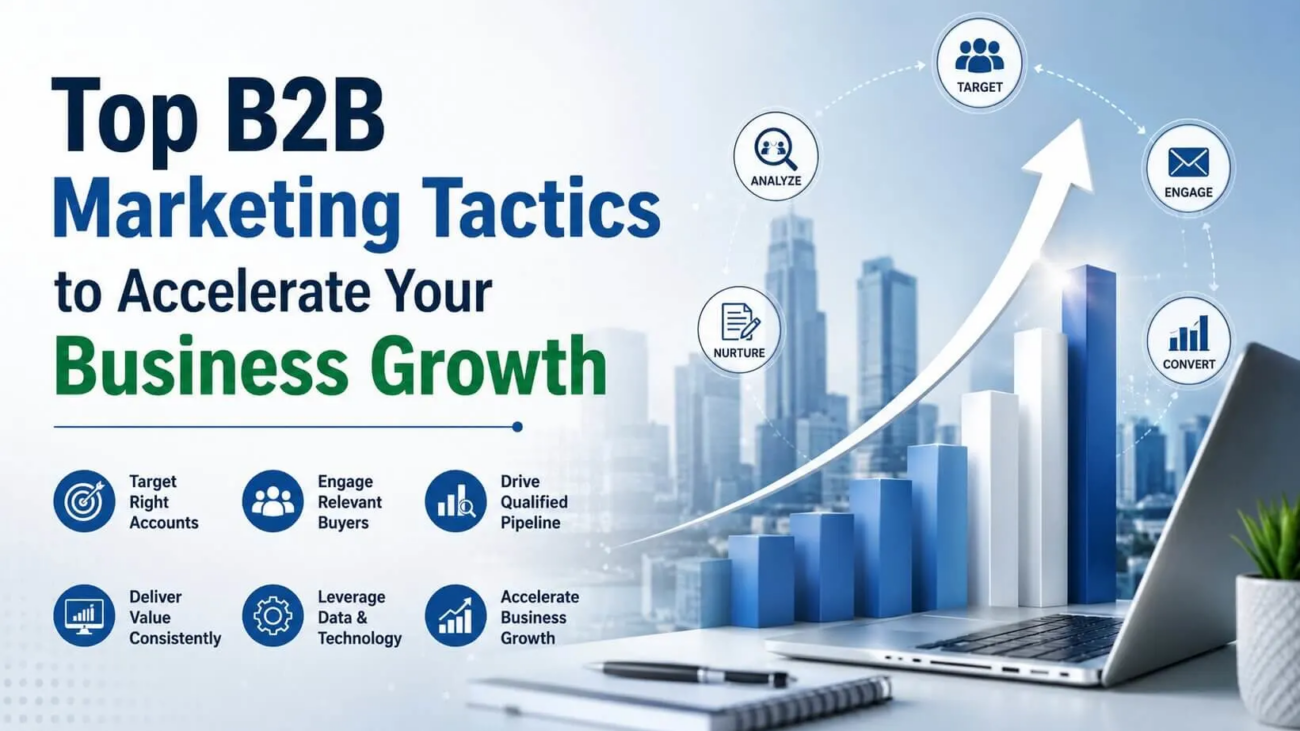
B2B marketing is no longer the pursuit of maximizing the total quantity of leads you attract. In 2026, winning businesses invest their resources in focusing the attention on ideal accounts, anticipating what’s driving buyers’ behavior, distributing pertinent information, and in a nutshell making marketing efforts result in real income.
The most effective, tech-supported and at the same time client-driven strategies leverage technology, namely AI personalization, account-based marketing, B2B intent data, email marketing, and content distribution while always keeping in mind what is relevant for your customers.
How B2B Marketing Has Changed in 2026
Today’s B2B buyer is armed with information and has more sources for vendor and solution-based research than any before. The ability to contrast different sellers, research options, read customer accounts, consume professional expertise, and even utilize AI solutions has become commonplace, and these actions now occur long before any salesperson ever gets a phone call.
The evolution of the B2B buyer mindset fundamentally impacts the B2B digital marketing strategies.
- Shift in lead volume to qualified demand. The old mantra was that the more leads we bring in, the more revenue will eventually flow from them. Marketing must qualify those leads that match our target ideal customer profiles and are likely to be receptive to contacting.
- Shift from basic personalization to relevant personalization. It is no longer enough to use a prospect’s name to personalize our message. Personalization now involves their company profile and industry, role and level, tech stack, and purchasing triggers.
- Shift from traditional search to AI-enabled discovery. B2B Companies must create content that provides value for its audience and is coded in a way for modern search and AI platforms to interpret the information accurately.
- Shift from individuals to a buying group of leads.In B2B companies we get called about purchasing by many different stakeholders, and this means that we need to be involved in the complete buying cycle rather than just dealing with one single point of contact.
15 B2B Marketing Strategies to Drive Business Growth

1. Develop Your Ideal Customer Profile
Identify the ideal industries, companies of all sizes, places, estimated revenue amounts, technological products used, functions, and the actual business problem.
A solid ICP helps marketers avoid wasting resources on prospective customers. It further enhances your B2B prospecting approach by allowing sales teams to concentrate on target accounts that pose potential business success.
2. Build a First-Party Data Strategy
Some of the best customer data that a B2B Marketer could have. In order for your first party data not to be stale, you need to continuously acquire, organize and update information. Collect your first-party data through various means like website interactions, completed forms, exchanged content, organized events, client and prospect relationships, etc., which are legit sources of first-party data.
Customer databases should be checked and purged on a routine basis. There might be an opportunity to fix or refresh some incomplete, outdated information. You should be using B2B data enrichment services to take partial data and augment it with firmographic, technographic and contact information.
3. Use AI-Powered Personalization
With modern B2B marketing strategies, Artificial Intelligence is also becoming one of the crucial components. In the absence of an identical message campaign targeting a whole audience, AI will aid you to uncover consumer behavior and trends, develop content and communications that work specifically for every prospect and even automate the delivery process. B2B marketing using AI should work as supplements instead of substitutes for experience and creativity. Most effective AI marketing is an integration with experienced brand knowledge, AI expertise, and insight about customers.
4. Implement Account-Based Marketing
ABM treats lucrative organizations as singular marketplaces. Instead of transmitting the same messages across myriad individual consumers, marketers and salespeople coordinate to find priority accounts and tailor campaigns just for them. Account-fit, pertinent content, communication personalization, coordination by sales, and measurable results comprise powerful ABM. It is especially potent for businesses that have big-budget contacts or very long sale cycles.
5. Use B2B Intent Data to Identify Active Buyers
Only a fraction of the consumers we identify now are in purchasing mode. Using B2B intent helps identify organizations that have begun researching or consuming your or another provider’s content by other measures, suggesting they could soon be preparing for purchase. Intent data needs to be used as prioritization, not an explanation of purchase likelihood; combined, however, with firmographics and account fit, it should guide your B2B sales teams to where their efforts are most likely to generate success.
6. Use Technographic Data for Precise Targeting
Understanding the technologies that a business employs can shed light on that company’s operational world. Companies often leverage technographic data to determine which organizations in their market leverage a certain platform, category of technology, or competing alternative.
For example, a software provider could build a campaign specifically for companies using an older technology that its product can replace. This creates a much more relevant proposition than simply targeting an industry.
7. Create High-Value B2B Content
Content from a B2B marketing company should respond to questions that people are asking now. B2B content marketers need to get out of keyword-first thinking and provide useful answers to actual questions that have led someone to begin considering solutions on your website or theirs.
Useful formats are:
- In-depth guides
- Industry reports
- Case studies
- Comparison pages
- Research-driven articles
- Webinars
- Checklists
- Original insights
- Customer success stories
Great content is what your prospects consume when they are too early to talk to someone in sales to help prove your authority as source.
8. Optimize B2B Content for SEO and AI Search
Search is an integral part of B2B customer acquisition-and search behaviour has continued to change.Develop content based on obvious question and topic areas. Use self-explanatory headings; create brief, targeted copy; utilize relevant internal links; provide practical illustrations; and organize it logically.
Move beyond simply embedding traditional keyword phrases. The aim here is to have content that’s understood by humans, computers, and AI. Answer Engine Optimization (AEO) is one approach you can take to supplement organic SEO in your efforts to help search engines recognize, locate and return valuable information from.
9. Build a Targeted B2B Email Marketing Strategy
Email marketing requires relevance over volume. Segments a customer list by: industry, role, how far the customer is down the pipeline, what customers are interested in, level of engagement. And draft messages based on different personas.
An email sequence might look like: Awareness, education, proof, offer, follow up. Do not email the same campaign to everyone. Better segmentation tends to yield better customer experience.
10. Use LinkedIn and Social Selling
Benefits the business to establish credibility professionally in B2B social media marketing. Use social media to reflect expert level knowledge not another channel of advertising: Share the business’ unique insights, lessons learned from customers, the dynamics of the industry, research work, micro-tutorials and interesting resources.
Also, sales teams can perform social selling in order to establish a relationship with the key decision makers before presenting.
11. Automate Repetitive Marketing Workflows
B2B marketing automation can reduce repetitive manual work.
Automate tasks such as:
- Lead routing
- Email sequences
- Lead scoring
- Follow-up reminders
- Webinar communications
- CRM updates
- Re-engagement campaigns
At the very least automation should increase efficiency while removing any customer interactions feeling robotic.
12. Develop a B2B Lead Nurturing Strategy
A high number of your prospects in a B2B capacity won’t be buying in the first conversation or visit. Lead nurturing’s purpose here is to ensure that you are front and center during that prospecting customer journey. There should be separate nurture streams based on the prospect’s needs and stage in the buying journey.
Educational content can bring early stage prospects down funnel toward consideration; case studies, demos and customer testimonials can then be used to support closing late stage buyers. The goal is not simply to get to an MQL, but to guide the right leads to the right buying action.
13. Align Sales and Marketing
Marketing performs better when sales and marketing work toward the same definition of a qualified opportunity.
Agree on:
- Target accounts
- ICP criteria
- Lead qualification
- Account priorities
- Handoff processes
- Follow-up expectations
- Pipeline metrics
Marketing should understand which leads actually become opportunities and customers. Sales should provide feedback about lead quality and customer objections. This feedback loop helps your B2B demand generation to improve over time.
14. Use Customer Marketing for Retention and Expansion
Your business should not stop at just the initial sale, customers can be retained, upsold to, refer to other customers, and evangelize your brand. Use customer marketing for retention, it will make your B2B customers feel supported when you educate them on extra products, new features, services that would suit them, and content to support them further.
Existing customers may also share testimonials, reviews, and referrals for new B2B customer acquisition.
15. Measure Marketing by Pipeline and Revenue
The final strategy is measurement. Do not judge your entire marketing program by impressions, clicks, or lead volume alone.
Track metrics such as:
- Marketing-qualified leads
- Sales-qualified leads
- Conversion rate
- Cost per qualified opportunity
- Pipeline generated
- Customer acquisition cost
- Revenue influenced by marketing
- Customer lifetime value
- Return on marketing investment
B2B Lead Generation Strategies That Work
Firstly, you define your ICP and add enrichment on account level to give you the perfect fit accounts that form your list of target companies. Second, identify the exact individual decision makers and the buying committee within these accounts and use intent-based data to track live intent. Last but not least, you leverage a personalization that is triggered by that intent to do highly targeted outreach, and with a constant nurture with values, to move those accounts into the funnel and finally convert-building sustainable efforts instead of simply “buying a bunch of leads or buying tons of data”.
Data quality is critical for companies with very large databases; if titles are old, company data is incorrect, or contact details aren’t updated, you lose the ability to run campaigns effectively. Data appending, data enrichment or building a customized prospect list are areas where services like these fit; Business data from LogiChannel is organized around enriching and appending current data, missing data, and building targeted prospect lists.
B2B Demand Generation vs. Lead Generation
Lead generation looks to find and grab an address for potential buyers. Demand generation looks to drive awareness and interest as well as build trust and the desire itself in advance of and through-out the buying journey.
For example: Content → SEO/AI search → Social → Thought leadership → Engagement → Lead capture → Nurturing → Sales opportunity
The strongest B2B growth strategies combine both. Demand builds interest whereas lead gen provides sales the named opportunities they can pursue.
Framework for Scalable B2B Marketing
The marketing growth engine needed to build a scalable B2B marketing engine:
- Identify — Define your ICP and priority accounts.
- Understand — Combine customer, firmographic, technographic, and intent information.
- Attract — Publish useful content and optimize it for search and AI discovery.
- Engage — Reach out with email, social selling, personalization, and custom campaigns.
- Nurture – Establish relationships with prospects not ready to buy yet.
- Convert — Align marketing and sales around qualified opportunities.
- Expand — Retain customers, encourage advocacy, and identify expansion opportunities.
- Measure — Link marketing to pipeline and revenue.
B2B Marketing Trends In the Years to 2026 & beyond
With the shifts that were observed, the trends transforming B2B marketing include:
- AI-assisted buyer research
- AI-powered personalization
- Account-based marketing
- Intent-driven targeting
- First-party data strategies
- Technographic targeting
- SEO combined with AI search optimization
- Revenue-focused marketing measurement
- Greater sales and marketing alignment
But there is a simple underlying trend to it all: B2B marketing becoming a more data-centric, individualized, automated, and customer-focused function.
How to Measure B2B Marketing Performance

Looking at the top of the funnel you should be reviewing organic traffic, engagement with your content, engagement with your emails and qualified visits to the website.
Look to the middle to bottom of the funnel with reports on conversion rates, qualified opportunities, pipe line value, customer acquisition costs, sales revenue and the quality of your marketing data. Even with some of the highest performing campaign types in marketing, you still need recent customer data to do it justice.
Frequently Asked Questions About B2B Marketing
There isn’t any ‘one size fits all’ approach and the best programs typically mix ICP targeting, valuable content, SEO, email, ABM, data driven targeting, nurturing and sales alignment.
B2B marketing strategies refer to specific initiatives used to target and turn business clients into paying customers. Whether that’s to start using things such as email marketing, content marketing, ABE, LinkedIn outreach, webinars, SEO, lead nurturing and sponsored ads right the way through to account-based marketing.
The ability of the internet is changing to help marketers study data, create personal campaigns, create material, streamline work processes, uncover trends, and develop more precise targeting. Nevertheless, human checks on B2B are still important in order to check on the data accuracy, strategy & also the company image.
B2B intent data refers to behavioral signals that may indicate that a given organization is in the market or actively conducting research for a specific product or solution. This data helps marketers with prioritization of accounts and outreach tailoring.
The core of B2B data enrichment is about augmenting poor or incomplete records by complementing them with missing relevant details. Better quality data is instrumental to better-qualified lead segments, outreach campaigns, targeting, and personalized advertising efforts.
Treat it for the whole revenue journey, not for pure lead volume, in a lead generation game, work to identify high fit accounts, develop your content accordingly, engage personalize, nurture those accounts, integrate marketing and sales, track your performance for qualified pipeline and revenue.
Conclusion
The ideal B2B marketing plan is not how much marketing staff are doing. The real ideal B2B marketing is to get the right companies in the right channel, delivering the right message, right now in the right step on their journey of buying. Build this up on a solid ICP and good B2B marketing data, supplement with valuable content, optimize for SEO, introducing AI and personalized content through a combination of intent signals, ABM, email and social selling, and tie these efforts to the sales processes and report the pipeline.
Businesses looking for better B2B marketing data and better B2B prospecting, LogiChannel can help by offering: data enrichment, data appending, custom list building, data licensing, as well as targeted business data, to start reaching customers smarter, because it all begins with better data. Dive into the LogiChannel B2B data suite-and cultivate a more precise roadmap from prospecting to growth.