
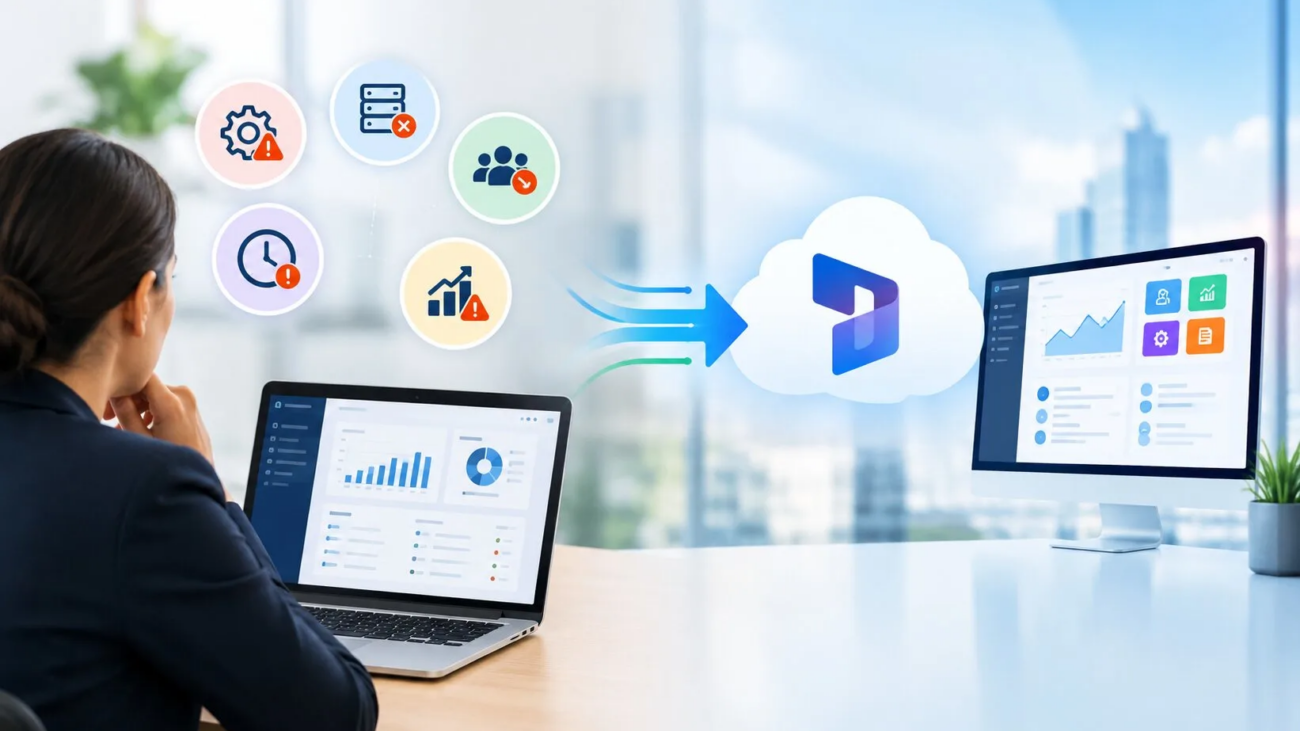
Dynamics 365 migration 5 signals to identify clients

Dynamics 365 Migration: 5 Signals to Identify Potential Clients

The right prospects matter if you sell IT consulting, cloud migrations, or software implementation services and support, that’s more true than ever. Businesses today are awash in aging legacy applications, aging on-premises servers, slow database performance, and hours of wasted time trying to get disconnected applications to work if they want a way forward.

These businesses want to migrate to a modern cloud solution such as Microsoft Dynamics 365, and they want to do it the right way, without having to change the entire organization and disrupt the day-to-day operation of their business. But they don’t want to figure out which companies have the cash, the executives, and the need; they want to identify specific digital and business “warning signs” that a company is struggling to make its legacy system work, so they can contact them proactively with the perfect solution.

For the past twenty years, medium and large enterprises have had use of older, server-based enterprise database management systems such as legacy versions of Microsoft Dynamics AX or Navision, localized SAP installations, or custom-built enterprise databases.

These companies can’t justify hosting new servers, security risks are on the rise, and outdated software can’t provide real-time information sharing, AI tools, or hybrid communications to branch offices, so we’re experiencing a tremendous enterprise migration in which companies are switching from stiff legacy databases to Microsoft Dynamics 365.

Transitioning to a new cloud platform requires data mappings, custom workflows, training, and the migration of user data, which presents an opportunity for IT solution providers and system integrators who utilize enterprise technographic data sets to identify accounts in the right stage of the data migration process.

Of course, before you sell migration services you first have to understand the goals you are helping companies to realize.

What Is Dynamics 365 Migration?

Migrating to Dynamics 365 is the procedure of transferring data relating to the firm, such as financial information, consumer information, and custom workflows, from legacy systems such as an on-premise ERP, a legacy CRM, or previous spreadsheets to the cloud-based Microsoft Dynamics 365 environment.

The Role of Dataverse in Migration

Microsoft’s architecture separates Finance and Operations data models from Customer Engagement apps that natively use Dataverse. Customer Engagement apps, such as Sales and Customer Service rely on Dataverse as a data platform. In contrast enterprise operations modules, like Dynamics 365 Finance and Supply Chain Management have their different data architectures. These different structures need connectors or configuration through the Power Platform.

Why Migration Signals Matter for B2B Prospecting

  1. End-of-Support Deadlines: Software companies eventually stop providing support for versions of their products. For example extended support for Microsoft Dynamics AX 2012 ended in April 2022. Support for AX 2012 R3 ended in January 2023. Companies that are still using these versions need to look at the risks they face and consider ways to update their systems.
  2. Cloud Secure Access: Newer platforms use identity controls like Microsoft Entra ID and strict security policies that allow people who are authorized to access cloud applications from any device that works with the system and it removes the need for old and complicated virtual private networks.
  3. Application Integration Architecture: Even though some built-in connectors make it easier to use customer engagement apps connecting parts of a company’s financial and operational systems requires careful setup using standard connectors or the Power Platform.
  4. Built-In Artificial Intelligence: New cloud platforms include their artificial intelligence tools, like Microsoft Copilot but older systems do not have this built-in and need complicated workarounds using application programming interfaces to use outside tools.

The Role of Dataverse in Migration

Microsoft’s architecture separates Finance and Operations data models from Customer Engagement apps that natively use Dataverse. Customer Engagement apps, such as Sales and Customer Service rely on Dataverse as a data platform. In contrast enterprise operations modules, like Dynamics 365 Finance and Supply Chain Management have their different data architectures. These different structures need connectors or configuration through the Power Platform.

Why Migration Signals Matter for B2B Prospecting

  1. End-of-Support Deadlines: Software companies eventually stop providing support for versions of their products. For example extended support for Microsoft Dynamics AX 2012 ended in April 2022. Support for AX 2012 R3 ended in January 2023. Companies that are still using these versions need to look at the risks they face and consider ways to update their systems.
  2. Cloud Secure Access: Newer platforms use identity controls like Microsoft Entra ID and strict security policies that allow people who are authorized to access cloud applications from any device that works with the system and it removes the need for old and complicated virtual private networks.
  3. Application Integration Architecture: Even though some built-in connectors make it easier to use customer engagement apps connecting parts of a company’s financial and operational systems requires careful setup using standard connectors or the Power Platform.
  4. Built-In Artificial Intelligence: New cloud platforms include their artificial intelligence tools, like Microsoft Copilot but older systems do not have this built-in and need complicated workarounds using application programming interfaces to use outside tools.

5 Signals a Business May Need Dynamics 365 Migration Services

How to identify a company that is in need of your software migration assistance? You seek out certain operational indications. When businesses exhibit these five signs, they are prime candidates for a migration project.

Sign 1: They Are Relying on Unsupported, Aging Software

It is a fact that if a company has software installed 10 to 15 years ago, then they are facing increasing support, security, and maintenance risks. Each legacy product has a unique end-of-support date and upgrade route:

  • The Problem: Software developers no longer provide security updates. Instability risks are present every time a new patch or system update is released, as internal IT personnel have to deal with it. In addition, migration paths differ depending on the legacy ecosystem, such as a structured upgrade path from Dynamics AX 2012 to Dynamics 365 Finance and Supply Chain Management, from Dynamics NAV to Business Central, and from legacy Dynamics CRM to the new online customer engagement apps and Dataverse.
  • Your Opportunity: Consult with the IT Director and address the unique security challenges of running unsupported legacy software, and present an easy to understand specific software-to-cloud migration strategy to the IT Director.

Sign 2: Their Sales, Finance, and Inventory Data Do Not Talk to Each Other

Ever called a business and had the customer service reps have to search three different records just to answer a fairly simple question about an order?

  • The Problem: When unlinked, employees need to copy and paste data from spreadsheets into accounting software. It causes errors, bottlenecks in product shipments, and angry customers.
  • Your Opportunity: Consolidate all sales tracking, inventory management and financial reporting into a single solution with Dynamics 365. Dynamics 365 has everything consolidated.

Sign 3: Their Internal IT Team Is Drowning in Maintenance

The majority of the time, the company’s internal IT staff is spending time fixing server crashes, resetting passwords and patching custom code rather than working on new projects that will expand the business.

  • The Problem: You are losing your company’s time and resources and your product delivery timelines due to maintenance fatigue.
  • Your Opportunity: Pitch migration as a means of replacing server hosting and the daily care and feeding of infrastructure with Microsoft’s secure cloud, empowering their internal team to focus on business growth.

Sign 4: They Are Experiencing Rapid Growth Through Mergers and Acquisitions

If a mid-market business or an enterprise acquires a smaller competitor, they will be adopting an entirely separate software stack.

  • The Problem: One corporation operating with one system. Another new subsidiary operating with a completely different system. When you try to integrate their financial statements, it’s a living nightmare.
  • Your Opportunity: Help them implement a two-tier ERP process. Explain how maintaining their corporate general ledger by moving newly acquired branch offices onto Dynamics 365 can allow them to bring operations together in a hurry without throwing them into the midst of a multi-year ERP.

Sign 5: High Employee Turnover and Long Training Times

If it takes a new hire six months to even figure out how to get through a company’s confusing and antiquated software screens, it’s costing the company every single day.

  • The Problem: Outdated interfaces and slow computers make learning tools more difficult and computing a challenge.
  • Your Opportunity: Rate of adoption and training friction below old screens due to Dynamics 365 clean, familiar and approachable interface (not a weird outdated screen like other ERPs) that users will instantly find comfortable and familiar with their existing Microsoft 365 apps (Excel, Outlook etc).

How to Qualify and Prioritize Potential Migration Accounts

It is not about cold calling any company that’s in the phone book, but rather finding firms that are looking for migration firms.It’s not about cold calling businesses that are listed in the phone directory, but it is about finding companies that are seeking migration firms. To get accounts that fit your ideal customer, you must have a well-defined, intelligence-based research approach.

Method 1: Monitoring Technical Job Openings

Job boards are public windows into a company’s internal technology challenges.

  • What to look for: Check job boards for jobs that are seeking engineers with experience in legacy systems, like “Dynamics AX Developer” or “Legacy AS/400 Administrator.
  • What it means: A job posting for a legacy developer or administrator indicates ongoing maintenance, technical support needs, or a potential future modernization assessment. Sales teams must qualify the project scope before assuming active migration purchase intent.

Method 2: Tracking Software Version Lifecycle Announcements

Be sure to watch for when software reaches the end of its life and when it no longer gets support from the companies that make it.

  • What to look for: Every business that is still using a version of ERP software or CRM software will have a date when the version they are using stops getting official support.
  • What it means: Create a campaign that reaches out to businesses that are using that version of the software and offer a plan to help them move to a new system before the support ends.

Method 3: Analyzing Corporate Growth and Expansion Signals

The most likely companies to outgrow software are those that grow rapidly.Rapid growth is the most likely indicator of outgrown software.

  • What‍‍‍ to look for: Business news releases about new company rounds of funding, warehouses’ opening, international expansion, or mergers and acquisitions.
  • What it means: M&A deal brings the combination of software suites as well as different integration needs. A company that has acquired numerous regions will probably need a unified infrastructure down the line, but the acquisition itself is only a signal for investigation, not the closing of the deal right ‍‍‍away,

Method 4: Ingesting Verified Technographic Datasets

Manual‍‍‍ research will bring only a few people to your door while structuring an outbound sales agency will need well-developed data.

  • What to look for: Use validated B2B intelligence databases like the records in LogiChannel’s Microsoft Dynamics 365 users list and filter companies’ employee count, industry sector, geographic region, and the currently employed technology stack.
  • What it means: Your sales team can focus on potential clients that already utilize Microsoft systems and are likely to be interested in upgrades, rather than spending SDR time on random calls to companies that don’t even use Microsoft at ‍‍‍all.

Which Decision-Makers Should Migration Providers Target?

After you have established a business that you want to message to, your message must stand out from the crowd. Enterprise decision-makers such as Chief Information Officers, Chief Technology officers and VPs of Operations are inundated with dozens of general sales pitches each day. Don’t talk like a sales brochure; if it comes across like that, it will be deleted.

Best Practice 1: Never Threaten a "Rip-and-Replace"

No IT Director will be pleased when a salesman tells him/her that his/her core system is garbage and should be torn out today. That system has been installed over a number of years and is a significant investment of corporate funds.

  • Rather: Present migration services as an up-to-date, additive bridge. Demonstrate to them how they can leverage Dynamics 365 alongside their current core architecture (two-tier ERP system) to address current business operational challenges without impacting business operations.

Best Practice 2: Tailor Your Message to the Specific Departmental Pain Point

Executives have various interests. Don’t send the same message to the head of sales as you do to the Chief Financial Officer.

  • To CFOs: Discuss ways of cutting infrastructure maintenance costs, increasing the accuracy of financial reporting, and decreasing long-term total cost of ownership (TCO).
  • VP of Operations: Discuss the reduction of manual data entry, reduction of order-to-cash cycles and increased inventory visibility in warehouses.
  • For the IT Director: Discuss improved cloud security, less server maintenance hassle, and natively integrated with Microsoft 365 and Azure.

Best Practice 3: Lead with Education, Not a Hard Sell

Provide immediate value at your first touchpoint. Send a quick technical whitepaper, a case study demonstrating a migrated company without outage, a free software architecture review. Gain trust and establish a relationship before asking for a contract.

The Migration Roadmap: What to Show Your Clients

When you get a meeting with a prospective client, they will want to know one major thing: “How are you going to move us over without breaking our business?”

A credible migration proposal demonstrates strict control over operational risk and business disruption through a structured roadmap:

  1. Discovery and Assessment: Write down all the systems that are being used, the ways the business works, how data there is, any special code that was made and what connections are needed.
  2. Solution and Migration Design: Pick the Dynamics 365 program, set up how everything will work in the end and make sure there are clear rules for moving data.
  3. Data Testing: Look at the data, fix it if it’s wrong, get rid of copies and try moving it in an area that isn’t used for real work.
  4. Validation, Cutover and Stabilization: Make sure important records match up, check the ways the business works, do the move during a time that was planned, watch for any problems and help out a lot after the move is done.

Deepening the Audit: Comprehensive Data Governance and Cleanup Framework

Before even one byte of existing data touches the cloud environment, technical consultants need to create a robust data hygiene foundation. Often, migration projects don’t even get past this stage because companies don’t want to just introduce new software bugs, they also want to move years of broken records, duplicate customer accounts and unused data fields into the new environment.

The Three-Tier Data Classification Model

To facilitate the transition project teams should make sure that all legacy data is sorted into three buckets before moving onto mapping. 

  • Active Operational Records: legacy data that is tied to manufacturing runs, ongoing customer contracts, open support tickets and regulatory compliance requirements is moved into active Dynamics 365 tables. 
  • Archival Data: legacy data that must be kept for audit or tax reasons but does not need to interfere with the day‑to‑day tasks of the organization. This data is downloaded and stored to cheap secondary storage with clear access policies.
  • Outdated Data: Duplicated data, test data created ten years ago, and inactive customers with nothing to do from a commercial or legal standpoint. Instead of using this data to inflate migration time, it is securely cleaned and deleted.

It’s in the best interests of everyone to do a comprehensive data audit prior to developing a custom script and integration. Doing so avoids reporting errors down the road, increases database performance, and guarantees end users see a nice, clean, reliable system on day one.

Managing Stakeholder Adoption and Change Management

No matter how technically perfect your migration, if your internal users won’t adopt and use the system, it will go nowhere. Resistance from users can be one of the quietest killers of enterprise software projects.

Overcoming Resistance to Change

  • Do not recommend launching the Dynamics 365 environment only for the IT department. suggest getting input from your day‑to‑day power users in sales, finance and customer service from the start of the design process.
  • A warehouse operator should not be required to go through the onboarding lessons as an office‑based financial accountant. Recommend tailoring training paths for each role so that employees only go through the lessons they need for their workday.
  • Pick Internal Champions like identify mentors who are well‑respected and computer literate, within each group. Identify individuals who can serve as internal “super users.” When people see friends and colleagues using the tool people will want to use the new tool.

Leveraging Partner Ecosystems and Co-Selling Networks

Independent software vendors (ISVs) and boutique IT consultancy operating to expand a migration practice in isolation with respect to the pipeline will find that the best way to gain immediate market traction is via coordinated partner channels.

The Power of Ecosystem Referral Loops

  • Co-Selling with Cloud Providers: Cloud vendors often attract enterprise leads who are interested in migrating to Dynamics 365 but have specific partners in mind to do the heavy lifting at the regional level. Structured referral relationships with these large cloud vendor ecosystems offers predictable inbound migration volume.
  • Cross-Industry Case Studies: For hesitant executives, demonstration of a peer review success will ring a lot more true than a generic ‘we think this will work’ statement. Show them how a company in the sector made the switch from legacy systems to Dynamics 365 and see how the time to close deals would drop quickly.

How to Qualify and Prioritize Potential Migration Accounts

Not every company showing a digital signal is ready for a sales call. Use this simple qualification matrix to score accounts before spending SDR hours:

Prospect Signal / CriteriaEvaluation MetricResearch Source
Confirmed Legacy ProductIdentify exact version (e.g., AX 2012)Job boards, tech stacks, or IT disclosures
Modernization InitiativeOfficial announcements or cloud goalsPress releases, annual reports
Recent M&A ActivityMulti-system integration footprintBusiness news, funding updates
Technology FitCurrent Microsoft ecosystem usageTechnographic databases like Microsoft Users list

FAQs on Dynamics 365 Migration

The trickiest part of any migration is most often the cleanup and mapping. Your company likely has years of customer records, product listings and spreadsheets. It’s best to clean up all that data before you move it to the cloud.

Timelines vary hugely based on business size. For a small to mid-market business implementing one CRM and a single financial module it can take three to six months. For a huge corporation with a multi-subsidiary global ERP migration it could be as long as 12 to 24 months.

Not necessarily. This two-phase or two-tier ERP strategy is adopted by many of the large enterprises. They maintain their existing financial system and slowly roll out the main regional subsidiaries, field teams or sales division on Dynamics 365 before moving the rest.

Large global system integrators drive towards huge, long-term projects. Smaller and mid-sized consultancies compete in niche verticals (for example healthcare, retail, manufacturing) and provide insight, agility and detailed expertise on project implementation that large vendors can rarely match.

Conclusion:

Transitioning to Microsoft Dynamics 365 is both a future tech upgrade and an operationally critical requirement for today’s global enterprise stuck on these obsolete, insecure legacy systems.

If you’re an IT consultant, software company or B2B sales team, identifying these companies at the right time, in the right place opens up a warm pipeline of high value opportunities. With software support lifecycle tracking, monitoring technical job postings and verified B2B intelligence datasets such as the Microsoft Dynamics 365 Customers List, you don’t have to rely on the “old fashioned” method of cold calling.

Don’t wait around for customers. Try these identification methods, lead with consultative problem solving, and establish your business as the guide that your clients can lean on as they transition into the cloud.
Top Fortune 500 Companies Using Microsoft Dynamics 365 in 2026

Top Fortune 500 Companies Using Microsoft Dynamics 365 in 2026

The market for enterprise technology is one of the most highly competitive in the entire world. The vendors fight over the next large contract, and the businesses that sell into this sphere have equally fierce competition for the next qualified lead.

However, under all of this competition lies an equally significant issue: finding out exactly which enterprises use what platform. It is difficult to identify potential clients regardless of the industry. But it is especially challenging to do when working in the enterprise technology sector, where many businesses prefer to keep private information regarding their tech stack.

This is where a data-driven approach plays a role. At LogiChannel, we have a great deal of experience with technographic intelligence to help B2B sales and marketing professionals find out who uses what software in large quantities.

Today, in this blog, we will discuss Microsoft Dynamics 365. We will consider the features of this tool, the reasons why enterprises choose this software, its popularity among organizations, and the famous companies that are confirmed to use it now. If you want to get more information than in a few examples, feel free to explore our Microsoft Dynamics 365 Users List.

Understanding Microsoft Dynamics 365

However, the age of digital transformation can be considered something from the past, as it is the norm nowadays for any business.

Companies in practically all industries are switching to integrated platforms, where sales, finance, operations, and customer service come together into one united picture of a business.

Such a trend has been the driving force behind the boom in ERP and CRM platforms. Organizations are no longer satisfied with disjointed spreadsheets, old-fashioned databases, and other solutions that only fragment their operations. Instead, they look for a single platform that will give a complete picture of what is going on in a company at any time.

One of such systems that have proven themselves successfully is Microsoft Dynamics 365. This system is a native ERP and CRM platform, which gains popularity among various types of organizations at a very fast rate due to its integration with such common programs as Microsoft 365, Azure, and Power BI.

What is Microsoft Dynamics 365

Microsoft Dynamics 365 is an intelligence suite of business applications developed by Microsoft.

This bundle integrates CRM and ERP into one modular cloud-based platform.

Traditional systems used,

Unlike traditional systems that lock businesses into their system and do not offer flexibility in choosing applications, Dynamics 365 allows you to choose the applications you need first, such as Sales or Customer Service, and add new modules like Finance, Supply Chain Management, or Field Service, depending on your growth.

The software is developed using various products offered by Microsoft, such as Dynamics AX, Dynamics NAV, and Dynamics CRM, which have been combined to come up with Dynamics 365. It is regarded as one of the artificial intelligence platforms that compete with other major players in the market like Salesforce, SAP, Oracle, and NetSuite.

With knowledge about what Microsoft Dynamics 365 is, it is now important to understand why the application has become so popular among businesses.

Reasons Why Companies Opt For Microsoft Dynamics 365

Here are some of the reasons why Dynamics 365 is favored over other similar systems.

1) Native Microsoft Integration

Those organizations which have worked on Microsoft 365, Microsoft Teams, and Azure will find that Dynamics 365 is an extra feature which is not available alone. It is very easy to perform data exchange from Outlook, Excel, Power BI, and Dynamics 365 as compared to when there is integration with some third-party system.

2) Scalability

Businesses may use just one application out of Dynamics 365, such as Dynamics 365 Sales, and then move on to using Finance, Supply Chain Management, or Human Resources. This makes it very favorable for companies of all sizes, from small to enterprise size.

3) Combines ERP and CRM capabilities

Many vendors either offer only a Customer Relationship Management tool or a business management tool (ERP). Dynamics 365 combines both.

4) AI and Analytical Capabilities Built Into the Software

Through its built-in Copilot capability, Dynamics 365 is becoming more and more of an AI-driven platform instead of a traditional record of business systems. Sales departments will have deal insights, finance departments will have support for forecasting, and customer service departments will receive support for case summarization without ever having to leave the software.

5) Comprehensive Functionality Range

Dynamics 365 offers a vast selection of business capabilities that include the following:

Sales & Marketing

  • Lead and opportunity management
  • Sales forecasting
  • Campaigns and marketing automation

Customer Service

  • Case management
  • Omnichannel
  • Field service management

Finance & Operations

  • Financial management and reporting
  • Inventory management and supply chain
  • Project management

Analytics & AI

  • Integration with Power BI
  • Insights provided by Copilot
  • Forecasting

Given such functional variety, it might be reasonable to ask about the success of the software itself.

How Successful is Microsoft Dynamics 365

It can be seen from these figures that momentum is clearly established. According to Research and Markets The world  Microsoft Dynamics market has grown from about $11.37 billion in 2025 to $12.71 billion in 2026 and further throughout the decade, driven by rising adoption of native cloud ERP and CRM systems among organizations.

Specifically, on the CRM front, Dynamics 365 has carved out a niche within an increasingly competitive landscape. According to recent industry tracking, Microsoft’s CRM solution enjoys about 5.2% market share with a year-over-year revenue growth of 23% in the last FY25 period, positioning the product in the tier immediately following Salesforce.

On the ERP side, third party sites have shown that Microsoft Dynamics had attracted more than 61,805 customers in 2026, within that 47% of customers are located in the US.

The enterprise adoption rate deserves mention too. The independent studies done by technology usage reveal that about 20% of the customers of Microsoft Dynamics 365 are enterprises that have more than 1,000 people, while 13% have more than a $1 billion revenue. 

This might be a less enterprise adoption rate than what its competitors would have you believe, but it is still a substantial one for enterprises that use the software for their critical activities.

One thing is for sure – Microsoft Dynamics 365 is not just a specialized software. Some of its users are retailers, manufacturers, airlines, financial institutions, and consumer goods enterprises, many of which are globally recognized. Some of them are:

Microsoft Dynamics 365 is an intelligence suite of business applications developed by Microsoft.

This bundle integrates CRM and ERP into one modular cloud-based platform.

Traditional systems used,

Unlike traditional systems that lock businesses into their system and do not offer flexibility in choosing applications, Dynamics 365 allows you to choose the applications you need first, such as Sales or Customer Service, and add new modules like Finance, Supply Chain Management, or Field Service, depending on your growth.

The software is developed using various products offered by Microsoft, such as Dynamics AX, Dynamics NAV, and Dynamics CRM, which have been combined to come up with Dynamics 365. It is regarded as one of the artificial intelligence platforms that compete with other major players in the market like Salesforce, SAP, Oracle, and NetSuite.

With knowledge about what Microsoft Dynamics 365 is, it is now important to understand why the application has become so popular among businesses.

Top Companies Using Microsoft Dynamics 365 in 2026

Not all major businesses document their entire stack of software components; this is why such documentation becomes particularly relevant. The following businesses have been positively identified as being Dynamics 365 customers through Microsoft customer success stories and other publicly available sources.

Company NameIndustryHeadquartersRevenue(approx.)Employees (approx.)
The Coca-Cola CompanyFood & BeverageAtlanta, GA, USA$50.1 Billion10K+
Ford Motor CompanyManufacturingMichigan, United States$189.9 Billion10K+
NetflixBroadcastingCalifornia, United States$48.4 Billion10K+
CVS HealthInsuranceRhode Island, United States$415.1 Billion10K+
IntelComputer Equipment & PeripheralsCalifornia, United States$57 Billion10K+
AdobeMultimedia, Games & Graphics SoftwareCalifornia, United States$26 Billion10K+
T-MobileTelecommunicationsWashington, United States$90.5 Billion10K+
UnitedHealth GroupInsuranceMinnesota, United States$450.1 Billion10K+
Procter & Gamble(P&G)Cosmetics, Beauty Supply & Personal Care ProductsOhio, United States$87 Billion10K+
Johnson & Johnson VisionManufacturingFlorida, United States$270.9 Million501-1,000
IBMBusiness ServicesNew York, United States$69.1 Billion10K+
Jones Lang LaSalleReal EstateIllinois, United States$27.4 Billion10K+

The revenue and number of employees mentioned above are estimates and have been taken from recent annual filings and reports by the companies themselves; they do change year on year and are based on currency reporting.

Want to Explore More Companies Using Microsoft Dynamics 365 With Their Contact Details?

How Fortune 500 Companies Use Microsoft Dynamics 365

Examining how global corporations configure Microsoft Dynamics 365 exposes the tactical realities behind their technology investments:

Case Study 1: The Coca-Cola Company & Global Bottling Ecosystem

Case Study 2: HP Inc. — Scaling Customer Service Automation

Case Study 3: Ford Motor Company — Mixed Reality Field Servicing

Case Study 4: CVS Health — Enterprise Healthcare & Pharmacy Operations Enablement

Companies Using a Different ERP & CRM Platform

It’s true that not all companies go for Dynamics 365, and that’s something worth mentioning right off the bat. The competition in terms of enterprise software is quite significant, and there are several major competitors.

Firstly, Salesforce is still one of the most widely used CRM platforms worldwide, thanks to its huge library of third-party apps on its AppExchange and extensive customization possibilities.

Then there’s SAP, which leads in terms of big enterprises with lots of processes, such as manufacturers and logisticians, because of its ERP depth and extensive experience configuring software for specific industries.

Another choice is Oracle for those companies that value integration of ERP, databases, and cloud services provided by one vendor.

For rapidly growing mid-market companies that prefer cloud ERP without having to deal with complex implementations of old systems, there’s NetSuite, an Oracle product.

Finally, HubSpot is good for smaller firms with a preference for an easier learning curve and lower initial cost compared to enterprise CRM systems.

In essence, there are only a few considerations when choosing a platform:

  • Costs and total cost of ownership
  • Customization requirements and needs, especially industry-specific work processes
  • Scalability as the company expands into other markets or other industries
  • The existing technological base, especially for companies entrenched within Microsoft or Salesforce technology

This is precisely why technographic information becomes crucial. It will help you understand not only if you can sell something but also how.

Conclusion

The popularity of Microsoft Dynamics 365 in the market has been gained because of its combination of the CRM and ERP solutions into one package, along with extensive integration of the platform into the Microsoft ecosystem and increasing range of artificial intelligence features provided by Copilot. 

These companies, ranging from the bottlers of Coca-Cola to the sales forces of Rockwell Automation, are a good illustration of the broad usage of Microsoft Dynamics 365 in many industries and business functions.

When addressing decision-makers from such companies in the B2B field, technographic data becomes an integral part of the process. Technographic data allows a company to address specific needs of its clients. That is why it is important to have a verified list of companies using Microsoft Dynamics 365 at hand.

For those who want to go further than just a few samples of publicly available information, it is recommended to check out the Microsoft Dynamics 365 Customers List provided by LogiChannel to see the real verified contact information of those organizations.

FAQs of Companies Using Microsoft Dynamics 365

There is no exact number due to the variations in sources and definitions, but estimates indicate that tens of thousands of companies are already using Microsoft Dynamics 365 as an enterprise resource planning solution alone, while tens of thousands more have adopted its customer relationship management solutions.

Some of those that can be named for sure are Rockwell Automation, JLL, The Coca-Cola Company, Mercedes-Benz, T-Mobile US, BNY Mellon, HP Inc., and L’Oréal. It should be noted that there are many large enterprises out there that are not revealing all of their tech stack publicly.

It is not appropriate to say that either of them is “better”. The market share of Salesforce is much higher than that of Dynamics 365, and Salesforce has a richer app ecosystem. Dynamics 365 is generally preferred by companies who use Microsoft 365, Azure and Power BI as well as by those who need both CRM and ERP integrated in one single platform.

The most commonly used sectors include manufacturing, IT & technology services, financial services, retail and consumer goods mainly due to their utilization of the platform in terms of its integrated supply chain, finance and customer experience capabilities.

  • Stripe
  • Adyen
  • Payoneer
  • SoFi
  • Robinhood
  • Klarna
  • Affirm
  • Plaid
  • Marqeta
  • Brex
SAP Successfactor Users Email List

SAP SuccessFactors Users List: A Smarter Way to Reach HR Decision-Makers

The typical outbound B2B salesperson sends thousands of emails per month to a standard email address like HR Director, only to find them in unchecked email boxes or worse, bounced. If you’re looking at a low open rate or dead inboxes, here’s the thing: a job title only indicates what they do on paper. It doesn’t show their tech stack, daily pain points, or how large their budget is. Target with confidence.

Focused outreach based on confirmed SAP SuccessFactors deployments allows you to ensure architectural fit without wasting the time and resources on outreach. Installed software equals infrastructure, not budget. To develop a qualified pipeline, combine technographics with operational triggers like new leadership, new job ad activity, or new SAP SuccessFactors system integration projects.

For example, SAP SuccessFactors users will typically require functionality for SAP HR analytics, SAP system integration, and SAP employee information management.

Identifying companies and contacts involved in HRIS and Employee Data management projects is key to your B2B sales team making more relevant prospects. There are, though, no guarantees just because SAP SuccessFactors is in use.

Look for new SAP Success Factors HR system upgrade activity, or another sign of new technology projects or changing business requirements that could mean there’s a more appealing lead.

What Is SAP SuccessFactors?

SAP SuccessFactors is a cloud-based HCM solution that’s designed to be embedded into core enterprise architectures such as SAP S/4HANA and the older ECC systems. 

SuccessFactors began as a cloud-based goal-tracking platform before SAP purchased it in 2012. Now the company offers an enterprise-grade cloud platform that runs worldwide personnel records, labor law compliance, and workforce management.

What Business Functions Does SuccessFactors Support?

Who Typically Uses SAP Success Factors?

Multi-brand organization with offices, manufacturing facilities and teams within multiple countries that require a singular, clean view of their overall global headcount.
Businesses that are subject to government audits on a monthly basis, union regulations, employee councils, and extremely stringent safety regulations (such as banks, hospitals, pharmaceutical companies, and airplane manufacturers). 

Businesses with SAP S/4HANA, Ariba or Concur already in the house-and running HR software at the same time-that want to take advantage of the cost savings and headache avoidance.Mixed Workforces as employers with workers in both the office and plant environments, hourly employees and outside contractors in the same workplace.

Why SAP SuccessFactors Customers Are Valuable B2B Prospects

Technographic filtering gives you a heads up on whether or not a potential customer can architecturally support you prior to beginning conversation. Confirming the existence of a live SAP SuccessFactors environment enables revenue teams to qualify the technical viability and enterprise scope of a prospect, although budget and active buying cycles should be separately qualified.

Enterprise Infrastructure Investment

Successful implementation and ongoing administration of Success Factors require a formal, corporate investment in the technology through subscription licensing, implementation partners, system integration and IT administration. They have corporate software purchasing processes and top management whose job is to assess enterprise technology.

Complex Workforce Demands & Technical Friction

Enterprise human capital platforms don’t operate in a vacuum. Since they are the information hub of the organization, they are required to iteratively share information back and forth between payroll clearinghouses, identity management platforms and shift-scheduling applications.

Every day business issues where the standard out of the box modules fail for companies using Success Factors include:

Identifying Adjacent and Cross-Sell Opportunities

Never sell a rip-and-replace. Disintegrating core HCM ruins the business and jeopardizes the implementation for years to come. Show how your offering can complement and extend their SAP investment to overcome resistance and accelerate your sales cycle.

Inside the Enterprise Buying Committee: Who Buys SuccessFactors Solutions?

Research before calling an enterprise HR decision maker When you’re cold calling a large enterprise HR account, you’re unlikely to get any further if you’re targeting a single decision maker for example, the Chief Human Resources Officer (CHRO).

Create a multi-threaded sales cadence that is connected to the most important operational departments that can connect, control, and secure systems, approve budgets, and make day-to-day decisions:

DepartmentTarget Job Titles & RolesCore Operational ResponsibilitiesWhere to Find It
Executive HR LeadershipChief Human Resources Officer (CHRO), Chief People Officer (CPO), VP Human ResourcesMacro-level workforce strategy, executive talent retention, organizational culture, board-level reportingLowering overall labor overhead while maintaining executive retention and board-ready reporting.
HR Technology & HRISVP HR Technology, Director of HRIS, HR Operations Manager, HR Systems ArchitectTechnical ownership of SuccessFactors configuration, workflow maintenance, API data syncs, software enhancementsMinimizing API synchronization drift and custom middleware maintenance between Employee Central and third-party tools.
Enterprise IT / SAPDirector of Enterprise Applications, SAP Practice Director, Lead SAP Systems ArchitectCross-functional integration between SuccessFactors and core ERP backbones (SAP S/4HANA, ECC)Maintaining ERP uptime and eliminating database drift between SuccessFactors and S/4HANA.
InfoSec & GovernanceChief Information Officer (CIO), VP Information Technology, Enterprise Security Director, CISOCorporate digital infrastructure, cloud platform governance, SSO implementation, corporate data protectionAutomated user provisioning (SCIM), single sign-on security, and clean SOC 2 audit trails.
Talent Acquisition & StaffingVP Global Talent Acquisition, Head of Recruiting, Sourcing & Employer Branding DirectorCandidate pipeline generation, high-volume applicant processing, interview coordination, candidate experience.Time-to-fill reduction, sourcing quality, candidate pipeline visibility, recruiting tool UX, recruitment advertising ROI.
Corporate Learning & TalentChief Learning Officer (CLO), VP Talent Management, Director of Leadership Development.Employee onboarding curriculum, compliance training delivery, leadership development, employee upskilling.Training completion rates, automated compliance auditing, workforce capability uplift, employee career progression.
Global Compensation & PayrollVP Total Rewards, Global Payroll Director, Employee Benefits ManagerCross-border payroll execution, statutory tax withholdings, wage-and-hour compliance, equity administration.Zero payroll error rates, localized statutory compliance, system automation, benefits cost optimization.
Strategic Sourcing & ProcurementDirector of Strategic Sourcing, Enterprise Procurement Manager, Vendor Management LeadCommercial negotiation, master service agreements (MSAs), vendor risk assessment, software contract renewalsContract risk reduction, software licensing efficiency, SLA enforcement, commercial discount structures.

Enterprise Company Size and Revenue Tiers

By categorizing a validated directory of 9,543 organizations within SAP SuccessFactors, our research team identified three levels of accounts according to their level of activity:

Geographic Footprints & Regulatory Priorities

With its primarily European roots, SAP enterprise footprints are prolific across Europe, as well as a widespread presence across North America and a growing presence in the Asia Pacific markets. From the verified account database as North America (~48%-52% of total customers) as the US (~44%) and Canada (~5%) are the largest and most ubiquitous areas for Success Factors deployments for the rest of the world. Banks, tech, retail and health care are high penetrated segments. When talking with North American customers, emphasize savings, and automating admin work, AI recruiting automation and pre-built integrations with Salesforce, Workato and Teams. Europe & EMEA (~32%-36% of customers) with large coverage in Germany (~10%-12%) and UK (~8%-9%) with strong coverage in France, Switzerland and Nordics.

In European enterprise, popular amongst large clients for local GDPR compliance, local Works Council agreement, and local approach to cross-border payroll orchestration automation. Multiple geographies in APAC and LATAM Regions: Australia (around 4-5%) India, Singapore, LATAM high-tech manufacturing (Mexico, Brazil). Using -language UX, mobile shift-scheduling applications, for high volume deskless workforces, local labor law compliance reporting.

Why SAP SuccessFactors Customers Are Valuable B2B Prospects

Pinpoint organizations employing enterprise software with workarounds Just one information source will give you a stale list and no good leads. And, relying on only one source is a mistake. Real enterprise software verification ranges include, hiring posts and job boards, website code scans and public company disclosures.

Method 1: Analyzing Job Postings and Hiring Signals

Job postings are one of the most accurate ways to find out about technology users. Track LinkedIn, Indeed and corporate careers pages for job openings with certain administrative and engineering needs:

Communications that ask for “Experience configuring SAP SuccessFactors Employee Central” or “Administration of SAP SuccessFactors LMS” are high-confidence validation indicators for an active, live deployment. These SAP Cloud Integration and OData API technical requests are breadcrumbs that I hear on top of the technical referrer, checking for the services that the team is creating, integrating, or supporting.

Method 2: Checking the Client's Digital Footprints & ATS Routing

Applying for positions using Success Factors: Applicant flows through specific application processes for success hiring:

Examine links & redirects from recruiting careers (AAP) pages. Landing on a sub domain, for example, career[X].successfactors.com, denotes Success Factors Recruiting application. Remember, ATS routing is only an indicator of TA tooling, not use of Core HR (Employee Central), Payroll, or LMS.

Operating evidence of a live environment from client-side telemetry, external redirects, and career portal scripts revenue teams should corroborate this data against alternative sources to ensure that environment was not simply swapped out or decommissioned recently.

Method 3: Auditing Public Regulatory Filings & Executive Disclosures

Public companies openly mention major software upgrades in their yearly financial reports:

Please look through the US SEC Forms 10-K and 10-Q. Also go through the EU filings. Find Management statements that talk about ERP Consolidation HCM Standardization or SAP Enterprise Cloud contract. Then check the press releases, SAP official customer transformation case studies and SAP conference presentations, such as SAP Sapphire and Success Connect for any mention of ERP Consolidation HCM Standardization or SAP Enterprise Cloud contract.

Method 4: Ingesting Structured Technographic Datasets

While manual verification works for tier-1 target accounts, it does not scale across an active outbound team. Our intelligence engine combines automated DNS telemetry with scheduled researcher audits, offering out the door files for CRM processing.

For our SAP SuccessFactors customers list, we utilize an organized list of SAP SuccessFactors customers so that your revenue team can make multiple searches on hundreds and hundreds of verified users organizations by industry, employee headcount tiers, and geographic location.

What Information Should a Verified SAP SuccessFactors Users Database Includes?

Create accounts through the standard corporate switch (info@, hr@,) name drop cadence velocity and allows a drop in contact-rate efficiency. Deliverability relies on verified direct dials, verified individuals’ inboxes and tidy business domains before a cadence even gets started.

A reliable enterprise data must answer three operational questions before reps start calling: Who may own the technology? How to get hold of the right people? What buying signals should we look for before we reach out?

Complete Field Schema & Attributes

About the database data, technology deployments, executive positions, verified business email addresses, phone numbers, and LinkedIn.

You use content which distributes common front desk switchboards or unadministered general email boxes (info@, hr@) and squander your sales development teams’ bandwidth and damage your domain reputation for cold emails.

Sample Preview: What Information is Included in the SAP SuccessFactors Customer List?

Company NameIndustryHeadcountKey Decision-MakerVerified Business EmailDirect Phone
Global Bank & Finance CorpBanking & Finance25,000+VP of HR Technologyd.***@global***.com+1 212-***-****
Apex Manufacturing LtdManufacturing8,500+Director of HRISs.***@apex***.com+1 312-***-****
CarePlus Health SystemHealthcare14,000+Chief People Officerm.***@careplus***.org+1 617-***-****

SAP SuccessFactors Customer List vs. General HR Contact List

As we can see a specialized SAP SuccessFactors dataset and a plain unsegmented HR contact list makes the business value stand out right away:

Strategic AttributeGeneral HR Contact ListVerified SAP SuccessFactors Customer List
Technology TargetingBlind outreach across hundreds of incompatible software stacksVerified targeting focused exclusively on confirmed SuccessFactors environments
Organizational FitRequires separate technology qualification; software footprint unknownHelps establish technical fit and organizational context; purchase budgets require separate qualification
Integration MessagingGeneric; cannot reference specific workflows, modules, or APIsHighly specific; directly references OData APIs, Employee Central, and SAP BTP connectors
Stakeholder MappingBasic; often limited to a single generic “HR Director” titleComprehensive; maps HRIS, SAP Practice Directors, Enterprise IT, and Procurement
Sales Velocity & ROILow; substantial SDR bandwidth is wasted qualifying technical fitHigh; architectural compatibility is pre-established before initial contact
Market PositioningGeneric software vendor competing against hundreds of cold emailsNiche tech partner with native solution for their tech stack-specific technology stack

Note: Knowing a company uses SAP SuccessFactors creates a technology setup but it doesn’t mean the company wants to buy anything. Information about the technology should be combined with signs that show the company is looking to buy. These signs could be the addition of a new CIO or CFO in the firm, a company acquiring another company or a position available for a systems administrator

Overview of the customer profile: Names and street addresses get interchanged as for generic labels in any examples.

How to Choose the Best SAP SuccessFactors B2B Data Provider

Opting the right B2B provider comes down to how they check that the software is really being used and that the contacts. They also keep the records current and fix errors before any sale happens.

1. How is technology adoption verified?

Question what types of evidence they rely on (billboards, publicly available customer disclosures, relevant technical signals or other), whether the evidence is recent, and how they verify proven software adoption against inferred.

2. What is the database refresh frequency?

Lost deal contact lists decay constantly when people change jobs, transfer between services and leave. This method should be checked on a rigorous timetable.

3. Are email addresses technically verified prior to delivery?

Test whether the vendor tests email syntax, confirms the domain MX exists and SMTP mailbox level handshakes where supported. SMTP mailbox level handshakes test the existence of the mailbox and whether the server responds; however this doesn’t take into account internal spam filters or future mailbox moves.

4. What deliverability rate and bounce replacement warranty are offered?

Seek a defined data-accuracy goal and notice of hard bounce policy (e.g., offer a replacement credit or record update for bounces during a stated evaluation window, like 30 days). Require the provider to distinguish server acceptance of messages from inbox delivery.

5. Does the dataset provide direct-dial phone lines?

Ensure that the provider offers targeted dial-to-connect phone number data and not general front-desk switchboard phone numbers if your outreach cadence depends on cold calling

6. Are corporate entities resolved cleanly?

Pay attention to how the provider: reveals how they identify duplicate records; separate legal entities from office locations; and specifies how the subsidiary maps back to its parent company.

7. Can the provider deliver an illustrative sample dataset?

The data companies are rated on the amount of data they verify, how frequently they refresh data and their relationships with customers.

8. What is the commercial licensing model?

Review the data licensing terms. Confirm whether the vendor provides flat files with perpetual internal-use rights, or if usage is bound to active platform seat licenses, export caps, or renewal restrictions

Streamlined Compliance & ABM Execution

Email Governance & Compliance Checklist

5-Step Account-Based Marketing (ABM) Playbook

FAQs on SAP SuccessFactors Users List

An SAP SuccessFactors Customers List is a collection of B2B data that shows which companies are using SAP SuccessFactors as their human capital management platform. This list has more than company names, it also has information like revenue, total number of employees around the world and the type of industry they are in. It shows which SAP SuccessFactors modules are being used like Employee Central, Learning Management System (LMS) or Recruiting.

The important part is that it gives contact details. This includes email addresses, phone numbers and LinkedIn links of people, in HRIS, Enterprise IT and Procurement.

High-confidence validation needs checks from sources:

  • Job Postings: Job Postings are ads that’re still active, they are looking for experience in setting up SAP SuccessFactors Employee Central, OData APIs or SAP Cloud Integration (CPI).
  • Careers Subdomain Routing: Careers Subdomain Routing directs to career sites that send visitors to subdomains like career[X].successfactors.com.
  • Public Disclosures: Public Disclosures contain details about SAP cloud contracts, ERP consolidation and HR modernization. This information is found in SEC 10-K/10-Q reports, yearly reports and SAP Sapphire customer events.
  • Telemetry Data: Telemetry Data come from DNS tracking and web technology scans, they show end or server-side scripts.

Deals involving enterprise HR technology need support from groups. Create outreach that targets areas:

  • HR Operations: Director of HRIS VP of HR Technology HR Systems Architect; responsible for setting up systems moving data and ensuring that the platform works properly.
  • Enterprise IT and SAP Practice: Lead SAP Solutions Architect, Director of Enterprise Applications, work with ERP systems such as SAP S/4HANA or ECC.
  • Governance: CISO, VP Information Technology; responsible for SSO SCIM user setup and SOC 2 security standards.
  • Procurement: Category Manager, for HR Tech, Strategic Sourcing Director; handles deals, MSAs and software licenses.

SAP SuccessFactors is not a tool, it’s the core system for managing employee data, payroll and global compliance. It’s deeply linked to core ERP systems like SAP S/4HANA. Removing it would cost millions, it would cause operational chaos, it could lead to legal issues around labor laws.

That’s why a rip-and-replace pitch fails. Instead focus on solutions that work alongside SAP. Position product as a layer that enhances SuccessFactors. Show how it integrates via SAP BTP, APIs or native connectors. This builds trust, reduces risk

Adoption doesn’t always mean buying, look for triggers that show real readiness. A new CHRO, VP of HRIS or CIO within the 90 days is a strong signal. They often assess legacy systems. Watch for hiring in SAP Cloud Integration or BTP development roles. That means a digital transformation project is underway, M&A activity is another flag. When companies come together they have to make sure employee information matches across systems.

When there is growth in the workforce especially with workers who don’t have desks or work hourly it shows problems, in scheduling following rules or talking to employees. These are all signs an account may be open to solutions.

A generic HR contact list wastes time, it sends messages to people who may not use SAP SuccessFactors at all, that’s inefficient. An SAP SuccessFactors list ensures every contact is already in the environment. It confirms fit before the first call. Sales reps can send messages. They can reference issues like OData APIs, Employee Central workflows or Works Council rules. This builds credibility, also gets response rates.

Reach direct dials and verified emails instead of bouncing into generic inboxes like hr@ or info@.

When opting for a data vendor for SAP SuccessFactors, quality matters, as that first check how recently the data was verified, need a validation within 60 to 90 days not from web archives. Look for SMTP handshake checks. This ensures emails are deliverable, at the MX level. Make sure the data includes phone numbers, mobile numbers or desk extensions, not just call center numbers. Require bounce replacement guarantees that come with a contract. The contract should promise credits if deliverability drops below a threshold above 92 percent.

Final Takeaways

Technology adoption data can provide your sales team with a short list of relevant accounts. Cross-reference and validate prior to outreach to determine the right decision makers and evaluate if another buying signal exists to justify focus on the account. Don’t try to sell a high friction platform replacement, instead, pose your solution as an additive to SAP.

Find verified case stories similar to your target industry and company size and all around your target location by visiting SAP SuccessFactors Customers List and ordering a verified sample data.

Introduction

You’ve probably experienced frustration when attempting to sell an HR solution before. You write a compelling email; you create a massive list of prospects; you launch a campaign only to receive no response. The HR industry is one of the most saturated industries in B2B marketing, and it continues to get more competitive every year to find new customers.

The root cause of this issue isn’t necessarily the solution itself, but rather your target. A majority of marketers still use broad industry lists or simply search for job titles to find the “right” person at the “right” time. While this tactic may work at times, it leaves a huge amount of potential business untapped. What if there was a way to skip the guesswork altogether and go directly to the people who have experience using enterprise HR solutions? These are the people who are interested in improving their HR processes and systems.

This is the reason why companies buy SAP SuccessFactors Users Lists. It provides a targeted, data-driven approach to reach HR decision-makers who do not merely have an affinity for your space, but rather actively have it in their daily work life.

A Quick Understanding on SAP SuccessFactors

Companies using SAP SuccessFactors are the largest and mid-sized organizations that are seeking a cloud-based solution to support their HR operations. Through its Employee Central module, customers can manage all elements of HR, including the following: the hiring process, developing talent, and managing employee learning. 

Regardless of whether an organization is managing a workforce of 250 or 100,000 people, SAP SuccessFactors provides HR leaders with the data visibility, compliance coverage, and process structure to manage their modern workforce. Purchasing the platform demonstrates a company’s commitment to investing in long-term HR technology as well as providing insight into the company’s identity as a customer.

Who Actually Uses It?

SAP SuccessFactors is used by large corporations but would not be classified as an enterprise-only solution. The system is also being deployed by many rapidly growing medium-sized companies, global companies, and industries where the HR strategy plays a significant part in their overall business strategy (e.g., IT and software, healthcare, manufacturing, banking and financial services) all have a high level of dependence on SAP SuccessFactors to manage their workforce because of the complexity of managing their workforce, compliance, and the relationship of their workforce with their business’s success.

The types of people you will want to reach out to at these types of companies include HR Directors, Chief Human Resource Officers, Talent Acquisition Leaders, and HR Technology Managers. They are not just screening your inquiries but are active buyers with a budget allocation and specific objectives to improve how their organization manages their employees.

What exactly is an SAP SuccessFactors Users List?

In short, it is a database that is made of businesses that utilize SAP SuccessFactors and their decision-makers’ information. A quality list includes the following data: business name, industry, size, revenue; as well as the decision-makers’ first and last name, title, email address and in some instances telephone number. 

The distinction between this database and a generic B2B mailing list is the underlying technology signal to which they are all committed; i.e., they all have made a decision to use enterprise HR software which enables you to understand their priorities, how comfortable they feel with their budget, and how open they are to HR-related discussions than any of the other data points you have might have. 

Consequently, you are not cold-calling someone who has not previously had an interest in HR technology; instead, you are calling someone who has evaluated HR technology, has made a decision to utilize it, and has signed a contract with a vendor. Therefore, this provides you with a very different context for making your outreach.

The Real Benefits of The SAP SuccessFactors Users List

Using a verified list of SAP SuccessFactors users provides you with many benefits. You improve your targeted marketing because you identify and connect with the right HR professionals immediately instead of sifting through irrelevant information. You enhance your leads’ quality since they have all been developed based on context rather than chance. 

You accelerate your sales pitches since you are dealing with people who already understand your language. You increase the return on investment from your campaigns, as more personalized, relevant information sent to a warmer audience will perform at a higher level.

The most important benefit of understanding a prospect’s technology stack allows you to perform large-scale personalization. You can provide further clarification on their platform, discuss potential integrations, and use your solution in conjunction with what the prospect currently utilizes and trusts. 

Making the Most of the List

SAP SuccessFactors is a great tool to help you get in touch with your target audience, but having the right customer list is half the struggle. The combination of using email campaigns to target their current HR platform provides a higher engagement rate than just doing an email blast or sending out mass spam emails. 

Connecting with HR leaders on LinkedIn is a perfect way to reach out directly and run targeted sponsored posts that would be relevant to them. If you are looking to target a specific account with a full Account-Based Marketing (ABM) strategy, the most successful way to do this is to coordinate your efforts between email marketing, LinkedIn, a strong piece of content, and a direct salesperson for those accounts.

When developing content for your target audience in HR, show them examples of the successful ways in which companies similar to theirs solved similar issues. By showing your audience, credibility will be established quickly.

You accelerate your sales pitches since you are dealing with people who already understand your language. You increase the return on investment from your campaigns as more personalized, relevant information sent to a warmer audience will perform at a higher level.

The most important benefit of understanding a prospect’s technology stack allows you to perform large-scale personalization. You can provide further clarification on their platform, discuss potential integrations, and use your solution in conjunction with what the prospect currently utilizes and trusts. 

What Separates a Good List from a Bad One?

The quality of data from one supplier to the next may differ significantly. If you want to evaluate a list of SAP SuccessFactors users, look for suppliers who refresh their databases on a regular basis; provide GDPR-compliant records; and can be segmented by various attributes such as industry, geography, company size, or job function. 

Validated contact information is extremely important as an email address or title which has gone “dark” (bounced back) is an inefficient use of your team’s time as well as making you appear less credible to your sender’s reputation as a sender.

Lastly, you should consider the ability to customize your list. The best data suppliers will offer to work with you in developing a list targeted to meet your specific needs as opposed to providing you with a generic export file.

An Honest Look at the Challenges

Every data-driven marketing strategy includes multiple points of friction within it, most commonly due to outdated records. Outdated records generally cause the greatest frustration in this industry due to the constant changes of roles within the workspace. Low engagement can occur from messaging turning repetitive and sounding too much like a sale. Also, compliance can become an issue when running campaigns targeting contacts or possible contacts in Europe or other regulated areas.

For most of these points of friction, there is a simple fix. You should partner with a reliable vendor, continually keep your records current, use different channels for each of your communications, and always focus on adding value to your audience without coming on too strong as a salesperson. Personalization is more than just “nice to have”; it is the key differentiation between campaigns that generate replies or are ignored.

Real World Cases

For example, a SaaS firm offering workforce analytics that originally planned to contact general HR was able to run a targeted campaign aimed exclusively at SAP SuccessFactors users. They put the product into context to build a conversation around what the product would allow them to do with their current HR data, making it easier for their target audience to see the value in the product. 

Also, consider an example of a staffing agency trying to grow its client list by reaching out to HR leaders at companies already using workforce management systems. This strategy allows the agency to contact organizations already thinking about talent management rather than trying to move those not currently engaged in that thought process. 

This could be done in the same way for HR technology vendors, implementation consultants, and training providers. Not only does the list provide the needed contacts, but it also provides context for those contacts so that outreach efforts can be successful.

Conclusion:

Broad-based marketing for HR typically costs a lot of money and it is getting less effective than it used to be. The SAP SuccessFactors Users List not only provides you with a large list of contacts, but it also provides you with an audience of HR decision-makers who have been through the process and have expressed their interest in your products or services.

If your products or services fit into the HR technology space, then you should consider starting with a sales pitch.

Start Reaching Verified HR Decision-makers who are willing to hear you