Here is the situation most BDRs know too well. The company contacts you, and you have a fairly good discussion with them, only to find out later that they had already entered into an agreement with your rival three weeks back.
It is unfortunate, however, since this company could have completely avoided this since the implementation of their new ERP system was not something that happened on a whim. This had taken many months of internal discussions, preparation of a business case, budget approval, and vendor evaluation without an RFP or even a telephone call. The signals were there. Nobody on your side was watching for them.
The BDRs who consistently outperform their peers are not necessarily better at selling. They are better at timing. They get into conversations earlier when the internal champion is still building their case, when no one has been shortlisted, and when a trusted vendor relationship can genuinely shape the direction of a decision. That is the window this guide is designed to help you find.
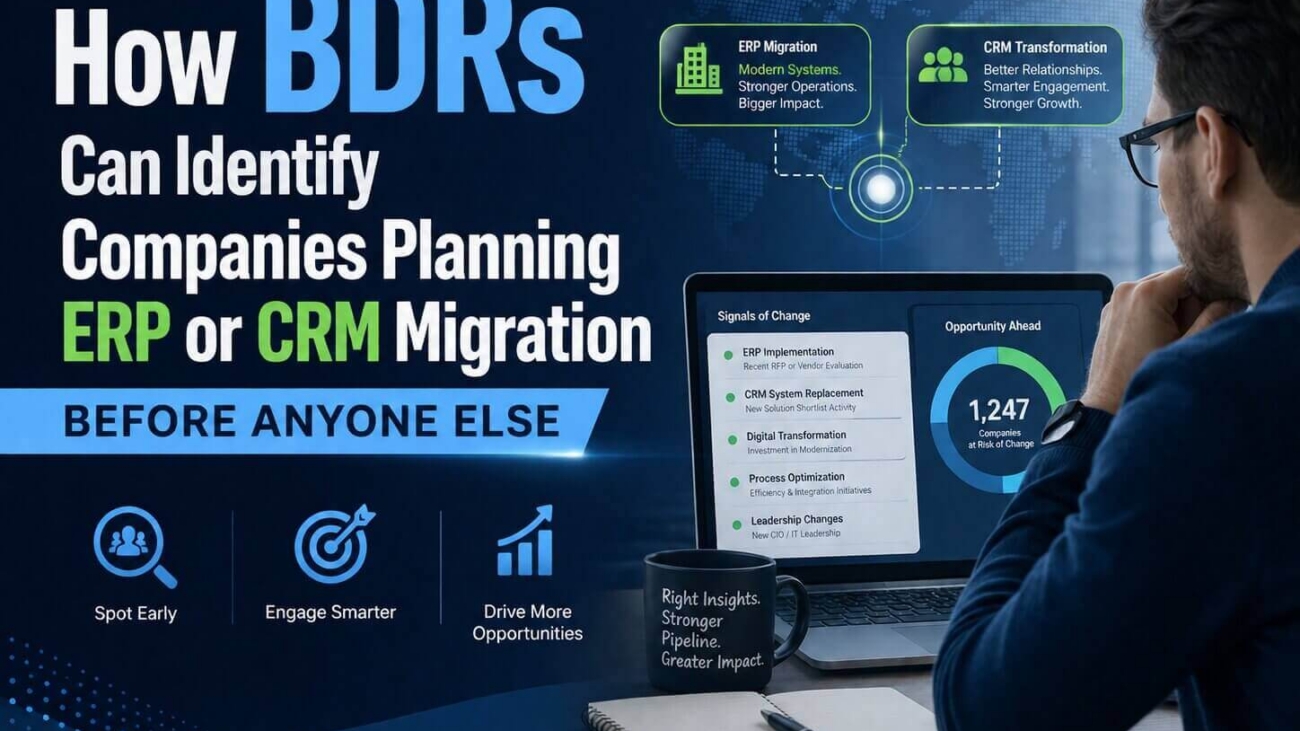
The following is an implementation-oriented list of the top twelve signs showing a company’s interest in ERP or CRM migration, how you can discover those signs via open-source materials, and what accounts to pursue first of all. No fancy theories, just the practices proven to work.
Why Timing Is More Important Than Outbound Prospecting.
Buyers’ journeys for enterprise software are lengthy, far beyond what salespeople typically assume. The average selection and implementation of an ERP software package takes about 12 to 24 months, from the initial internal discussion to go live. CRMs change faster, although the process is still very slow and rarely takes place within six months since the decision to replace a system was made.
The length of this process presents a challenge to BDRs, who base their actions on clear signals of intent, a posted RFP, a request for demonstration, or the mention of another vendor in the market. By the time these signals appear, the buying team has already been assembled, champions have already expressed their preferences, and other vendors who had the early access are already deeply entrenched in the process.
Engagement early on makes all the difference. Engaging during the discovery stage before requirements have been formalized is not engaging in a battle between three other companies on your shortlist. It is talking business with someone who doesn’t yet know what he needs.
The first-contact advantage is true. The vendor who aids the company in articulating its needs is likely to land on the shortlist automatically not for being better at products but simply because of time and relevancy factors. The BDRs who realize this switch their focus from hunting buyers to finding them.
Understanding the ERP and CRM Migration Journey
It will be easier for you to identify these early indicators if you know the typical process that a business follows prior to purchasing new enterprise software. There is a definite process in place when it comes to buying decisions, although the rate may differ from company to company.
Operational Problem Emerges: Something isn’t working. Reports take too long. Finance can’t close the books efficiently. Sales data doesn’t match what the CRM says. These conversations happen internally, usually starting at the team level and gradually reaching leadership.
Internal Discussion Begins: The issue is clearly stated. This is typically done by an unhappy department manager or even a recently appointed executive. Business case papers begin getting written up. The IT department is brought in.
Budget Authorization: A formal decision is taken on how much to spend on the solution. This is linked to the annual budgets, which is why there are peaks in ERP hiring during Q1 and Q3.
Vendor Research: The team starts looking at what is available. This is usually informal at first: analyst reports, peer recommendations, G2 reviews, and conversations at industry events.
Requirements and Shortlisting: A formal requirements document gets built. Vendors get evaluated. The shortlist forms usually have three to five options.
Demos, Negotiations, Decision: The final evaluation happens. Procurement gets involved. Contracts are negotiated.
Migration and Go-Live: Implementation begins. This is the phase most vendors see. It’s also far too late for BDRs who weren’t involved earlier.
The ideal entry point for a BDR is somewhere between Stage 1 and Stage 3 — when internal discussions are underway but no vendor has been formally engaged. That window is identifiable if you know what to look for.
The 12 Early Signals That Reveal Migration Intent
Each of the following signals is observable using public information. None requires a paid intelligence tool, though some tools make the process faster. The key is not to rely on a single signal; it is to watch for clusters of signals at the same account.
Signal #1: The Talk Has Begun About Digital Transformation
Watch for terms such as “operational efficiency,” “unified data,” and “scalable infrastructure” being used by a CEO in interviews, in annual report releases, and on their LinkedIn page. It is typically one of the early indicators that an internal discussion has started about digital transformation.
Where to look: earnings calls, investor days, CEO interviews, and LinkedIn pages of the company. The public companies make available quarterly earnings calls along with complete transcripts, which serve as gold mines for the BDRs when targeting mid-market and enterprise-level prospects.
Example: The CEO of a manufacturing company says in the Q3 earnings call that ‘we are investing in digital infrastructure for our next phase of growth.
That is not vague; that is a buying signal with a budget attached.
Signal #2: Recruitment of ERP, CRM, or Digital Transformation Professionals
Job openings are among the most underutilized prospect research tools in B2B sales. When a business puts up an ad for an ERP project manager, a CRM administrator, a digital transformation manager, or an enterprise architect, they are not merely hiring a staff person; they are recruiting people to work on a project that has already been internally approved.
Organizations do not recruit ERP project managers just like that. The decision to initiate an initiative has already been made at the time of recruiting. The internal decision has often already been made or is weeks away from being made.
Identifying opportunities: Job alert notification setup through LinkedIn, Indeed, and Glassdoor with keywords such as “ERP,” “CRM,” “implementation,” or “digital transformation” added to your list of top 50 target accounts. Regularly review the career pages of companies directly using their respective websites.
Signal #3: New Executive Hires Especially CIO, CTO, or VP of IT
There is a phenomenon that all seasoned BDRs are familiar with: a new tech executive joins the firm and, before 12 to 18 months have elapsed, the old ERP or CRM system gets upgraded.
The new chief information officer (CIO) and chief technology officer (CTO) are appointed for this exact reason. They often come with pre-conceived ideas on what the platform should be, based on their previous experience. Furthermore, they have the desire to make a quick impression, and overhauling an outdated technology system is one of the best ways to achieve this goal.
A new VP of Sales inheriting a CRM they didn’t choose is an equally reliable signal for CRM replacement. Monitor LinkedIn for C-level and VP-level hiring within your target companies. The time frame of three months after the appointment of the new executive can be the most responsive to communication.
Signal #4: Expansion, Acquisition, or Merger of the Company
Growth creates system strain. In case an organization buys another business, enters new markets, or builds more branches, the ERP system or the CRM system is the first one that tends to reveal signs of breakdown. Reporting becomes inconsistent, finance teams struggle to consolidate, and sales data fragments across disconnected platforms.
Mergers are particularly powerful triggers. Two companies merging almost always means two different ERP systems, and running parallel systems indefinitely is expensive and operationally unsustainable. ERP consolidation usually becomes a priority issue about six months to two years after merger completion.
Sources of Information: Press releases from the company itself, PR Newswire, Merger (a website to track mergers and acquisitions), and LinkedIn news of companies. Make a Google Alert for “[company name] acquisition” or “[company name] expands.”
Signal #5: Aging of Current ERP Applications
Software end-of-life notices mean that companies are going to either migrate into another system or upgrade. As soon as a certain platform decides to stop supporting a particular version by a certain deadline, every company with such a version has to choose between upgrading and migrating into another solution.
Examples of platforms doing so: SAP end-of-life notices concerning ECC to S/4HANA migration (SAP has already moved its S/4HANA support date till 2027); Oracle end-of-life notices for some modules of E-Business Suite; and Microsoft ending support dates for Dynamics versions.
The most underserved ERP applications are legacy Siebel CRM, ACT!, and SugarCRM deployments.
Signal #6: Cloud Transformation Initiatives
Cloud migration and the replacement of legacy ERP or CRM systems need not necessarily be two distinct considerations. More often than not, the decision to migrate to the AWS or Azure cloud environment also brings along with it the opportunity to implement legacy on-premises ERP systems.
If there is ever mention made in a press release, conference, or even in a job posting about a ‘cloud-first’ strategy, then it may be wise to ask oneself, which enterprise systems are they moving over to that cloud, and which of these systems can actually be replaced instead of migrated?
The signal: Cloud architects being hired alongside infrastructure roles. Search for postings where the term “cloud-first” is used with ERP, finance system, or data consolidation.
Signal #7: Increased IT Budget or Technology Investment
When an organization announces in public any increase in IT investment through its annual report, earnings call, or press release, it is a clear indication that the spending on technology has been approved by the board. What needs to be asked by the BDRs is where that budget is going?
For public companies, annual reports and investor presentations are freely available on their IR pages and often include explicit references to technology priorities for the coming year. In the case of private corporations, interviews with CFOs or CEOs in the media may be forward-looking about investments in infrastructure.
Signal #8: Integration Problems Start to Emerge
If a company is in the process of hiring API programmers, middleware architects, or integration specialists, this may be a sign that they are attempting to integrate applications that can’t communicate with one another, and that this is a symptom of an outgrowing software platform.
This is worth monitoring carefully, because it cuts two ways. Some companies invest in integration as a stop-gap to buy time before a bigger replacement. Others realize through the integration project that a wholesale platform replacement is actually cheaper than continuing to patch the existing environment. Both scenarios create a buying conversation.
Signal #9: Change in Tech Stack
A company transitioning to a different cloud provider, adopting a new business intelligence platform, or extending their use of Microsoft or Salesforce may well be making changes in their technology strategy overall, including ERP/CRM decisions.
The transition of a company from Google Workspace to Microsoft 365 is usually followed by a greater interest in Microsoft Dynamics or Azure solutions.
A company expanding its Salesforce footprint by adding Marketing Cloud or Service Cloud is a natural prospect for conversations about Salesforce’s ERP adjacencies or the broader CRM consolidation opportunity.
Tools like BuiltWith, HG Insights, and Datanyze let you see the technology stack a company is currently running and, importantly, changes to that stack over time. A company that recently adopted Azure and dropped a legacy middleware tool is showing you something meaningful.
Signal #10: The Consultants Are Here.
However, if someone from Deloitte, Accenture, PwC, or EY has added this mid-market company as their client in LinkedIn, then it is certain that something big is happening here. If one of these big four consulting firms is working with this company, then most probably they would be doing any of the below-listed three things.
By the time a Big 4 firm is engaged, the company has already decided to act; they are now getting help with vendor selection. If you have not started your discussions with the internal champion yet, you only have limited time left.
How to identify them: Look up LinkedIn to find employees from big consulting companies that mention your target firm as work experience.
This works surprisingly well for mid-market accounts where project teams are small enough that individual consultants update their profiles.
Signal #11: Employees Publicly Discuss Operational Challenges
People talk. Especially on LinkedIn. When a VP of Finance writes a post about the challenges of month-end close. When an IT director publishes a reflective post about legacy infrastructure. When a sales ops manager comments on a thread about CRM adoption, these are signals.
They are soft signals, and they require judgment. But combined with other indicators, they can tell you that the internal conversation about change is already happening — and that someone is emotionally engaged enough in the problem to talk about it publicly. That person is worth reaching.
Signal #12: Competitors in the Same Vertical Have Already Migrated
Industry dynamics matter. When a leading manufacturer migrates to SAP S/4HANA and publishes a case study about the results, their industry peers take notice. No CFO wants to be the last company in their vertical running a system that competitors have moved past.
ERP and CRM adoption tends to move in waves within industries. When one significant player in a vertical modernizes and the results become public, it often triggers a round of evaluation conversations across the industry. BDRs who track vendor case studies and customer announcements can use this to identify which companies in a vertical are still running legacy systems and are therefore likely to feel increasing competitive pressure to act.
Where Can BDRs Find These Signals?
Being able to identify what one should be looking for is easy. The key to being an efficient prospector lies in knowing where to search without dedicating six hours every day to research. Here is a helpful guide:
| Signal | Where to Find It |
|---|---|
| Executive recruiting (CIO, CTO, VP IT) | Use LinkedIn’s advanced search filter for companies and look for recruits within the last 90 days |
| Recruiting ERP / CRM specialists | company careers site, LinkedIn Jobs, Indeed, Glassdoor |
| Technology stack deployed | BuiltWith, HG Insights, Datanyze, Slintel |
| Funding and financing events | Crunchbase, PitchBook, TechCrunch, press releases |
| Merger & acquisitions | Company press sites, PR Newswire, Mergr |
| Financial and annual reports | Company investor relations sites, SEC Edgar (USA), Companies House (United Kingdom) |
| Cloud adoption signals | Press releases, LinkedIn company updates |
| Digital transformation initiatives | interviews with the CEO, earning calls (seekingalpha.com and motleyfool.com transcripts) |
| Directories of ERP/CRM partners | SAP Partner Finder, Oracle Partner Network, Salesforce AppExchange |
The best-performing BDRs utilize 2 or 3 out of these 4 channels on a regular basis, once a week, as opposed to looking at all of them sporadically. Consistency is more important than completeness when it comes to early signal detection.
How to Prioritise High-Intent Accounts
| Signal | Score Priority |
|---|---|
| New CIO, CTO, or VP of IT hired | 20 Critical |
| ERP / CRM Project Manager role posted | 20 Critical |
| Digital Transformation announcement (press, annual report) | 15 High |
| Cloud migration initiative announced | 15 High |
| Merger, acquisition, or new market entry | 10 High |
| New funding round closed | 10 Medium |
| Technology stack changes detected (Azure, AWS, Salesforce) | 10 Medium |
| Consulting firm (Big 4) engagement visible on LinkedIn | 8 medium |
| Legacy ERP/CRM end-of-life approaching | 8 Medium |
An account scoring 40 or above across multiple concurrent signals should go to the top of your outreach queue immediately. An account scoring 20 or below warrants monitoring but not immediate heavy engagement.
The key insight is that signals compound. One signal is a data point. Three signals at the same account within 60 days is a buying pattern, and that deserves real attention.
Outreach Strategies That Work Before Competitors Arrive
Start Conversations, Don’t Start Product Pitches
The single biggest mistake BDRs make when they identify an early-stage opportunity is leading with the product. A company that has just hired a new CIO does not want to receive an email saying, ‘I see you recently hired a new CIO. Our ERP solution is perfect for companies like yours. “That email ends up in the bin.
Early-stage outreach must show that you get their problem, not that you know the answer. The distinction may seem slight, but it makes all the difference.”
What works: Reference the specific signal you observed. Make it relevant. Offer something useful before asking for anything.
- Reference what you noticed: ‘I saw you recently announced a cloud infrastructure initiative. We work with a lot of manufacturing companies navigating that transition and…’
- Instead of stating a proposition, pose the following question: ‘Are you at the point where ERP alignment becomes a part of that discussion or do you think it’s mainly an infrastructure project at this point?’
- Provide some insight first before requesting time Provide something interesting, such as a link to a useful resource, an observation on what your competitors are going through, or some information.
- Personalization, specifically generic personalization (‘I love your company’s mission!’), is immediately recognizable and counterproductive. Specific personalization (‘I noticed you’re expanding into three European markets this year; that usually creates some ERP complexity around localization…’) shows you’ve actually done your homework.
The goal of first contact at this stage is not to book a demo. It is to establish that you are a credible, informed person worth talking to. The meeting comes from that, not from a product pitch.
Common Mistakes BDRs Should Avoid
The majority of errors in ERP and CRM prospecting stem from being impatient, over-targeting, or lack of understanding of the buying committee process.
- Wait until they send an RFP – By the time there’s an RFP, the list of vendors to consider is probably already known informally. The responses to an RFP are usually a mere formality.
- Targeting IT only – There’s more to ERP and CRM than technology. Decisions about ERP and CRM systems include finance, operations, sales management, and C-suite. BDRs targeting IT alone miss out on business people.
- Ignoring finance—The CFO or controller is frequently the most important voice in an ERP decision. If your outreach never touches the finance function, you are missing a critical part of the buying committee.
- Generic cold emails — At the volume of outreach most BDRs send, personalization feels impossible. But the accounts flagged by your signal monitoring deserve genuine personalization. Save the templates for low-priority accounts.
- Chasing every ERP user — Not every company using an ERP is about to replace it. Signal-based targeting filters out the noise and focuses your energy on accounts where something is actually moving.
• No buy-in from the decision-making committee – the decision on ERP and CRM software is seldom made by one individual. Identify the committee right at the start: the CIO, the CFO, department heads, and IT people. Try to establish your relationship with more people than the initial one who answers.
Developing Repeatable Migration Prospecting Playbook
The BDRs who always identify an opportunity early are not doing anything supernatural. What they have done is develop a process that works behind the scenes of their regular work process.
A basic migration prospecting playbook has five components:
- Monitoring intent—Create Google Alerts for target account names, as well as ‘digital transformation’, ‘ERP migration’, ‘cloud migration’. Also look at LinkedIn postings for your target accounts once a week.
- Scoring—Keep a spreadsheet or CRM field tracking sales scores for your top 100 accounts. Update this weekly.
Escalate anything that crosses your threshold score.
- Technology tracking — Run target accounts through BuiltWith or HG Insights quarterly to check for technology stack changes. Flag any accounts that have added cloud infrastructure tools or changed CRM platforms.
- Hiring alerts — Set LinkedIn job alerts for each of your top accounts. Focus on ERP, CRM, enterprise architecture, and digital transformation titles. A new posting often precedes a buying signal by 30 to 90 days.
- Quarterly account reviews — Once a quarter, review your entire target account list for signal accumulation. Some accounts build slowly. A signal received from Q1 along with signals received from Q2 and Q3 can be considered an important pattern, even if the individual signals were not individually urgent.
The idea is not to track everything but to track the right things all the time so that when something really good comes up, you are the first to notice and capitalize on it.
Conclusion
It is not a secret for companies to share their plans regarding migrations. They reveal their plans through their earnings call statements, annual reports, hiring of executives, recruitment of new employees, hiring of consulting firms, and adoption of new technologies. The signals are public. Most BDRs just are not looking for them.
The transition from reactive prospecting to proactive opportunity identification is straightforward but requires a change of thinking. Rather than questioning ‘who needs my product immediately,’ the focus is ‘who is going to need the product in the next six months, and how can I be a part of that conversation today?’
Those BDRs who make a habit of following the signals, scoring the accounts, and engaging proactively through intelligent and informative outreach ahead of an RFP generate more business than their counterparts, not because they are good sellers but because they arrive before everyone else does. It is an available advantage for every BDR willing to master the process.
Take your best 20 accounts and identify three signals. Configure the alerts this week. Opportunities exist; you have to know how to recognize them before your competitors do.